“I fear you give your husbands cause for doing this. If you were subject to them and would not clamor back, or especially when they begin to be strangely cruel, if you would not answer back, but be patient, submit and obey them, and with friendly words appease them, you would, of course, not be beaten.”
The following is taken from the Church Postil of Martin Luther. J. N. Lenker, editor and translator, gives this note: “This sermon appeared in 1535 under the title: ‘A Beautiful Christian consolation in all kinds of suffering and trial from the 8th chapter of Romans, with the explanation of the Gospel for the Fourth Sunday after Trinity. Preached by Dr. Martin Luther.'”
Paragraphs 5-7 of this sermon are excerpted below. It may be read in its entirety here.
Christ does not here teach us to become pious and just through our works, but admonishes those who were already pious and just, that they be merciful like their Father in heaven, so that the heathen may thereby become better, and that thus unbelievers may be kindly enticed to become converted and edified, not only by preaching, but also by the merciful and blameless lives and good conduct of the good and just.
In the same sense St. Paul also teaches in 1 Corinthians 7:13: “And the woman that hath an unbelieving husband, and he is content to dwell with her, let her not leave [her husband],” as long as he will permit her to remain a Christian. Because it can so happen that the man may be influenced by the virtue of his Christian wife to become converted and say: “I see by my wife, that Christians are good people; therefore I also want to be a Christian.”
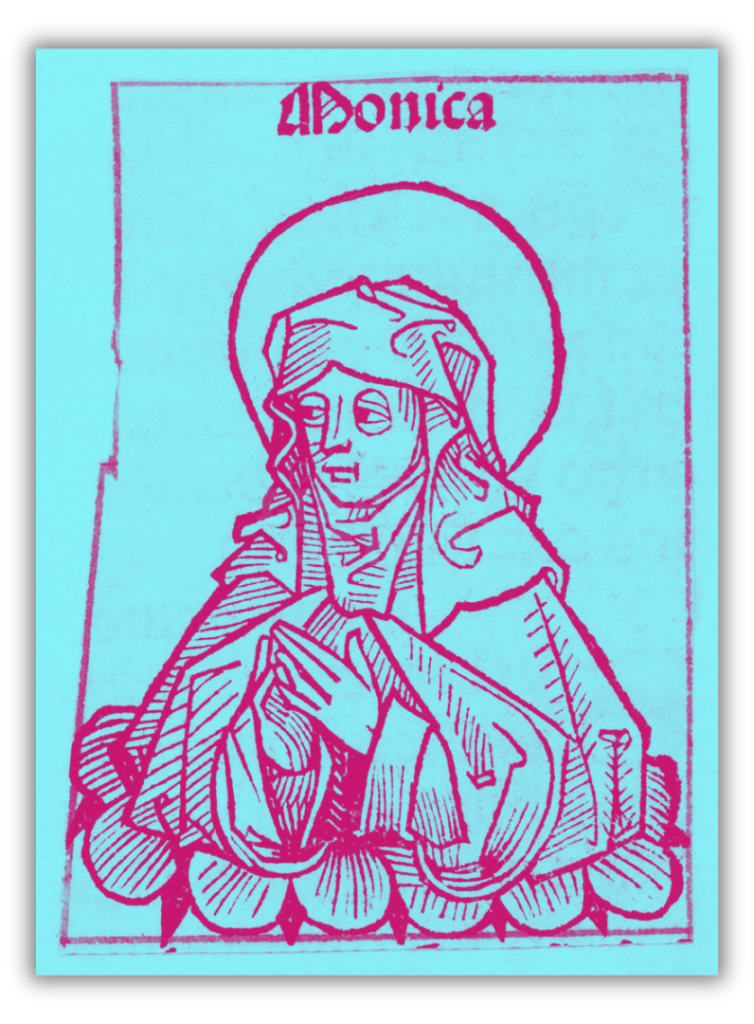
Thus we also read of St. Monica, the mother of St. Augustine, who had a strange and wonderful husband, who besides was also a heathen. But what did she do? She so conducted herself toward him that he did her no wrong. Other Christian wives were very much astonished at this, and went to her and complained about their husbands, that they could not do anything to please them, although they were Christians, and yet they were scolded and beaten by them; therefore they questioned her how she treated her husband, who, as every one knew, was not only a wonderful man, but a heathen also, and yet he never beat her.
Such favor they could not expect from their husbands, although they were not heathen, but Christians.
Kindhearted Monica answered them and said:
I fear you give your husbands cause for doing this. If you were subject to them and would not clamor back, or especially when they begin to be strangely cruel, if you would not answer back, but be patient, submit and obey them, and with friendly words appease them, you would, of course, not be beaten. For thus I am accustomed to treat my husband; when my lord scolds, I pray; if he is angry, I avoid him, or return kind words; in this way I have not only put down his anger, but I have also brought him so far that he is converted and has become a Christian.
Behold, the beautiful fruit that followed this conduct, because kind Monica was merciful toward her husband, and did not condemn and judge him. Thus it can often take place, as St. Paul says, that an unbelieving husband or wife may become converted through the one who believes.
Thus, says Christ here, should you Christians also do, because you are children of grace and peace, not of anger and discord, and are also called to inherit the blessing. Therefore you should also bring the blessing among the people, first by your preaching and public confession, and after that also by your good outward conduct, so that when the unbelievers judge and condemn you, treat you unmercifully and rob you, you will be merciful to them, and not avenge yourselves, but give and forgive, and besides help, love and bless them, and speak the best things of them before God and the world; that they may also observe by your good conduct that you are pious and blameless people, who do not only suffer evil, but also return good for evil. By this you will obtain a good name among the heathen, and be estimable and honorable in my sight, who art your Lord and God.
So far Dr. Luther.
Listen to the Church Postil every week on Telegram here and YouTube here. The Boniface Group has no formal affiliation with Schola Audio . . . but we know a good thing when we hear it.
After the Small and Large Catechisms of Dr. Martin Luther, the Church Postil should be at the top of the list for anyone who wants to acquaint themselves with Lutheran spirituality. See some other recommendations here.
+SDG+
Thank you for reading. The Boniface Group is the mission society of Holy Trinity Ev.-Lutheran Church of Gem County. If you would like to support our work, you may do so here. To learn more, visit our homepage and start reading from the top. Thank you, and God bless you.
The following is a complete transcript of an Issues, Etc. interview with the late great Kurt Marquart (d. September 19, 2006) on the topic of Eastern Orthodoxy. The interview originally aired on September 3, 2000.
This transcript was done manually back in 2015 by a family member of a friend. If you see any typographical errors, please let me know in the comments. Enjoy.
Todd Wilken: Greetings and welcome to Issues, Etc. I’m Todd Wilken. I’m sitting in for Don Matzat; he has the day off. Are you one of those evangelicals who’s plain burned out? Burned out with the shallow theology, tired of singing “Shine, Jesus, Shine” every Sunday, tired of praise choruses and sermons that have a lot to do with your everyday life, but very little to do with eternal life? Are you just burned out with evangelicalism in general? What’s the answer? Go back to Rome? Maybe even farther—Constantinople. You know, there are a lot of evangelicals who have opted to return to Eastern Orthodoxy, and they find there theological substance, a worship life that is not disconnected from the worship life of the Church in ancient times; they find there things that intrigue them, and a certain mystical attraction as well.
We’re gonna talk about Eastern Orthodoxy in this hour of Issues, Etc. My guest in this hour, Professor Kurt Marquart, is Associate Professor of Systematic Theology at Concordia Theological Seminary in Fort Wayne, Indiana. Welcome back to Issues, Etc., Professor Marquart.
Kurt Marquart: Thank you; good evening. How are you?
TW: I’m doing very well. What exactly is Eastern Orthodoxy? Could you give us a nutshell description?
KM: Well, Eastern Orthodoxy are the churches of the Christian East that— there are about nine national churches and several patriarchates, the largest of which is the Russian Orthodox Church.
TW: So when we use the term “Orthodoxy,” we are talking about a unified— and I know they’re going to hate to hear this— but we’re talking about, in a sense, a denomination or a communion, like the Anglican communion?
KM: Yes, it is a communion, but consisting of several independent churches, canonically independent, but they recognize the Patriarch of Constantinople as a kind of symbolical head.
TW: On the big issues— justification, the sacraments, the major doctrines of the Christian faith— can we say that there is a unity there in Orthodoxy as well? We can speak about them monolithically with regard to those issues?
KM: Well, I think it depends on whether the Orthodox theologian in question has been influenced by contemporary studies or not, very much as in other denominations, and the very traditionally minded unfortunately have inherited a kind of Roman Catholic polemical view of the Reformation, but the more, the better educated of the Eastern theologians will have a more sophisticated view of the matter.
TW: Walk us through some of the history of the East-West split in Christendom to find out the origins of this split.
KM: Yes. The main division, of course, the famous one, took place in 1054, with the mutual excommunications by Constantinople and Rome. And then the churches have walked side by side these last thousand years. There has been, for example, the Council of Florence, before the Reformation, which united the two churches, but the Russian Church, for example, strongly rejected it, as did some others, and therefore that union failed to produce a lasting result.
TW: So since 1054— and that’s a long time, Dr. Marquart— then, we have had an essential divide in the Church between East and West?
KM: Yes.
TW: Is it a theological divide as well as one of history?
KM: Well, the theological differences grew— grew, I think, in the course of time, because in the West, Scholasticism developed, and the East never quite got hold of that; their theology was never quite as precisely quantified as Western Scholastic theology.
Evangelical Eastern Exodus
TW: So why are many evangelicals— and I think in particular of Frankie Schaeffer, he’s the son of the famous Christian apologist— why are evangelicals like him enamored with Orthodoxy, even, in his case, converting to Orthodoxy?
KM: Yes, and not only evangelicals, but Pentecostalists; I’ve heard of one man in California who had fourteen different congregations—they all gave up hand-waving for icons and incense, and so on, and it’s attractive to many people. I think people see in Eastern Orthodoxy a lost dimension of the historic Church. It appeals to— well, it appeals to some very good senses, but it also can be a kind of romantic evasion of harder issues.
TW: Now, that surprises me for you to mention Pentecostals going Orthodox all of a sudden. I wonder— you said “giving up hand-waving for icons and incense”—
KM: Yes, yes.
TW: Do you think there might also be, along with the romantic infatuation, a certain— what?— a certain mystical connection between something like Pentecostalism and Orthodoxy that would make the transition easier in that case?
KM: Well, I don’t know about that, but I do know it means exchanging one very subjective, individualistic mysticism for a much more corporate, historical one, which appeals to the romantic imagination.
TW: Do you think that it is simply because a lot of evangelicals are tired of a bankrupt theology, a vacuous content in preaching and in music, a worship life that has gone basically the way of the world, whereas Orthodoxy has remained in many ways a culture unto itself?
KM: Well, yes, I think an important document here is the Chicago statement of, I think, 1977, where quite a number of evangelical leaders drew attention to the great weakness and shortcomings of so-called evangelical worship, and they lamented the absence of a genuinely sacramental churchly dimension and lamented the superficial nature of this sort of saccharine, sweet, sugary nature of it, and ten years later, two thousand evangelicals en masse joined the Antiochian Eastern Orthodox Church on dissent. But that was a famous Chicago call, issued from Chicago.
TW: Does it have something to do also with a view of history and Church history? People longing to connect with a church that does not ignore history before its own personal congregation’s founding or before I was born?
KM: Yes, I think that is the appeal. It gives the impression of continuity, unbroken continuity with Christian antiquity.
Jaroslav Pelikan
TW: So then, how do we account for a prominent Lutheran like Jaroslav Pelikan, who many people may be familiar with as an editor of a greater part of Luther’s works in English— how do we account for someone who— he was not fleeing a vacuous theology, there is a definite connection to history in the Lutheran tradition, the theology is substantive— why would someone like Jaroslav Pelikan go East?
KM: Well, it’s hard to enter into individual minds here, but given, the, um, his— remember, Pelikan, in particular, I don’t know how typical he would be among all the converts— but Pelikan began as a kind of bright Missouri Synod— he was called a wunderkind, marvel— one of the marvel-children in the Missouri Synod— but he spent his life criticizing and lambasting the foundations of orthodox Lutheranism, and in the end, I think he saw the bankruptcy, but I think he escaped into mystical vapors and incense.
TW: Do you think his, the attraction there for him was— well, let’s stay away from Pelikan in particular— do you think the attraction for some Lutherans to Orthodoxy is one that you mentioned before, kind of a romantic infatuation with things Orthodox?
KM: Yes, I think it’s that, and I think the disillusionment with how Luther’s doctrine of the priesthood of all believers has become interpreted as a kind of general democratic mob-rule principle, that whatever the majority wants, the majority gets. And people disillusioned with that can easily jump into the arms of authoritarian Orthodoxy.
TW: And we would be one hundred percent with someone who would be disillusioned with mob rule.
KM: Yes. But the solution is not this mystical autocracy which you find in the East.
TW: I was— go ahead.
KM: I was just going to say, among the less well known in the West and less attractive features of Orthodoxy, I myself— I greatly love the Eastern liturgy. A great treasure is there from which all churches have profited and can profit. However, in practical terms, the notion of spiritual authority as understood in the East leads to things like the existence, for example, in Kiev, in Ukraine, of three different Orthodox patriarchs, each claiming to be the rightful patriarch of Kiev. I think one was recently murdered about three years ago. I don’t know if he has been replaced. And it is considered by some, I think those who follow the patriarch of Moscow, that his rivals are not truly connected to that historic body and therefore are grace-less—their sacraments offer no grace. Hence you have the expression, “a grace-less church.” Just because you’re connected with the wrong bureaucracy, you have no sacraments and no grace. I mean, this is horrendous, really.
TW: Now that’s something we’re gonna have to revisit a little later in this conversation when we talk about the particular differences between Orthodoxy and Reformation theology. I was watching National Public Radio— listening to National Public Radio recently, this was a couple of years ago, and there was a feature story on American evangelicals returning to Orthodoxy, and the growth of the American Orthodox Church here in America, and the liturgy that they returned to—some of them had never in all of their Christian lives seen a church service conducted in this way. When we come back from the break, Dr.— Pastor— sorry, Professor Marquart— I always get it wrong when there’s no “Dr.” on the front of the name— when we come back from this break, Professor Marquart, I would like you to describe as accurately but as briefly as possible what the average Christian might see if they walked into a Sunday morning service at an Orthodox church. You talk about that liturgy; how would it appear to us, how would it appear distinct from what most Christians are familiar with?
We’re talking with Professor Kurt Marquart; he’s Associate Professor of Systematic Theology at Concordia Theological Seminary in Fort Wayne, Indiana, talking about Eastern Orthodoxy, its allure, and where does it stand on the big issues, like justification, the sacraments? What role do icons play in the piety of the Orthodox? These are some of the questions we’re going to be answering in the minutes ahead. Professor Kurt Marquart is my guest; we’ll be right back.
Orthodox Worship
TW: Welcome back to Issues, Etc. I’m Todd Wilken. I’m sitting in for Don Matzat; he has the day off. Professor Kurt Marquart is my guest. We’re talking about Eastern Orthodoxy. Professor Marquart, I’ve given you a little time to think about it—what would I see if I attended an Orthodox church on a Sunday morning?
KM: First of all, you’d be impressed by the icons— the overwhelming impression of “angels and archangels and all the company of heaven”— you’d have visual reminders of that surrounding you. You’d have incense, and you’d have magnificent chanting— I’m thinking of the Russian liturgy, which I think is more magnificent than the Greek. And you could only describe that sound as otherworldly, as transcendent. I remember Alexander Solzhenitsyn remarking once that he remembers being taken to a church, to a liturgy, when he was a young child, in the Soviet days, when it was forbidden, of course, and says, he had made— the celestial beauty of the singing made such a deep impression on him that no amount of intellectual argument later or personal suffering were able to wipe it out. And you wonder how many children would be impressed by the kind of clap-trap and popular-entertainment-seeking that is practiced in so-called “happy-clappy” churches. Another thing is, the story has it that the monastery, I think it’s Trinity Monastery in Jordanville, New York, which is the headquarters of a very conservative branch of the Russian Orthodox Church, and the story that I heard was that they got the land by, or much of their money, from an American lady who happened to drive by, happened to stop in and attend the matins of the monks. And she said she immediately realized this is the only place in America where people pray. And she left all her wealth to that monastery.
TW: So it really does strike an impression on the observer.
KM: Yes, yes, it certainly would.
TW: I was at an Orthodox funeral about four or five years ago, and I remember all the things you mentioned—the incense, the icons, I remember a definite sense of transcendence—
KM: Yes.
TW: — about the worship service. I also remember a Kyrie, the “Lord have mercy,” that was chanted responsively, that took twenty full minutes. Is it an ornate liturgy— overly ornate liturgy?
KM: Well, it depends on whether it’s a high festival or not. Sometimes, for example, the “Alleluia” is repeated— there’s a story of an inexperienced Russian deacon who, in Moscow, was helping at a service, and suddenly he didn’t realize— and this was not to be repeated, it was his own direction— and he chanted “Alleluia forty times”— that was for a high festival. But normally it’s not recited that often. And of course in the Russian you have the magnificent Gospodi Pomilui, which is the equivalent of the Greek “Lord have mercy.”
TW: Would you think that the average Christian would have a hard time following what was going on on a Sunday morning in an Orthodox church?
KM: Well, you’d have a difficult time following it intellectually, yes. Even the Russian-speaking person would not quite follow, would not understand word for word the old Slavonic liturgy because the word usage is quite old.
Orthodoxy and Justification
TW: What does Orthodoxy teach with regard to the heart and soul of the Christian faith, justification?
KM: Well, unfortunately on justification, the Orthodox Church was mainly absent twice in the history of the Church when these great matters were debated and settled: once when St. Augustine debated with Pelagius, and especially North Africa took a very clear stand, which Rome later supported, against Pelagianism, the idea of self-salvation, or that you don’t really need much grace. And then a thousand years later, when the Augustinian monk Martin Luther had to fight the same battles over again, in a more subtle way, again the East was absent from that discussion.
TW: So if they missed out on the major debates that took place in the Western Church on justification, what view of justification does Orthodoxy hold?
KM: Well, one interesting thing is that the Orthodox writers generally don’t like St. Augustine. They refuse to call him “saint.” They usually refer to him as “blessed,” which means only local recognition rather than a global one. And they think that Augustine exaggerated the unique necessity of grace. Their theology, however, is not as exactly worked out as the Roman, and so it tends to make the impression of imprecision. But basically their idea is that, well, they like to use the term “deification.” Man by divine grace participates in the divine energies of God and so is led to be healed from the consequences of the Fall.
TW: Now put that into English that we can all understand.
KM: [laughs] Yes, it’s not so easy. But the thing is, according to Orthodoxy, the Fall did not, as we biblical Christians believe, really destroy man’s spiritual image of God. According to Orthodoxy, they usually distinguish the image of God and the likeness of God. And the image of God includes free will and can never be lost without human nature itself being lost. So there’s an in-built Pelagianism at the heart of Eastern Orthodoxy that holds that man, even in the Fall, did not lose his spiritual free will. Therefore the Fall— in the Fall, man did not experience spiritual dying, as St. Paul says, but weakening, sickening, and that sort of thing. So he needs the reviving but not resurrection.
TW: So, justification, according to Orthodoxy, would be akin to healing rather than to resurrection?
KM: Yes. Quite so. And there is a residual free will which can and must cooperate with God’s free grace in this whole process.
TW: What is the correct view? What would— what does Scripture actually teach on justification by contrast with the Orthodox view?
KM: Well, of course, according to Holy Scripture, which was so clearly recaptured by the Reformation, St. Paul clearly teaches that we are bankrupt after the Fall, and therefore we need— we are in a state of spiritual death, Ephesians 2, and need to be made alive. Justification is the forgiveness of sins received, entirely earned by Christ and entirely received by faith alone.
TW: So then, apart from the more exact formulation of the Roman Church, and the less exact formulation of the Orthodox Church, is there a real difference on justification between Rome and Constantinople?
KM: No, I don’t think there is. Substantively, Rome and Constantinople are very much alike in a number of things, including this tragic practice of what I call a Christian occultism, namely the invocation of the Blessed Virgin and other saints. And even, for example, in the Eastern liturgy, you can hear something which I don’t think the West since the Reformation puts quite that crassly, but the Russian pontifical liturgy says, “Presviataya Bogoroditse, spasi nas,” which means, “Holy Mother of God, save us.”
TW: So, Mary’s not only invoked for intercession, she’s invoked for salvation.
KM: Well, that is a recited liturgical exclamation. But it depends on the degree of theological sophistication and education as to how people understand that, I suppose.
TW: Is this why Orthodoxy can appeal to people of all different stripes? You mentioned Pentecostals, general evangelicals, Lutherans— because their theological statements are less precisely formulated, you can almost fit your theology into it, regardless of where you come from?
KM: Well, just listening to you say that, it sort of strikes me, but I think it would appeal to the person, the whole postmodern mindset where mystical enactment or ritual enactment is more important than any kind of theological definition. So you flee from intellectual clarity to mystical obfuscation. That’s part of it, I think.
TW: I distinctly remember having a conversation with a fellow pastor friend of mine on Orthodoxy and justification, and we read two statements. One of us— I, I believed the statement sounded very much like the Council of Trent, and he believed it sounded very much like the Lutheran Confessions. And the sad thing was, the statement was general enough it probably could have been read both ways.
KM: Yes.
TW: We’re trying to answer in this hour how it is that we’re supposed to read that key question of justification according to Orthodoxy. So— go ahead, Doctor.
KM: I just was going to say, there is a book, you know, recording the Lutheran-Orthodox dialogue held in North America, and I think it’s called Salvation Today. And there you find quite clearly delineated the basic differences between the Lutheran-Pauline and, we believe also Johannine, understanding of justification as a free gift, and the Orthodox understanding that it’s basically equivalent to sanctification or growth in love and good works.
Justification and Theosis
TW: This is not a small question, the question of justification. This is the question. We’re talking about Eastern Orthodoxy in this hour. Professor Kurt Marquart is my guest. You mentioned before that central to the doctrine of justification among the Orthodox is this notion of “participating in the divine life.” Is it called theosis, am I correct on that?
KM: Yes, theosis, or deification, in English.
TW: Now, is there, is this a view that can be supported from Scripture? Is it something that the Western Church has completely ignored? Or is it a particular error of the Orthodox?
KM: No, it all depends on how you define the word. But the basic text, the clearest text is in 1 Peter 1:4 [he meant 2 Peter 1:4], where we are partakers, said to be partakers of the very divine nature, participants of the very divine nature. It’s quite a remarkable thing in all the ancient Fathers, consider that as culminating here on earth in the reception of the Holy Eucharist or the Lord’s own body and blood.
TW: So, rightly understood, Christians of the non-Orthodox persuasion could hold to a similar view of theosis.
KM: They must if they follow the Holy Scripture. But the term has sort of fallen into disuse in the West. But there was a very— may I tell you a surprising story? It surprised me at the time. There was an interesting dialogue between the Russian Orthodox Church and the Lutheran Church of Finland in Kiev in 1977. And the chief lecturer on the Lutheran side was a Professor Mannermaa of the University of Helsinki in Finland. And he brought out the quite remarkable fact which most of us have quite forgotten, that theosis or deification is very prominent in the writings of Martin Luther. Now who would have suspected that? And moreover, Mannermaa points out that for him— that for Luther— he meant it in a very different way from the standard Orthodox view, and for him, justification can be put in those terms.
TW: So how would Luther have understood theosis, then?
KM: Here’s the difference. For Luther, theosis or deification means this: The Lord Jesus Christ is God and man in one person. In Him, our humanity is absolutely united with God in one person. And through His humanity, by faith, our humanity participates in that. So by sharing in Christ by faith, we participate in the fullness of God. So here it is purely a gift. The famous saying, the famous statement of Luther in the Galatians commentary, where he said that “in faith itself, Christ is present.” In other words, that Christ is not merely— that the object of faith is not merely an idea, a specter, some spectral concept, but Christ Himself. And faith grabs hold of Christ, and thereby, God. And therefore justification is theosis. That is, the sinner, who has nothing in himself, by faith receives the righteousness of Christ and is united with Him.
TW: So how does Orthodoxy then view the sacraments?
KM: Well, could you first contrast that with standard Orthodox presentation, for example, as you have it in Gregory of Palamas, in the fourteenth century. For him, deification is rather the result of an ascetic exercise. And you have monks and other holy persons reciting the “Jesus Prayer”, breathing in a certain way, and if you rightly, by this ascetic exercise, unite yourself with God, then at the end you may glimpse with your physical eyes the uncreated light of God. So it’s a very different view. It’s a difference between God coming down and man going up.
TW: So, the Orthodox view, with man would be that man participates in the divine life by his own efforts, at least in part.
KM: Well, they would never say that. They would say that it’s a gift of grace. But remember, the free human will must cooperate in all that. And also, Gregory Palamas makes a special point of saying that it’s not really the nature of God, it’s not the being of God, but only His energies with which we’re united. And in the Lutheran-Orthodox dialogue, it’s very interesting that the Orthodox representative makes a special point of that, that they don’t accept the Petrine text I’ve just quoted, “partakers of the very divine nature.” They’re embarrassed by that; they say we really participate only in the divine energies, but the nature is beyond any participation. So I think there’s a touch of Platonism in that.
Listener Questions & Comments
TW: Let’s get to the sacraments in a minute here. First, let’s take a phone call from Bill, who’s listening in Phoenix, on KGCB. Bill, welcome to the show.
Bill: Yeah, how you doing, interesting show. Enjoying it.
TW: You got a question, Bill?
Bill: Yeah, it was a— I read a Eastern Orthodox paper last year, and I think Frankie Schaffer was one of the editors, I can’t remember the name of it. But anyway, in an editorial they talked about some of the differences between Eastern Orthodox and evangelicalism, and one of the areas they mentioned was, they don’t hold to Sola Scriptura, and I just wondered if the professor would comment on that.
TW: Good question, Bill. Thanks for the call. Professor Marquart?
KM: Yes, quite right. They hold, like Rome, to the authority also of Holy Tradition, but unlike Rome, “tradition” is regarded by the Eastern Church of consisting basically of the decisions of the seven ecumenical councils. And of course, the Church Fathers, the ancient Fathers are understood as in harmony with that.
TW: Is it a similar view to that of Rome of infallibility of Church tradition, if it comes from the seven ecumenical heads?
KM: Well, yes, ecumenical councils are as such infallible, but there is no doctrine of any person— certainly there’s no infallibility of the Patriarch of Constantinople, one of whom in fact became a Calvinist, and was killed for his troubles.
TW: The phone number, 1-800-730-2727. Let’s talk to Deanna. She listens in Minneapolis on KKMS. Hi, Deanna.
Deanna: Hi. I have a confusion here about what you’re saying about justification. I am Greek Orthodox and have been brought up in the Greek Orthodox Church all my life, and from what I’ve learned from going to church is that we are saved through grace.
TW: OK, and you’re hearing something different here.
Deanna: Right.
TW: OK, Professor Marquart.
KM: Yes; the word “grace” is a longsuffering member of our theological vocabulary. You may remember the whole Reformation turned on the meaning of the word “grace.” You can say very similar things about grace and mean quite opposite things by it depending on what you mean by “grace.” Also Rome, for example, is willing to say “grace alone.” But Rome, as also Constantinople, thinks of grace— and Rome here in a worse way— but they think of grace as a kind of substance, spiritual force, etc., which is poured into man, and when man by his free will makes use of this grace, then in that way salvation is accomplished.
TW: So one could say, “You are saved by grace,” but mean “grace— which includes man’s active and willing participation.”
KM: Yes; grace essentially as a stimulant to Christian behavior. And grace as a kind of divine electricity, the divine energies which stimulate us to produce love and good works.
TW: Professor Marquart, if you were going to advise Diana to go back to her priest, and to ask him a question to clarify this word “grace,” what would that question be?
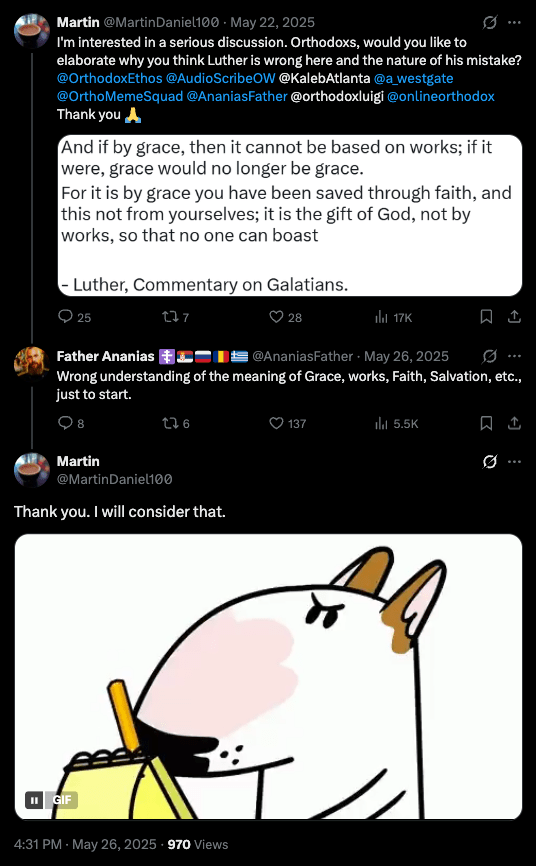
KM: Well, I don’t know about a question, but I’d suggest two Bible texts particularly that define how St. Paul uses the term “saving grace.” The term “grace” can be used in the sense of a gift of grace. But when Paul uses “saving grace,” for example in Romans 4, it’s quite clear that there grace means simply the divine attitude of forgiving kindness. And also in Romans 11:6, where it says, “If by grace, then no longer by works, otherwise grace is no more grace.” So grace is defined there as God’s attitude, not as some power poured into us, by which we then produce good works.
TW: Diana, go back and ask your priest what he means by “grace.” Ask him if he means, is it the favorable disposition of God toward us in Jesus Christ? Or does it include anything in us whatsoever? See what his answer is to that question; it may clear it up for you. Thanks for the call.
KM: May I add something to that?
TW: Please.
KM: Is that, you find, just as among Roman Catholic clergy, you find also many priests who are quite open to evangelical, Reformation interpretations of things, so you may find a wide variety of individual interpretations, but that is not the official position of the Eastern Church as such.
On the Sacraments
TW: What is the official position of the Eastern Church on the sacraments?
KM: Well, technically the official position is that of the seven ecumenical councils. However, through the Middle Ages, the tradition of seven sacraments has been accepted by the Eastern Church. Very much like that of the Roman Church, except that, instead of confirmation, you have a sacrament of anointing, chrismation, which is administered at baptism.
TW: So, you would have baptism, you would have chrismation, you would have the Lord’s Supper, you would have marriage, ordination, and extreme unction?
KM: They have confession.
TW: And confession, OK.
KM: The chrismation, that would be their version of extreme unction [Marquart misspeaks here and corrects himself later in a brief exchange with a caller].
TW: So it’s roughly parallel to that of Rome. Do they hold similar views to the sacraments, in particular the sacrament of the Mass? Do they hold similar views about the Lord’s Supper?
KM: Well, the one good thing is that the Eastern Church, as well as Roman Catholicism, holds to the true presence of the Lord’s body and blood in the Eucharist. But then in the Middle Ages, especially under the— well, after the Middle Ages, as a result of the Counter-Reformation, much of the Eastern theological literature came to reflect ideas of transubstantiation. But understand that some modern Eastern theologians are moving away from that. The Lutheran theologian Chemnitz, writing at the end of the sixteenth century, points out that we, too, in the Reformation, we accept the old Greek term metabole, that is “change”— there is a change in the Sacrament, but not a change as though the bread changes into body, but change that before the consecration it is only one thing, and after the consecration, when the word of God is added, then you have both an earthly element, the bread and the wine, and heavenly elements, the Lord’s body and blood— the analogy of the Incarnation.
The Place of Icons
TW: Professor Marquart, I was at this Orthodox funeral I told you about, and the icons there were huge. There were full-sized panels that stood at the front of the church. I really couldn’t even identify every person on each panel. But they seemed to have a prominent place in the worship. What is that place?
KM: Well, ikon is basically Greek for “image,” and the peculiar nature of the typical Eastern icon is that, unlike Western liturgical art, or Western ecclesiastical art, it does not simply mean to represent, say, a person or an event, but it means also to represent its spiritual significance. And therein, to my mind, lies a great strength of the icon. The icon will never simply repeat, will never give simply a photograph-like reproduction of some saint. It’ll— by the nimbus and so on— it’ll seek to indicate the spiritual meaning and the spiritual personhood and the spiritual significance of the event. And I think therein lies a certain defense against secularization. When you think of ecclesiastical art in the West, you think of Raphael and those magnificent paintings of the Middle Ages. But they were basically paintings of beautiful bodies— there’s no spiritual significance to them. I think the advantage of icons is that they avoid that secularization.
TW: Shouldn’t all church art do that? Seek to preach a sermon, not just represent a figure?
KM: I think so. But when you look at some of the saccharine productions in our Protestant church art, one could only find that the Eastern icon has more substance to it.
TW: But how have icons been abused in the East?
KM: Well, the abuse is— and largely, I think, from misunderstanding in popular superstition— that the spiritual power of the icon has been transferred to the actual physical object. I remember, for example, years ago in New York, there was a visiting miracle-working icon of the Mother of God being circulated, and one dear lady who was suffering from advanced cancer had that icon brought to her and put in bed with her, with the idea of helping to cure her. So I think that is a superstitious use. But it depends again on the degree of spiritual and theological enlightenment of the individual, how the thing is regarded.
TW: And those abuses wouldn’t fall within the teaching of Orthodoxy per se, but more within the piety of the faithful.
KM: Yes, practical piety, as you find also in Roman Catholic countries, can be very far removed from official dogma.
Free Will
TW: Let’s go back to the phones. Phil is listening in Chicago on WYLL. Hi, Phil.
Phil: Hi! Yes, this is Phil. I’m an Orthodox Christian who became Orthodox, amongst other things, through reading the Lutheran Cyclopedia, back, uh, the 1925 edition, I think. Basically, I think there’s been some misrepresentation here. For instance, doctrine of sacraments, the issue of anointing the sick is different from chrismation. Chrismation is basically considered the sacramental act of receiving the Holy Spirit, as baptism is the sacramental act of becoming a Christian.
KM: Yes, I’m sorry—
Phil: These two are distinct sacraments, they use different oil.
TW: OK, Phil—
Phil: Also—
TW: Phil, what about the issue of grace, Phil? We had a previous caller, an Orthodox caller—
Phil: Right. We don’t believe in original guilt, and also, we believe in the power of the Gospel, that the Gospel is the power of God unto salvation, not a preexisting order of election which chooses individuals.
TW: Does man have a free will to make, or to cooperate with God’s grace?
Phil: Man can respond positively or negatively. Consider the parable of the soils, sometimes called the parable of the sower. The life principle is entirely in the seed. Soil is dead by itself; it can’t grow anything by itself. But the issue of whether the seed sprouts and produces a crop depends on the disposition of the soil.
TW: So man has a capacity to make a decision to accept Jesus, in some sense.
Phil: Right. And Pelagius is not known as “St. Pelagius”; he was associated— he’s considered a condemned heretic, as is his associate Nestorius, Patriarch of Constantinople— also a condemned heretic.
TW: OK, Phil, let’s get Professor Marquart’s response. Professor Marquart?
KM: Yes, first of all, on the chrismation, of course, I did initially say that chrismation is really the counterpart of Western confirmation. And you’re quite right, the— but instead of extreme unction there is anointing of the sick, and Rome, after Vatican II, is returning to that view as well.
TW: What about the issue of cooperation with grace?
KM: Well, there, yes, of course, that is the standard Eastern view, that man never lost his capacity of free decision, and had he done so, he would have lost human nature and would have ceased to be human. And that’s fundamentally wrong; that’s contradictory to the Pauline teaching.
TW: Not only wrong in a theoretical sense, but it does violence to the doctrine of justification as Paul presents it, doesn’t it?
KM: Yes, because it makes it no longer a gift of life to the dead, but makes it something in which we have a part.
TW: Let’s talk to Pete in Minneapolis. He’s listening on KKMS. Hi, Pete.
Pete: Yeah, very interesting. There’s a small Russian Orthodox church in our neighborhood that I’ve gone to on occasion, especially for their festivals, and it’s just as you described earlier, Professor, the singing is absolutely remarkable, and you feel you’re in— I feel that I was in a sacred space. And my comment is that so much of modern Christianity is— of Protestant Christianity— is becoming a very ordinary kind of space. It’s like you’re going to a railway station or a school or something. Could you comment on that?
TW: Thank you, Pete. I don’t think you’re going to find any disagreement on that criticism of modern evangelicalism, even where it finds itself among Lutherans, with Professor Marquart, are we?
KM: No, but unfortunately, there are some mindless Lutherans who are aping this headlong rush into pedestrian nonsense, and so it’s good to hear again what our caller is reminding us. Do you know that when Russia became Christian a thousand years ago, virtually exactly a thousand years before Communism collapsed, the commission that had been sent by Prince Vladimir reported that they had gone to see very many interesting things, including Rome and Islam and Judaism; “But,” the report says, “when we got to Constantinople, to the Cathedral of the Holy Wisdom, suddenly we no longer knew whether we were in heaven or on earth.” And that is a strength of the old Eastern liturgy. It does maintain the sense that in the liturgy, when we participate in the mystery of the Lord Jesus Christ, risen from the dead, we are in fact in heaven.
TW: OK, so evangelicals of all stripes are burnt out. They’re burnt out with a worship that seems as mundane as going to the shopping mall. They’re burnt out with songs that have little detectable theology, sermons with less detectable theology, and many of them are flocking to Rome or even going so far as Constantinople. Is there another alternative, Professor Marquart?
KM: Well, if only Wittenberg would know it, Wittenberg should be the place to which the spiritual heirs of Geneva would take their first recourse when they get homesick for the old traditions of the Church. But many modern Lutheran churches themselves have forgotten their identity and are also straying from the ways of the Church, and that is deeply tragic.
TW: Professor Marquart, thank you very much for being my guest.
KM: Thank you very much; it was a great pleasure. Thank you.
TW: Professor Kurt Marquart is Associate Professor of Systematic Theology at Concordia Theological Seminary in Fort Wayne, Indiana. We’ve been talking about Eastern Orthodoxy.
Jesus has founded one Church on earth, a Church that He gathers around His Word and sacraments. We’ve identified in this hour a major difference that exists between those of the East and those of the West, those of the Reformation and those of Orthodoxy, on that issue of justification. Not a small question, folks. Not a minor question, not one that we can simply agree to disagree about, but a question about how you are saved. It is by God’s grace through Jesus Christ alone. I’ll be back next week.
[T]he Church simply recognized the books of the New Testament as apostolic. And it is not the Church’s recognition but their apostolic origin which gives these books authority.
A recent X post on the topic of the canon of Scripture caught my eye yesterday and sent me into the archives of an old defunct blog. Enjoy.
From personal email correspondence in 2012 with my most senior friend and mentor, Charles McClean, pastor of Our Saviour Lutheran Church UAC (LCMS) in Baltimore, MD.
McClean’s comments, reproduced below, were made in response to the oft-voiced contention of those under the papacy and in the Eastern communions that “the Church established the canon”, which contention I had posed to him hypothetically:
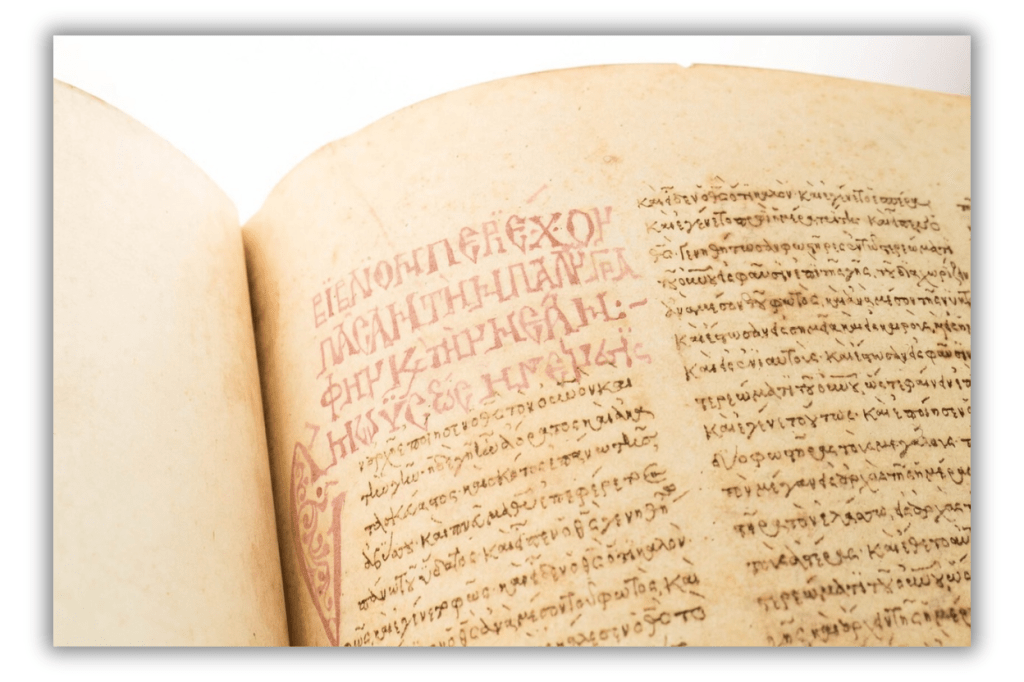
[T]he Church simply recognized the books of the New Testament as apostolic. And it is not the Church’s recognition but their apostolic origin which gives these books authority. The New Testament is the written deposit of the apostles’ teaching. The process whereby these books were recognized was untidy and in a sense reaches its completion with the 39th Paschal Letter (so called because it was the letter announcing the date of Easter) of St Athanasius as bishop of Alexandria in 367 in which the great bishop lists the 27 books of the New Testament. He does not see himself as establishing anything or promulgating some new rule or canon for he begins by saying, “Permit me to remind you of what you already know.” And the untidy process can be seen in the citations from the New Testament in the church fathers, the use of the New Testament writings as readings in the Eucharist, and in the rejection of Marcion’s list at Rome in 140 AD.
It is a remarkable fact that the Church of the Augsburg Confession has never authoritatively defined the New Testament canon but has always recognized the distinction between the homologoumena (books everywhere accepted as apostolic) and the anti-legomena (books whose apostolic origin has been questioned). This is a matter of historical fact and so can never be changed. The anti-legomena are Hebrews, James, II Peter, II and III John, Jude, Revelation. Although this theoretical distinction remains in Lutheran teaching, for all practical purposes all 27 books of the New Testament are received as canonical. The late Martin Franzmann of blessed memory (1907-1969) says, “in the last analysis, the church of God can become convinced and remain assured that they are indeed the wellsprings of salvation only by drinking of them.”1
The whole question of the papacy is yet another issue. But even many Roman Catholic scholars now admit that it was not until somewhere in the second century that one can even speak of a bishop of Rome. Until that time the Church of Rome like Corinth seems to have been led by a corporate episcopate or presbytery.
The Word of God creates the Church, the Church does not create (but can only receive) the Word of God. The Church at most recognized the New Testament writings as the apostolic witness to Christ, the Word of the Lord in written form.
Needless to say these are issues which have been endlessly debated for centuries — and the end is not yet.
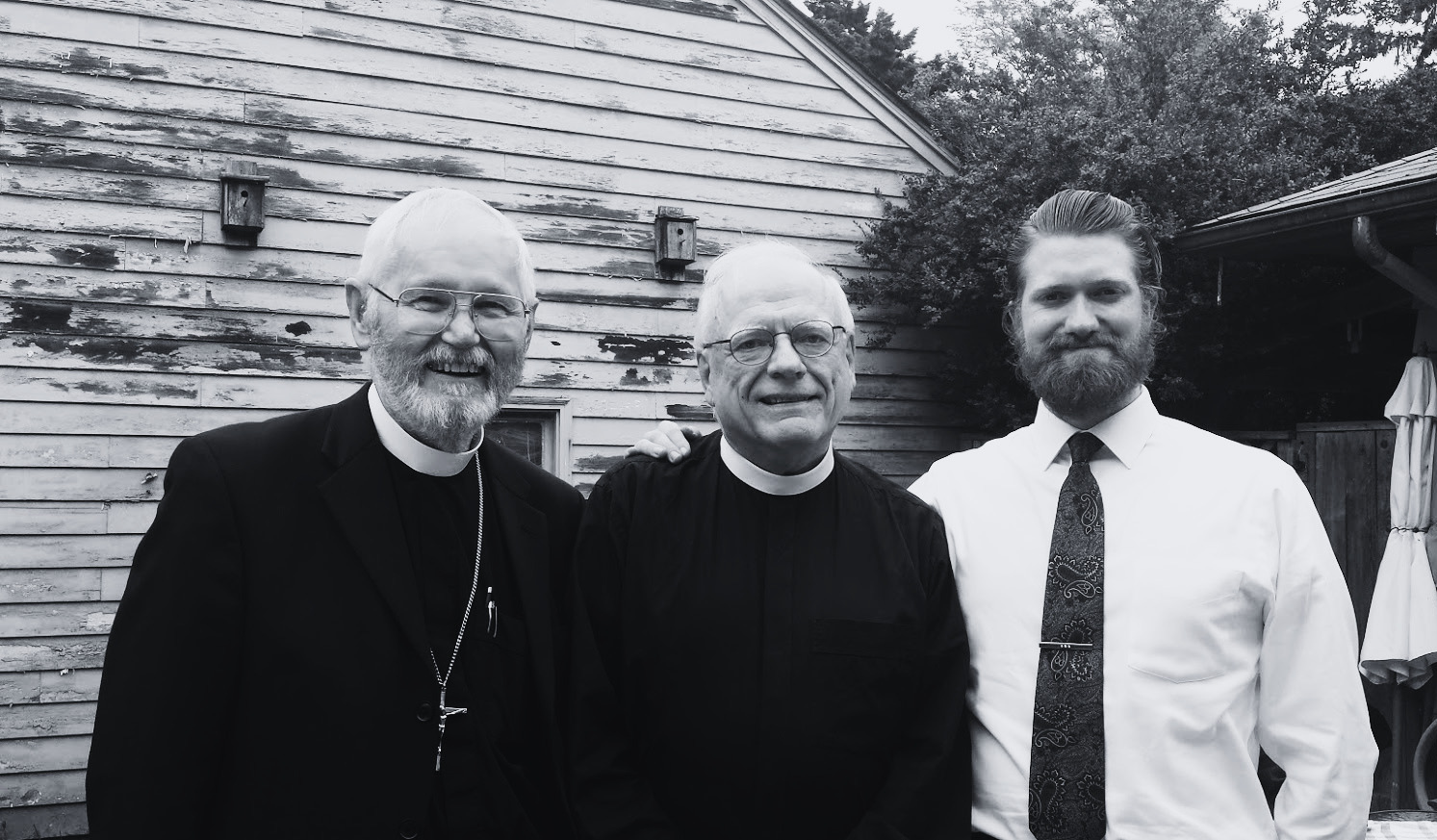
Bruce Ley, Charles McClean, and yours truly in Oregon, May 2015.
The Word of the Lord Grows: a First Historical Introduction to the New Testament. St Louis: CPH, 1961; p. 295. ↩︎
The propagation of sermon recordings to the general public fundamentally alters the nature of preaching. It causes the preacher to preach with potential abstract anybody anywhere in mind, rather than the actual saints who are congregated around the Word and sacraments in that particular place and time.
It is impossible to listen to a recorded sermon. It is impossible to watch a recorded sermon. You cannot read a sermon on the internet or even in a book. You cannot share one with a friend — not one that’s already been preached, at any rate. For a sermon, as a species of Christian conversation, just is a thing articulated, heard, and engaged in in real time and space. A sermon is not the sound of words. A sermon is not a field of text.
When we hear the term “sermon”, we naturally think of the public preaching of the Word on a Sunday or other holy day, to and in the midst of the congregation, and it is well that we should. Nevertheless, it is also good to remember that the term “sermon” in its original derivation means something like discussion.
This is no assertion on the mere basis of etymology: 1 Corinthians 14 is essentially St. Paul giving commands regarding the proper conduct of a doctrinal discourse and discussion — in other words, it is St. Paul saying how the sermon should be regulated in a godly way.
The great early twentieth-century Lutheran theologian Georg Stoeckhardt (1842-1913) makes incidental, yet fairly extensive, reference to this topic here in this writing. “Frequently a discussion connected to the instructional discourses,” he comments, “a sort of conversation on the teaching. Whoever had not understood something asked the teacher, and this point was discussed.”
Nowadays it is more customary for the instructional discourse to take place in the midst of the service (the “sermon” as we know it) and for the discussion to take place afterwards (the commonplace of “Bible Class”), although if I had to guess the split on how many after-church Bible classes are devoted to the preacher fielding questions about his sermon versus him boring his fellow saints to distraction with a one-man hobbyhorse rodeo . . . well, I’m not sure I could do it.
There’s nothing wrong per se with the separation between the two halves of the ancient sermon. That said, it wouldn’t be wrong per se to keep them together, although given that the separation is now a longstanding custom in a matter of adiaphora — since well before the Reformation, in fact —, we Lutherans, at least, would seem to be admonished by our Confessions to retain it.
While we’re on the subject, though . . . when was the last time you witnessed or participated in the other half? But actually — not just as a perfunctory five minutes before you proceeded to spend an hour and half on three verses of Habakkuk (interspersed with anecdotes about a discussion on Facebook from the previous week), as though you were graciously indulging a whim from the proles and more or less doing them a favor.
No, but when was the last time you took as long as was needed to give an account of your doctrine that day and answer your fellow Christian men’s questions about it?
No, not because you are magnanimous, but because you owe it to them, and you owe it to your Lord. You are not infallible, and being apt to teach is part of what is required of you. It is conceivable that you might even receive correction from them. What? came the word of God out from you? or came it unto you only?
And would you not be glad to receive it? Or does that only happen at Winkels and conferences, when you’re among fellow professional Christians?
I’m not impressed by good preachers because the pulpit is a place where teaching takes place without any pushback.
Can the man lead in conversation with other men?
Can he direct others toward the truth when it isn’t scripted?
We do not put sermons on our website at Holy Trinity. We can’t. It would be impossible. To be a bit insufferable: sermons are events. They cannot be put anywhere.
We do record the sermons and make the recordings available to . . .
members who were absent
catechumens who might wish to re-listen and discuss them with absent family members, and
on occasion, local inquirers here in the Treasure Valley.
Yes, preaching is public, but let’s be clear about what is meant by this. In his annotations on the 1943 Synodical Catechism of the old LCMS, Edward Koehler points us in the right direction:
Question 275: How does the local congregation publicly administer the Office of the Keys? * Answer: According to God’s will the Christian congregation chooses and calls men as ministers, who in the name of Christ and in the name of the congregation publicly perform the functions of the Office of the Keys. (The pastoral office a divine institution, Acts 20:28; Eph. 4:10-12.)
Koehler: The word ‘publicly’ here does not mean openly, before the eyes of the public, but it means in the name of the public, which, in this case, is the local congregation. While each true believer in Christ is a royal priest in his own right, and should, therefore, by word and deed ‘show forth the praises’ of God (650), he will not remain aloof from other believers, but rather seek the fellowship of those that hold the same faith as he (690), and join a Christian congregation in order that together with others he may do what the Lord commanded all of them to do. — Since all members of a congregation have the same right and duty, no one may take it upon himself to act in the name of all others, but he must by them be called or commissioned to preach, etc., (Rom. 10:15).
Read the rest here. (Here is an unroll for those not on X.)
The propagation of sermon recordings to the general public fundamentally alters the nature of preaching. It causes the preacher to preach with potential abstract anybody anywhere in mind, rather than the actual saints who are congregated around the Word and sacraments in that particular place and time.
“Not true, I can do both!”
Even if we were to grant for the sake of argument that you could (you actually can’t), that would still be a problem, because you are only supposed to be doing one of those things at that time. For once in your life, stop trying to multitask.
“Oh yeah, what about WAM? He preached on the radio!”
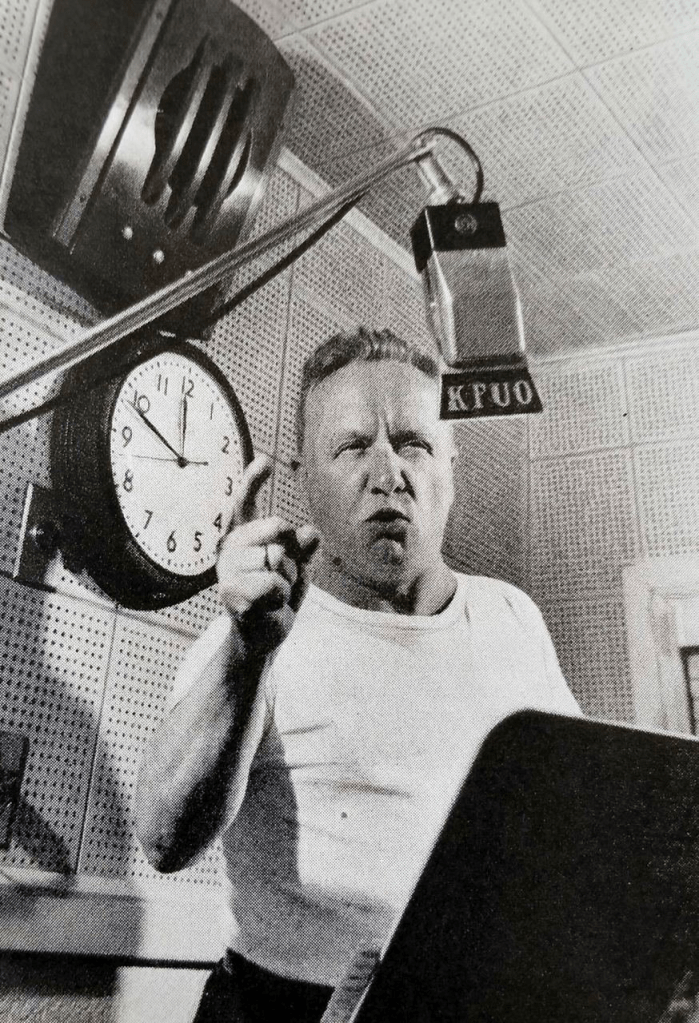
Do you think that’s the interior of a church? Is there a congregation sitting just outside the frame?
Walter A. Maier did not record the sermons he preached to his congregation and then broadcast the recordings on the radio. He gave his radio addresses on the air, yes. In a certain sense these were indeed sermons. They were great. We are big WAM fans here. There is a place for dedicated public addresses outside the four walls of the church. Podcasts are a species of that. I’m not sure why a video of your talking face and twitching waxed mustache needs to be involved, or how you justify this use of your time to your congregation, but I digress — clerical looksmaxxing, theobro/theonerd narcissism, and related topics will have to be taken up some other day.
Yes, there is a place for the public address in evangelism, other things being equal.
But do not pretend that you, immediately scurrying into the vestry with your iPhone after the service to upload your sermon recording onto Spotify and shop the link around to your fanbase, real or imaginary, are doing the same thing that WAM and others did.
(Old guys who started doing this before the rise of social media get a pass in my book, unless their sermons are trash. Hello, Clint.)
A sermon outline or partial transcript, created before or after the factum of a sermon itself, is not a sermon. It is a theological essay, a meditation, a devotional writing. Being a different thing, it serves a different function — perhaps a salutary one, but in any case never the same one.
Our congregation will very occasionally publish outlines, i.e, partial transcripts, of past sermons preached by our pastors. If and when this is done, it is done by the common consent and agreement of the men of the church and in their name. We pray that these outlines would be edifying and profitable to any who read them.
Thank you for reading. The Boniface Group is the mission society of Holy Trinity Ev.-Lutheran Church of Gem County. If you would like to support our work, you may do so here. (Crypto options coming soon.) To learn more, visit our homepage and start reading from the top. Thank you, and God bless you.
I wrote this letter back in October, but I never got around to sending it. Time got away from me, and I returned to it the week before your arrival out here. I’m sorry for that unintended delay.
I know that you want to take communion at Holy Trinity, and I know that you noticed that we didn’t have it when you and Uncle Art were visiting in October. Jake mentioned to me that you had said as much when you were visiting with the Watsons.
When we consider the matter of who would receive the Lord’s Supper, there are two pertinent questions:
Who should receive the Lord’s Supper?
Who should receive the Lord’s Supper from the same altar?
The answer to (1) is that all Christians are bidden to eat the Lord’s Supper. The answer to (2) is that only those who are united in doctrine should partake of the Lord’s Supper from the same altar/at the same table.
With that said, the determination that there is, in fact, unity in doctrine is not made individually or personally but congregationally. This was the position of the Evangelical Lutheran Synod of Missouri, Ohio, and Other States at its inception and for the better part of a century afterwards.
Leaving aside for the moment the question of whether the LCMS of today really is the same entity as the Evangelical-Lutheran synod established by C. F. W. Walther and his saintly contemporaries, it suffices to say that the same orderly approach to communion fellowship is still taken by conservative LCMS pastors and congregations — and rightly so.
For example, when Pastor Perestroika, speaking on behalf of the congregation of St. James, says that “those who are not members in good standing of this congregation or of a sister congregation of the LCMS or of one of our sister church bodies are asked not to come forward for communion at this time” (I’m paraphrasing from memory), he is correctly stating what the basis for communion fellowship must be — although his statement also assumes that church discipline, closed communion, etc., are practiced uniformly and consistently throughout the LCMS, and this is definitely not the case.
Fellowship among congregations is a two-way street. As such, it is not something that a congregation can simply declare. Even if we were inclined to do so, Holy Trinity could not simply declare itself to be in fellowship with Prince of Peace in Autumndale or St. James in Hobble Hill — or any other congregation, for that matter. Public mutual agreement is necessary. LCMS congregations are in fact prohibited by the constitution of Synod (“The Handbook”) from entering into fellowship agreements with other church bodies (and congregations) by unilateral congregational decision, independently of the Synod. LCMS congregations are bound by the fellowship agreements of the Synod as a whole, although plenty of congregations and pastors choose to ignore those agreements — and I would be remiss not to point out that this is covenantbreaking (see Romans 1:31), regardless of how one may feel about it.
Pastor Perestroika and the men of St. James believe that membership matters when it comes to communion fellowship, which is why St. James practices closed communion, i.e., admittance to the Sacrament based on membership: a person’s membership at St. James — or at a congregation which is itself a member of the Missouri Synod (or of a sister synod such as the AALC).
Pastor Keindingus and the leadership of Prince of Peace do not believe that membership matters — a person’s membership in a particular congregation or a congregation’s membership in a particular fellowship — when it comes to the Lord’s Supper, and they probably have never given much thought to the matter, which is why Prince of Peace practices open communion.
In keeping with longstanding orthodox Lutheran practice — which St. James at least tries to uphold, and which Prince of Peace does not uphold —, we at Holy Trinity, do not presume to practice communion fellowship where none has been established by mutual congregational declaration.
I know that you know this, but it bears repeating: closed communion is not in itself a declaration that those not invited to the table are not Christians. It is not necessarily even a declaration that those not invited to the table are personally heterodox. It is simply a recognition that communion fellowship in the Visible Church is established by, and exists among, congregations.
Certainly there is an element of sadness in all of this. We wish things were different. With the saints beneath the heavenly altar, we cry out “How long, O Lord?” as we behold the warfare against the Church, which manifests also among and within the congregations which claim the name of Christ. But we do not do so in a sanctimonious way. “For there must be also divisions among you,” St. Paul writes, “that they which are approved may be made manifest among you” (1 Co 11:19). “It was needful for me to write unto you, and exhort you that ye should earnestly contend for the faith which was once delivered unto the saints,” St. Jude writes (Jude 3). John Calvin echoes the apostles with these words: “Accursed is that peace of which revolt from God is the bond, and blessed are those contentions by which it is necessary to maintain the kingdom of Christ.” ( — a bit ironic, given how much energy the Calvinists have spent over the course of their history on trying to get Lutherans to commune with them, but we’ll let that lie for now.)
To summarize: divided congregations are not brought into concord in “the faith which was once delivered unto the saints” by celebrating the Sacrament together; no, but they celebrate the Sacrament together if and only if such concord is achieved. To knowingly do the former is a failure to discern the Lord’s Body every bit as flagrant as any sacramentarian denial of the Real Presence, and it incurs the same judgment (1 Co 11:27ff).
The situation in which conscientious Christian women find themselves in the Lutheran Church these days is certainly vexing. To date, we have had one unmarried gal come to us from Beautiful Savior over in Little Bog, the LCMS church where the Kettlebells used to be members. She comes by herself, without any family. To my knowledge, she does not live under her father’s roof; even if she did, he does not exercise any kind of headship with respect to her church attendance, etc., and so she has been “turned out” in this respect. All this to say, she has been going through catechesis with two others (both men) at our home on Tuesday nights for the last few months, and she will be received as a member on Sunday, April 12, along with one of them (whom she is now dating). Though she is already Lutheran by profession, she has not communed at Holy Trinity up until the present, because she has not been a member.
The situation with married women is somewhat different. Having pondered the matter in the light of Scripture to the best of my ability and conferred with various Christian brothers, this is where I have landed:
A Christian woman has a duty to abstain from the Lord’s Supper if the congregation where she is a member is, to her knowledge, publicly heterodox, i.e., if its confession (to include the teaching and preaching of its pastor or pastors) plainly contradicts the Catechism. If the congregation is at least publicly orthodox, however, she should submit her conscience to the decision of her husband as her head. Matters beyond her own congregation are not her direct concern, e.g., her congregation’s affiliation, synodical membership, etc. They are her husband’s direct concern, whether or not he recognizes them as such. If he is not doing his duty with respect to those things, she is not culpable for that.
I’ll admit, I find the situation you’re currently in to be a bit tenuous, inasmuch as Uncle Art won’t commune at St. James but is “fine with” (perhaps passively so) you doing so. But that is not nothing. You’re not refusing to submit to him. I know you wish he would take more of an active interest in these matters, but in the meantime, satis est. You and Uncle Art are members at Prince of Peace, Prince of Peace does not publicly contradict the Catechism, and Prince of Peace and St. James are in fellowship.
Orthodox Lutheran congregations ought to be in fellowship with each other, just as orthodox Lutheran Christians ought to recognize one another and assemble together for worship (Hebrews 10:25), which regular assembly just is an orthodox Lutheran congregation. I hope and pray that Prince of Peace and St. James both realize that the old Missouri Synod is gone and that the current-year LCMS corporation stands for false doctrine, and I hope that they and their pastors act accordingly and disassociate from it.
In the meantime, I pray that you can be at peace with the way things are, even though they are not ideal, even though our congregations are, for the time being, not in communion fellowship. I encourage you to continue doing what you are doing with a good conscience, even as you continue to pray that Prince of Peace and St. James (and others) would allow themselves to be reformed by the Lord of the Church in accordance with His holy Word.
[This project is ongoing. Please check back periodically as I intend to add subsequent theses to this page. Thanks are due to BackToLuther for his translation.]
Of the matters submitted to the Hon. Synod for discussion, those drafted by Herr Professor Walther,
Theses
on Communion-Fellowship with Those of Other Faiths,
were, by resolution, taken up, initially at the first session and then at three subsequent ones. These theses, which had been distributed in printed copies among the synod members present, were first read out one after the other in context and then individually explained, discussed, and proven from the attached scriptural passages. In addition, the author also demonstrated from various passages from our symbols and the writings of orthodox fathers the complete agreement of the above theses with the doctrine and practice of the Evangelical-Lutheran Church.
Thesis 1.
The true visible church in an unrestricted sense, or a part of it, is that in which God’s Word is preached purely and the holy Sacraments are administered according to Christ’s institution.
It is important to hear why the doctrine of the true visible church is taken as a basis here. A burning question of this time, and at the same time the bitter accusation of many who have fallen out of the bonds of a crude, unveiled union into a modern, new-faith Lutheranism against us and other faithful Lutherans, is this: Why do we not accept people of other faiths to Holy Communion? — They want nothing to do with the unholy theory according to which, falsely invoking the word of Christ: “Come unto me, all ye that labour and are heavy laden, and I will give you rest” (Matt. 11:28), everyone should be admitted to the Lord’s Supper as well as to the sermon; rather, they call this theory a downright sin and distortion of the Word of God and exclaim indignantly: One should not throw pearls before swine and the sanctuary before dogs. Nevertheless, they want to admit to Holy Communion all those who are not openly unchristian, regardless of their special confession. This unionist error is also held by the leaders of the so-called Church-Council, among others, who erroneously refer to a passage in our symbols.2 We must therefore, they say, admit to Holy Communion all those who prove themselves to be dear Christians. — But this almost unionistic principle is rooted in their erroneous doctrine of the Church. Our opponents do not wholeheartedly believe that there is a true visible church on earth in an unrestricted sense. — It is therefore all the more necessary that we bring this doctrine to our clear awareness in order to justify our doctrine and practice of the Lord’s Supper. If the opinion of the leaders of the “Church-Council” and their spiritual comrades were divine truth, we Lutherans would be committing a grave sin with our ecclesiastical separation from all other Christian fellowships. For if people of other faiths also belong to our Lord’s Supper, they actually also belong to our church, whose bond of unity and sign of confession is precisely the sacrament; we must therefore necessarily unite with them ecclesiastically in all other things as well. But our thesis gives us correct information about the true visible church. It speaks of such a church in an unrestricted sense. One can also speak of a true visible church in a non-unrestricted sense, just as one can speak of a cripple as a true, real human being. However, just as a person who is healthy in all his parts is called a normal person, a person as he should be, so here a true visible church is understood in an unrestricted sense to be such a church as it should actually be according to God’s will and foundation, a normal one. However, it should be noted that we are not talking here about the church in general, but about a visible church. A true visible church in an unrestricted sense is a group of Christians who are always mixed with evil and hypocrites, but with whom the pure, unadulterated Word of God and Sacrament can be found. A true visible church in a restricted sense, on the other hand, is what we call a similarly mixed group in which God’s Word and Sacrament are only essential. Such a church, for example, is the Reformed Church. It is a community that has come together with the intention of practicing God’s Word and Sacrament among themselves. But because it does not have these means of grace pure and unadulterated, one cannot speak of it as a true visible church in the unrestricted sense. However, praise be to God, there is such a church, and that is the Evangelical Lutheran Church. We happily confess this and hold with a firm conscience of faith that our dear church is the church planted by the Lord Christ and his apostles 1800 years ago, because our faith, doctrine, and confession agree in all things in the most exact way with the Scriptures, the words of Christ and the apostles. The Lutheran church is therefore not only a real church, but the true visible church of God on earth, insofar as true means nothing other than: as it should be according to God’s Word. The less we can or want to boast of our pious walk before other churches, the more we can and must boast before others of the pure doctrine which, thanks to God’s undeserved grace, shines on us poor sinners like the clear, bright sunlight. — But the leaders of the “Church-Council” deny this. To them, our church is only the best among many good ones, not the orthodox one next to the false believers, not the true visible church in an unrestricted sense. For these theologians, the difference between our church and other churches is therefore only a gradual one, not a specific one. That is why they only ever speak of “denominations” and thus prove themselves to be a sect whose claim to be the best must appear quite ridiculous. This term denomination or “evangelical denominations” for all Protestant parties, except Unitarians, serves our opponents in the “Church-Council” as a substitute for the expression of vulgar Unionists, that all Christians who are not papists or gross rationalists are to be regarded as orthodox, and that all these orthodox must also maintain ecclesiastical fellowship among themselves. — But this designation is as wrong as this form of expression. For example, one cannot call the Reformed Church an evangelical-reformed church, since it is not reformed by the pure Gospel. The predicate evangelical belongs to our church alone. We appropriately put the word evangelical in front of the name Lutheran because we do not believe in Luther, but in the pure Gospel taught by Luther. We are not Lutherists [Lutheristen]. Our adversaries know this very well and yet our doctrine of the orthodox Lutheran church is basically an abomination to them. They reject it as arrogant, intolerable presumption when we say that we Lutherans alone are in possession of the full truth. One can see that their unionist practice of the Lord’s Supper is also rooted in the miserable theory of open questions. If there are doctrines in the Lutheran Church itself that can be answered with Yes and No by Lutherans, why would one not also want to hold Communion with non-Lutherans who hold this or that special doctrine! — Our theologians of doubt only ever want to seek the truth, but have never found it, and in doing so place themselves alongside those pagan sages who always sought the truth but never found it and therefore called themselves philosophers, i.e., lovers of the truth. — But since Christ and his Gospel appeared on earth, the eternal, complete, saving truth has also been on earth, and for everyone. Anyone who denies this and does not yet have the truth is truly a miserable, pitiful creature and certainly not a Christian. — How clearly, distinctly, and comprehensibly, even for a child, are contained in God’s Word, for example, the doctrines of Baptism, of the Lord’s Supper, of the eternal, universal will of God! — Anyone who only holds his reason captive under the obedience of faith and does not willfully resist can and must be made divinely certain of the truth here and convinced that the counter-doctrine is of the devil. — Would our adversaries dare to accuse those apostolic congregations [Gemeinden] of arrogant self-conceit if they had refused the hand of brotherhood and communion in the sacrament to insidious false spirits, against whose poison of the soul the holy apostles had warned them verbally or by letter, and had declared to them: “We have the truth and you do not, but a doctrine of devils”? — They would not. But they do not want to grant us precisely what they must grant to those apostolic congregations. Why not? Because, as they say, we do not have the apostles as teachers, but only Luther. But O foolish objection, which reveals to us their unbelief in the Word of God! For do we Lutherans not still today have this holy Word of God “pure, well and right by his power, described in Holy Scripture”? Does not St. Paul still speak to us in the Bible in exactly the same way as he preached and wrote to his congregations at that time? Do we not therefore still have the eternal, full, infallible truth today? And would it not be a very false, wretched feeling of shame, stirred up by the devil, to think that it would be arrogant and self-conceited to say: I have the truth, because I stand on the rock of the Word of God, and I reject the contrary doctrine as a lie of Satan! — May God in his grace preserve us from such a sense of shame and all admiration for the spirit of unionism.
Incidentally, the reason why so many shy away from faithful adherence to the Word of God and pure doctrine is that they can easily and rightly conclude from this that faithful adherence to a life that is exactly in accordance with the Scriptures is just as detestable to them as pure doctrine. On the other hand, an orthodox Christian who has correctly recognized the doctrine of original sin has respect for God’s Word in general, as well as only for that piety which agrees with the Word.
We see that the great seductive powers within the Church today are, on the one hand, the Pope, who alone considers himself infallible, and, on the other, the [Prussian] Union, which finds infallible truth nowhere. Against both, we Lutherans hold that there is indeed an infallible truth, but only in the Word of God, and that we certainly possess it as long as we stand on the Word. Or should this be too much of an assertion, and not place us alongside the Roman Antichrist, who claims infallibility in matters of faith, morals and discipline for himself alone? No, never. For there, in Rome, they claim infallibility apart from, without, and even contrary to God’s Word by the devil’s instigation, but here we profess to be infallible, despite all our own personal capacity for error, because and as long as we speak as God speaks in His infallible Word. That is the enormous difference. Our spirit is, praise God, different from that of the Pope, but also from that of the Methodists. For while the latter blaspheme and condemn us because of our doctrine of the only orthodox Lutheran Church, they now claim to be the only true Church of God because they alone live piously. — Therefore, they are affected by what St. Paul writes 2 Tim. 3:1–9 about the glorious, arrogant, pompous, and hypocritical people of the last abominable times, while we are told what is written in the 14th verse: “But continue thou in the things which thou hast learned and hast been assured of, knowing of whom thou hast learned them.”
Listen to what Luther says about the form of the true visible church and the infallible truth of its doctrine: “The Catechism [Kinderglaube] says that there is a holy Christian church, and St. Paul says (1 Cor. 3:17): ‘The temple of God is holy, which temple ye are; but if any man defile the temple of God, him shall God destroy’[3]; therefore the holy church cannot suffer lies or false doctrines, but must teach only that which is holy and true, and that means God’s Word; and if it teaches only one lie, then it is already idolatrous. . . . But here someone who is good-natured (as people say) may reply: What harm would it do if we would adhere to God’s Word but would retain all these things (papistic abuses and errors) or also some others that are tolerable? I reply: Such persons may be called good-natured, but they are wrong-hearted and susceptible to seducement; for, as you hear, the church must not teach anything else than God’s Word, serve anyone else than God, place another light beside the [true] Light (placed by God in the darkness). It is indeed a will-o’-the-wisp and error even though it were only a single untruth, for the church should not and cannot teach any lies or error, not even a single one. If it teaches a single lie, it is already altogether wrong, as Christ declares in Luke 11:35: ‘Take heed therefore that the light which is in thee be not darkness. If thy whole body therefore be full of light,’ having no part dark, ‘the whole shall be full of light.’ That means the whole must be light and no part must be dark. The church must teach only God’s Word and truth, and neither error nor lies. And how could it be otherwise since God’s mouth is that of the church? Again, God cannot lie and therefore neither can the church. . . . The church must teach only God’s Word and must be sure of it, for on this account it is called the pillar and ground of the truth, built upon a rock, holy and without blemish. That means, as it has been rightly and well said: The church cannot err, for God’s Word, which it teaches, cannot err. But what is taught otherwise or in doubt whether it is God’s Word dare not be a doctrine of the church. . . . Duke George, of unblessed memory, once said that he knew well that many abuses have crept into the church, but that it could not be condoned that a single monk of a diminutive burg should venture to reform it. Very well, he admitted (and not only he) that your church is full of abuses; and that means it is not a pure, true church, for that should be holy and pure and without any additions, not to say, without any abuses.” (Wider Hans Wurst. 1541. Walch XVII, pp. 1682 ff. Walther: Die evang.-luth. Kirche etc., pp. 43–45. [The True Visible Church etc., pp. 36–37.])
Of course, these words of Luther are not meant to imply that there are not often poor, weak, erring Christians in the orthodox church as well; but as soon as they are convicted of their error by God’s Word, they abandon it, fall in line with God’s Word and confess the truth. But those in the Lutheran Church who stubbornly cling to their error must eventually be expelled. It is different in the Reformed Church. For this church, in its distinctiveness, stands precisely on error and, for example, in the doctrine of Holy Communion, does not listen to the clear Word of God, but to its foolish rational thoughts. One is therefore infallible and free from errorwherever one holds fast to the Word of God. For as certain as the Bible is the Word of God and inspired by the Holy Spirit, as certain as Christ is the Son of God and the mouth of eternal truth, it is also certain that we cannot err if we hold to the letter of Holy Scripture. He who does not believe this has neither strength and victory in the temptations of the devil, nor comfort in the terrors of death, and must miserably perish. His faith is nothing but a ghost. For true faith, as Luther says, dies a thousand times over because it has the truth. It makes us infallible. We do not say that a Lutheran Christian cannot err even in one thing contained in Holy Scripture, but only this we assert, that he has the full truth in all articles of faith, which are so clearly and distinctly revealed to everyone in Scripture, so that he can live and die happily on them. It is also a great deception of the false spirits when they claim that only this or that doctrine of faith, such as that of the deity of Christ, is clearly and distinctly revealed in Holy Scripture, while others, such as certain doctrines of distinction, are not, and that therefore one cannot attain the infallible truth in the latter. To this we say: No. All the doctrines of faith are clearly and unmistakably revealed in Holy Scripture, and in confessing these doctrines our Church is the infallible mouth of God, an assertion which, as we have said, is an annoyance to our adversaries, but a very great comfort to us. — But what we confess in the thesis we prove from the Scriptural passages appended to it. John 8:31, 32: “Then said Jesus to those Jews which believed on him, If ye continue in my speech [Rede], then are ye my true disciples [meine rechten Jünger]; and ye shall know the truth, and the truth shall make you free.” According to the basic text, the first part of this passage actually reads: “If ye continue in my word [Worte] (λόγῳ), then are ye indeed my disciples [in Wahrheit meine Jünger],” and from this we can clearly see that the Lord Christ declares those to be his true disciples, that is, the true church, who hold fast to his word, namely to the simple understanding of it. This is what the Lutheran Church does. Indeed, this also applies to the children of God living in false churches, for although they err here and there, they do so unwittingly. But as soon as they realize their error, they abandon it and remain with the speech or words of Christ. Nor do they cling with their hearts to the error, but only to Christ their Lord. But now the same Lord says of all those who abide in his word: “And ye shall know the truth, and the truth shall make you free.” Whoever therefore does not want to make Christ Himself a liar must confess hereafter that the true visible church of God on earth, that is, the Evangelical-Lutheran Church, and every Christian who abides in the Word, has found and really attained the infallible truth. The following passage
John 10:4, 5 reads: “The sheep follow him: for they know his voice. And a stranger will they not follow, but will flee from him: for they know not the voice of strangers.” — So, what is the Church? The totality of the sheep or disciples of Christ. What is true of these is also true of the Church. A sheep hears its shepherd’s voice and follows him. So does a Lutheran Christian follow his shepherd Christ. He believes His Word, however incredible it may seem to his reason. Furthermore, a sheep does not recognize the voice of a stranger, but rather flees it. This is how a Lutheran Christian condemns false spirits and their heresies, no matter how sweet and acceptable they may sound to his reason.
The passage Rev. 3:7–11 forms part of the epistle to the bishop of the church in Philadelphia. Christ does not say to him through the mouth of John: “Because thou livest so piously,” but rather: “Because thou hast kept the word of my patience, I also will keep thee from the hour of temptation, which shall come upon all the world.” This adherence to pure doctrine was therefore his crown, which he was not to allow to be taken from him. Although it says earlier: “I know thy works,” these works here mean nothing other than faithful adherence to the word of truth, just as the bishop of Laodicea they mean nothing other than his lukewarmness and his apostasy from the good confession. And how the promise given to the church in Philadelphia has been fulfilled to this day is evidenced by the multitude of Christians still living in this city, while the Laodicean church has disappeared and its place has become a heap of ruins. If the above promise is also to be fulfilled for us and our children after us, then it is truly necessary that we also faithfully keep the word in these last times of temptation. Note also that in this epistle Christ does not call those who have fallen away “dear brothers,” who take a different and justified standpoint, but rather those who “lie.”
1 Cor. 1:10 reads: “Now I beseech you, brethren, by the name of our Lord Jesus Christ, that ye all speak the same thing, and that there be no divisions among you; but that ye be perfectly joined together in the same mind and in the same judgment.” Here the divine judgment on the spirit of this time is pronounced and the Holy Spirit breaks the rod over the Union. The Lord says to it, as it were: “You are not my church.” For the unchurched, as is well known, one speech, mind, and opinion is an abomination, which in their opinion brings about the division and fragmentation of the church and which they want to leave to us “Old Lutherans.” But do they not thereby bear witness to themselves that their much-vaunted unity in the Union is nothing but a whitewashed grave and a hypocritical comedy? For how can there in truth be any talk of the unity of the church, where its members are only glued together outwardly (as in the papacy) and where many different beliefs and doctrines are held within it? It is not we, but they, the unchurched, who are accused of splitting up the church, and one might well say that they have as many divisions as there are people. However, the Holy Spirit of God also condemns the leaders of the “Church Council” with the words “the same mind and judgment.” Although they want to have the same speech in the church, demand the acceptance of all confessional writings of the Evangelical Lutheran Church, demand the signatures to them, they do not want to argue and argue about the “same mind” and “same judgment” for long. And yet, in the eyes of the Holy Spirit, this is no less a hypocritical and despicable union maneuver. For how can the speech of the mouth or the writing of the hands bring unity where hearts are torn and divided by various minds and judgments? — The passage
Eph. 4:3–6 defeats the man-made work of union. For here it says: “. . . endeavouring to keep the unity” (not of the body, but) “of the Spirit in the bond of peace.” And what does this consist of? In one body and one Spirit (namely, in one spiritual body implanted in Christ), so that Christians have one Lord, one faith, one baptism, one God and Father. This is the true inner unity that should exist among Christians in the church. And where it exists in this way, diligence should be exercised to maintain it through love, and care should be taken that envy and pride among Christians do not destroy them. Thus we see how this passage, which the unionists so often and gladly cite as their motto and favorite saying, contains precisely their destructive judgment.
Thesis 2.
A fellowship in which God’s Word is fundamentally falsified or at least allowed to be fundamentally falsified is not a true, orthodox church, but a false, heterodox church or sect.
This is very clear from the passage:
John 10:26, 27: “But ye believe not, because ye are not of my sheep, as I said unto you. My sheep hear my voice, and I know them, and they follow me.” Just as therefore according to this (cf. also the passage chap. 10:4, 5 above) only those are Christ’s sheep or true church who hear His voice, i.e., His Word, and follow Him, so also those who do not hear His voice, i.e., do not believe the Word, are not His sheep, but a false church. Furthermore it says:
Chap. 14:23, 24: “If a man love me, he will keep my words: and my Father will love him, and we will come unto him, and make our abode with him. He that loveth me not keepeth not my sayings.” In these words, too, the Lord Christ clearly indicates the characteristics of the true and false church. Those who keep Christ’s word are the true church, in which God Himself makes His home. It is God’s house and true temple. The Lord of heaven and earth dwells in it, not only according to His nature, but also according to His presence of grace. This is the hallmark of the true church. The false church, on the other hand, can be recognized by the fact that it basically does not keep God’s Word, but falsifies it. That is why God cannot dwell in it. It is a sect with which we do not want to have fellowship. — It is true that even within the Evangelical-Lutheran Church this or that person strays from the Word of God, but because this happens out of weakness and ignorance, it does not make our church a sect. But whoever fundamentally and persistently departs from the Word of God belongs to the false church.
But it is also very important that the thesis states that even where God’s Word is allowed to be fundamentally falsified, there is a false church. This is the case, for example, in the [Prussian] Union. For we do not deny that there may still be some in it who generally teach God’s Word purely. This fact alone does not make it, the United Church, either pure or a true visible church of God. On the contrary, we must confess that it is worse off than any other Protestant sect. For in these churches the situation is such that the true Christians therein, in their ignorance, think and are convinced in their hearts that their error is truth. One can therefore fight with them honestly and sincerely, just as we Lutherans do with honest Reformed Christians, on the doctrine of the Lord’s Supper, baptism, the Person of Christ, and so on. But in the United Church one may falsify the Word of God with impunity. Here the lie is as justified as the truth, and error is permitted in an ungodly way. Pure doctrine is declared to be a matter of indifference and a life characterized by works is considered the main thing. Truly, this wretched principle of union must be condemned even by the pagan Cicero. For when he mentioned in a speech the various doctrines of some philosophers, he added: “Which of these opinions is the right one, I do not know; but one thing I do know, namely, that only one of them can be the right one.” But the Union is also struck by Christ’s terrible judgment of the bishop of Laodicea: “Oh, that thou wert cold or hot! So then because thou art lukewarm, and neither cold nor hot, I will spue thee out of my mouth.” (Rev. 3:15, 16.) Just as a man who is eager for a refreshing drink of water is so disgusted when lukewarmwater enters his mouth, that he immediately spits it out, so the holy God is so disgusted by those who regard His revealed Word as an indifferent thing and equate error with truth, that He rejects them from His presence. — The theory of different directions leading to one goal, invented and held by unbelievers and unionistic, false Lutherans, is also nonsensical. For just as it is not possible for a number of travelers to all reach the same city if they take paths in different directions, so also is it impossible to reach one and the same destination in the spiritual realm by following different directions. Where there are different directions, a very different goal is always reached. — The orthodox Lutheran church certainly knows how to carry those in its midst who have gone astray out of weakness in order to bring them to repentance through punishment and instruction from God’s Word. However, if this does not succeed and those who are stubbornly in error reveal themselves, our church no longer recognizes them as brothers, but separates itself from them. The orthodox church can therefore never tolerate or justify error or false doctrine; it can never enter into union with falsehood. If, for example, a pastor wanted to present false doctrine and his listeners tolerated it, did not protest or punish him, or did not renounce him, we would have to consider them erroneous and possibly even heretical. For one rightly judges a parishioner by his preacher, just as one judges a church by its confession. Therefore, even if we readily admit that there are some honest souls in, for example, the Reformed Church whom we must consider to be dear Christians and brothers if we know them well, we can never unite with them in church. The United Church, on the other hand, is the church in which false doctrines, or at least false teachers, are tolerated and regarded as brethren. It is true that the United churches object, that they also follow God’s Word, that they accept the confessions of both churches, Lutheran and Reformed, where they agree, and where this is not the case, they decide according to the principle of evangelical doctrinal freedom from God’s Word. But even this is nothing but a hypocritical evasion and deliberate godlessness, since the Unionists do not confess a third correct doctrine above the divergent doctrines in question, but rather those among them who are Lutheran hold and declare the Lutheran doctrine to be the correct one, and those who are Reformed hold and declare the Reformed doctrine to be the correct one. Let us also listen to the fathers. First
Luther. He writes: “The holy church fails and stumbles and even errs, as this is taught by the Lord’s Prayer; but it neither defends nor justifies its error, but humbly begs for pardon and corrects its lapse. Therefore it is forgiven so that its failing is no longer accounted as a sin. If I am not to recognize by its obedience or its hardened disobedience, nor distinguish the true church from the false, I can no longer speak of any church. Then we may honor and regard as the holy church all heretics as also all factions and sects, for they are no worse than is the church of the pope, if indeed malicious disobedience toward God is not deleterious. But the papistic church is no better, because it maliciously disobeys God in the same way and perverts His Word; in addition, it justifies itself as being right as no other sects and heretics.” (Brief wegen seines Buchs von der Winkelmesse [Letter concerning My Book on the Private Mass]. 1534. Walch XIX, p. 1579. Walther: Die evang.-luth. Kirche etc., pp. 27 and 28 [The True Visible Church etc., pp. 22–23].)
Furthermore W. Baier: “The unity of the church is opposed also by syncretism or the fusion into brotherly and ecclesiastical concord of parties disagreeing in religion, despite the disagreement, so that there are tolerated either the doctrinal errors in the dissenting part or at least the erring persons themselves within the ecclesiastical communion as brethren in Christ or coheirs of eternal life, which toleration is wrong, even if the latter are regarded as weak and erring, but nevertheless as brethren who participate in the same divine service. Here indeed it is certain that the unlearned who through invincible ignorance are so given to certain errors that nevertheless by God’s grace they retain the saving faith, might be suffered as weak brethren were they known to us. But in this connection we speak of the dissenting part in view of the public ministry and the doctrine of faith and life, as it is publicly preached, as also in view of the sacraments as they are administered, namely, corruptly, so that therefore the members of such a visible communion are regarded per se, inasmuch as they are members of it, and not in view of that which belongs to them per accidens [accidentally]. — Such toleration of errors, first, is in opposition to the Scripture passages which command us to preserve the whole Christian doctrine free from error (2 Thess. 2:15), to keep the good thing committed unto us (2 Tim. 1:14), that is, to keep it intact, uncurtailed and unadulterated, and to continue in the things which we have learned (2 Tim. 3:14). But the doctrine will not be kept pure if opposing errors are tolerated at the same time and in an equal manner or are permitted to become mingled with it. Secondly, such toleration is in opposition to the duty of reproving imposed upon faithful teachers by God, through which [errors] are rebuked and condemned (cf. Titus 1:9, 13; 2 Tim. 4:2; 3:16), to which correspond the examples of Christ (Matt. 5:12 ff.; 16:6) and of Paul (Gal. 1:6). Thirdly, such toleration is very dangerous, for those errors and corruptions, unless they are restrained, assailed, and condemned, will spread ever more widely; the truth of the doctrineis rendered doubtful and suspicious, or at least it is regarded as a matter of indifference; and finally those that err are confirmed, and the deceivers are given a chance to infect ever more [people]. But the toleration of erring persons, since it pertains not merely to the unlearned, but to the entire communion, and therefore at the same time to the very public ministry and the heretical teachers, is in opposition to the commands to convince, rebuke, and avoid false teachers and propagators of errors (Rom. 16:17; 2 Cor. 6:14, 17; Gal. 1:8; 5:12; 2 Thess. 3:6; 1 Tim. 6:3; Titus 3:10).” (Comp. theol. posit. [part] III, [chap.] 13, 37 [pp. 665, 671]. Walther: Die evang.-luth. Kirche etc., pp. 34–35 [The True Visible Church etc., pp. 28–29].)
Thesis 3.
Every person is obligated to confess the true visible church and, if he has the opportunity, to adhere to it.
This thesis is therefore also important for our purpose. Whoever is convinced that there can, should, and does exist a true visible church, as stated above, must also admit that every person has the duty to join it. But the opinion that one has the freedom to join this or that church flows from unbelief that there really can be such a true visible church of God. But what does David say in
Ps. 26:6–8: “I will wash mine hands in innocency: so will I compass thine altar, O Lord: that I may publish with the voice of thanksgiving, and tell of all thy wondrous works. Lord, I have loved the habitation of thy house, and the place where thine honour dwelleth.” So the prophet is referring here to the true Church. In this alone dwells the glory of God, because 1. here only is His Word valid and because 2. here only is it taught that we are justified by grace alone through faith in the Gospel, which is heard here in preaching, absolution, baptism, and the Lord’s Supper. In the false church of the works-righteous, on the other hand, God is deprived of his glory. It would be just as absurd as godless to say: I have contributed something to my physical life, to my creation, through my own works or merits. But it is even more frightening and ungodly to say: I have contributed something, even if only the slightest, to the attainment of spiritual and eternal life. Anyone who thinks this way is a robber of God’s honor and is cursed. And yet this happens in the false church. Here people do not thank and praise God, but themselves. But the true Church is the church of thanksgiving, and in it all the miracles of the Lord are preached. That is why David loves this church so much and sticks to it. The passage
Matt. 10:32–33: “Whosoever therefore shall confess me before men, him will I confess also before my Father which is in heaven. But whosoever shall deny me before men, him will I also deny before my Father which is in heaven” — is likewise a main passage to prove that one should adhere to the right, i.e., the true visible church; not because, as the papists erroneously claim, it is only through this that one is in the Church at all, a Christian and saved, but because it is a duty to confess. And this is necessary, not for the sake of God, but for the sake of ourselves and our fellow redeemed. For it is God’s will that all men should be saved through the Gospel. Christians, however, are to preach it to and confess it before the world, not as though they all had a duty or a necessity to be public servants of the Church, but in such a way that they adhere to the true visible church, hear the pure Gospel in it, with it confess and defend the same against opposition. In this way the Church is a wholesome leaven in the world.
In Luke 9:26 the Lord Christ says: “For whosoever shall be ashamed of me and of my words, of him shall the Son of man be ashamed, when he shall come in his own glory, and in his Father’s, and of the holy angels.” All those who do not profess the church of the pure Word, or who adhere to a false doctrine, such as the Reformed, are ashamed of the words of Christ. An excellent example of faithful confession and adherence to the true visible church, on the other hand, is given to us by the first Christians in Jerusalem, of whom
Acts 2:41 and 42 testifies that they continued steadfastly not only in the apostles’ doctrine, but also in the fellowship, i.e., they professed the orthodox church, even though doing so was associated with great danger to life and limb. They realized that it was not enough to believe the pure truth for themselves, but that they were also obligated to confess this truth publicly. — Therefore, if Nicodemus had remained as he once was when he came to Jesus by night, in woeful shyness of confession, he would not have been a Christian and would not have been saved — which is why, precisely with this visit in mind, the Lord Christ said to him: “Verily, verily, I say unto thee, Except a man be born again, he cannot see the kingdom of God.” (John 3:3.) The passage
Heb. 10:24, 25 reads: “And let us consider one another to provoke unto love and to good works: not forsaking the assembling of ourselves together, as the manner of some is; but exhorting one another: and so much the more, as ye see the day approaching.” The “forsaking” here does not refer to staying away from a church meeting or a public worship service, but rather to keeping away from the fellowship of the orthodox church in general, although it is certain that anyone who misses the worship service and the church meeting is also already leaving the Church.
In Matt. 18:17 the Lord says: “And if he shall neglect to hear them [the witnesses], tell it unto the church: but if he neglect to hear the church, let him be unto thee as an heathen man and a publican.” Note this word against the enthusiasts who pretend that Christ has thrown the truth into the world, as it were, and that anyone who wants to accept it can do so. But that is wrong. Christ has established a kingdom through which to save the world, and, according to His word and will, there really should be a visible church whose voice one is to hear and to which one should profess allegiance.
1 John 2:19 says: “They went out from us, but they were not of us; for if they had been of us, they would no doubt have continued with us: but they went out, that they might be made manifest that they were not all of us.” This passage should be held up to those of other faiths who come to us and speak commendably of us and our confession, but who wish to remain quietly with their faith and in their church, because, as they think, they could also be saved without joining us. Tell such people: If you really held with us, you would also come to us. Either your praise is just hypocrisy or you are acting against your conscience. In the place
2 Tim. 1:8 the apostle writes to Timothy: “Be not thou therefore ashamed of the testimony of our Lord, nor of me his prisoner.” This passage provides the proof that and reason why we should also call ourselves “Lutheran.” Paul calls on Timothy to confess not only the word of Jesus, but also him, Paul. Whoever confesses Jesus should also confess those who preach Jesus correctly. Some who consider our Lutheran confession to be right deny it before our enemies by denying the Lutheran name. Even if we can take comfort in such denials, these people are hypocrites to whom Christ will one day say: You have betrayed Me! for you have betrayed my faithful witnesses. Or have you never read: “Inasmuch as ye have done it unto one of my brethren and servants, ye have done it unto me”? Of course, we are only talking here about those who consciously deny the true church. For it may well be possible for someone to leave the evangelical-Lutheran church outwardly and yet still remain a true Christian. For example, an awakened Christian lacking in knowledge may come here from Germany to a Lutheran congregation, but, enchanted by the sham spirituality of the Methodists, he may think that true, living Christianity can only be found in that community, and may then join them without having lost his Christianity. — But we see from all this that it is not enough to believe the pure doctrine, but that one must also publicly confess one’s allegiance to the orthodox believers.Also writing about this very well is
Luther: “I see that it is very necessary to admonish those whom Satan is now beginning to persecute. Among them there are some who think that they, when attacked, might escape danger by if they say: ‘I do not adhere to Luther nor to anyone else but cleave to the holy Gospel and the holy or Roman church; for then we shall remain unmolested.’ And yet they retain my doctrine in their heart as evangelical and hold to it. Truly, such a subterfuge will not help them, and it means as much as denying Christ. Therefore, I beseech them earnestly to beware. It is true that you by no means should say: ‘I am a Lutheran or a papist,’ for none died for you nor is your Master than Christ alone, and you should regard yourself as a Christian. But if you believe that Luther’s doctrine is evangelical and the pope’s unevangelical, you must not cast Luther aside; otherwise you will cast aside his doctrine, which you regard as that of Christ. So you must say: ‘Luther may be a scoundrel or a saint, for that I do not care; yet the doctrine is not his but that of Christ Himself.’ For you see that the tyrants have in mind not [merely] to kill Luther but to destroy his doctrine. It is on account of his doctrine that they attack you and ask you whether you are a Lutheran. Here surely you must not reply evasively, but you must frankly confess Christ, whether He be preached by Luther, Claus, or George. The person you may ignore, but the doctrine you must confess. For thus St. Paul writes to Timothy 2 Tim. 1:8: “Be not thou ashamed of the testimony of our Lord, nor of me, who am bound for his sake.[4]” If it would have sufficed for Timothy [merely] to confess the Gospel, Paul would not have commanded him not to be ashamed of himself, yet not of the person of Paul, but of Paul as a prisoner on account of the Gospel. If then Timothy would have said: ‘I hold neither to Paul nor to Peter but to Christ,’ though he knew that Peter and Paul taught Christ, he thereby would have denied Christ Himself. For Christ says Matt. 10 of those who preach Him: ‘He that receiveth you receiveth me; he that despiseth you despiseth me.’[5] Why is that? Because in thus treating His messengers (who bring His Word), it is as if they treated Christ Himself and His Word in the same way.” (Meinung von beider Gestalt des Sacraments zu nehmen [Opinion on Receiving the Sacrament in Both Kinds]. 1522. Walch XX, 136. 137. Walther. Kirche und Amt. 1852. Pp. 164–65. [Church and Ministry, pp. 139–40.])
Thesis 4.
Every man is obligated to avoid heterodox churches and, if he belongs to one, to renounce it and leave it.
We learn this from:
Ps. 26:4, 5: “I have not sat with vain persons, neither will I go in with dissemblers. I have hated the congregation of evil doers; and will not sit with the wicked.” — The vain persons from whom David keeps his distance are precisely the false spirits who stand on their own vain wisdom and righteousness and not on the Word of God. Further it is said:
Psalm 94:20: “Thou wilt never be one with the throne of iniquity, which frameth mischief by a law.” — Throne [Stuhl] here means “teaching-chair” [Lehrstuhl] or “pulpit.” With those who misinterpret, i.e., falsify the law, i.e., God’s word in general, God will never agree, but is their Enemy. But if He is their Enemy, how could we maintain friendship and unity with them? Therefore, not only with those who, as unbelievers, do not want to know anything at all about God’s Word, but also with those who misinterpret this Word or turn it into false teaching, we should and must disagree. We are commanded the very same also in
Jer. 15:19: “If thou holdest to me, then will Ihold to thee, and thou shaltremain my preacher: and ifthou teachest the righteous to separate themselves from the wicked, thou shalt be my teacher: and before thou shouldesthold to them, they must first returnunto thee.” Here, in fact, we are also commanded to separate from the ungodly. People object: Are all members of a false church ungodly? But to this we reply: Certainly not all; there are also Christians among them, but the ungodly — namely the false teachers and stiff-necked defenders of error — are precisely to blame for the fact that such a heterodox fellowship exists and remains, and that is why we must renounce it and keep away from it. From the passage
Rom. 16:17: “Now I beseech you, brethren, mark them which cause divisions and offences contrary to the doctrine which ye have learned; and avoid them” — we see, however, that it is not we who, when we separate ourselves and keep away false believers, disrupt the unity of the Church and cause it to splinter, as we are falsely accused of doing, but rather them which cause divisions and offenses contrary to the pure, wholesome doctrine of the Word of God.
In 1 Cor. 11:19 St. Paul says: “For there must be also heresies [Rotten] among you, that they which are approved may be made manifest among you.” — Heresy, according to the original text (αἵρεσις), means a fellowship of people who hold an erroneous doctrine against one or more articles of faith, that is, a sect. But the one who separates himself from such sects is revealed to be an orthodox Christian. Christians who unknowingly remain among them may well remain Christians through God’s wonderfully gracious preservation, but they are not revealed to us as such.
1 Cor. 10:18 says, among other things: “Are not they which eat of the sacrifices partakers of the altar?” From this we learn what is necessary for our separation from the false church: namely, that we abstain from all worship fellowship with it.[6] For just as those Corinthians who ate of the pagan sacrifice to idols entered into fellowship with the pagans, so even now a Christian enters into fellowship with the false church through participation in false worship.
Matt. 7:15 is the well-known but unfortunately little-heeded warning of Christ: “Beware of false prophets, which come to you in sheep’s clothing, but inwardly they are ravening wolves.” Some who listen to false teachers say: “We pick out the best of what they preach,” but we ask: “Is that what it means to beware of them, or is that running right into the gaping maw of the wolf?” Christ says: Do not listen to them! And truly, if they were not heard, they would have to stop preaching. After all, most of them are also belly-servers who preach only for the sake of good money. Luther could say that all he needed to overthrow the papacy was a great sack of money. — The chief proof texts for our thesis are also:
1 Tim. 6:3–5: “If any man teach otherwise, and consent not to wholesome words, even the words of our Lord Jesus Christ, and to the doctrine which is according to godliness; he is proud [verdüstert], knowing nothing, but doting about questions and strifes of words, whereof cometh envy, strife, railings, evil surmisings, perverse disputings of men of corrupt minds, and destitute of the truth, supposing that gain is godliness: from such withdraw thyself.”
Titus 3:10: “A man that is an heretick after the first and second admonition reject.” — A heretical person is precisely such a one who stubbornly errs in an article of faith.
Acts 20:30 and 31: “Also of your own selves shall men arise, speaking perverse things, to draw away disciples after them. Therefore watch, and remember, that by the space of three years I ceased not to warn every one night and day with tears.” — The Unionists also want to reject manifest unbelievers, but not the heterodox. This idea, however, is contradicted by this passage, in which we are warned against fellowship with those who hold perverse or false teachings.
2 John 10, 11: “If there come any unto you, and bring not this doctrine, receive him not into your house, neither bid him God speed: for he that biddeth him God speed is partaker of his evil deeds.” This is a chief proof text. People like to call John the disciple of love, but if he were to preach this passage to the world today, they would stone him to death. But he speaks divine truth. He also says beforehand: “Whosoever transgresseth, and abideth not in the doctrine of Christ, hath not God.” That is why one also should not bid such people God speed, i.e., not as though he should avoid civil courtesy towards them and the most necessary interaction with them, but rather that he should avoid all such contact with false believers from which they could infer our sympathy with them, for that would mean denying Christ. Marriages with those of other faiths are therefore dangerous, especially if the man is the heterodox party. What a heavy cross the orthodox party then has to bear, and how many thereby often succumb and lose their faith and good conscience completely! Even overly close business connections with false believers are not advisable. The apostle even says of such a person: “Receive him not into your house,” i.e., such people, except in the case of their being in dire need, should not be entertained in a friendly manner, nor given any support whatsoever for their ecclesiastical purposes.
Finally, 2 Cor. 6:14 reads: “Be ye not unequally yoked together with unbelievers: for what fellowship hath righteousness with unrighteousness? and what communion hath light with darkness?” Many people think that this passage does not apply to the heterodox, since it is talking only about unbelievers. But they are mistaken. The Union is based on nothing but unbelief, in that it accepts, authorizes, or even tolerates the heterodox and those who publicly teach against God’s Word. It is therefore actually the unbelievers who build the Union temple. Whoever joins the Union also joins the wicked and unbelievers who are in it as a matter of principle. An orthodox Christian should and must therefore seriously flee such communities and prefer never to receive communion or rather die than enjoy a Zwinglian communion. We are well aware that the false believers accuse us of taking great pleasure in disputes and quarrels over pure doctrine and in disunity in the Church. Oh, they do not suspect that it is a heavy cross for us. Yet God’s Word binds us. The Savior says: “He that loveth father or mother more than me is not worthy of me: and he that loveth son or daughter more than me is not worthy of me” (Matt. 10:37); yes, He says: “If any man come to me, and hate not his father, and mother, and wife, and children, and brethren, and sisters, yea, and his own life also, he cannot be my disciple.” (Luke 14:26.) In these latter words the Lord means to say: Whoever is not resolved to do, does not actually do, something out of love for Me which might perhaps be regarded by his own parents or other relatives as an act of hatred, cannot be a true Christian. Thus a faithful Lutheran may have a father who is tender, but blinded by heterodoxy, and who approaches him with many moving words and pleas, yes, with tears and entreaties, that his son might not belong to the Lutherans, that (in his father’s eyes) stiff-necked, harmful sect, that he might not, by accepting or defending the Lutheran name and confession, cover his father’s gray head with shame and bring him down with sorrow to the grave. And yet, in this case, such a Lutheran Christian must not yield or give way; he must not look to his father’s sorrow and sighing, but only to the Word of his God. But how will the blind world judge this obedience to Scripture? It will condemn his act as the most shameful hatred and malice against his physical father. — To endure this is no small thing, but it is necessary.
The Smalcald Articles in the Appendix [Of the Power and Primacy of the Pope] say: “This being the case, all Christians should beware most diligently that they do not make themselves partakers of such godless doctrine, blasphemy, and unjust tyranny, but they should flee from and curse the pope and all his members or adherents as the kingdom of Antichrist, as Christ has commanded: ‘Beware of false prophets.’ And Paul commands that we should avoid false teachers and execrate them as an abomination. And 2 Cor. 6 he says: ‘Be ye not unequally yoked together with unbelievers: for what communion hath light with darkness?’ etc. It is indeed difficult for us to separate ourselves from so many lands and people and teach a different doctrine. But here is God’s command that everyone should take care and not consent to those who teach false doctrine or intend to uphold it by tyranny.” (Müller S[ymbolischen] B[ücher] 336–37. [Par. 41, 42; Church and Ministry, p. 116.]) and
Luther: “Because so many and great warnings and admonitions of God have been addressed to them (the sacramentarians), . . . I must let them go and avoid them as the αὐτοκατακρίτος [autokatakritos] Titus 3:11, who knowingly and maliciously want to be condemned. Nor will I have fellowship with any of them, nether by letters, writings, words, nor deeds, as the Lord commands Matt. 18:17, whether he be Stenkefeld [Schwenkfeld], Zwingli, or whoever he may be. I regard them all as one ilk [Kuchen], for they refuse to believe that the Lord’s bread in the Holy Supper is His true or real body, which the wicked and Judas receive orally as well as St. Peter and all [other] saints. Whoever refuses to believe this (I declare), let him not molest me with letters, writings, or words. Let him not expect me to have fellowship with him, since that will never happen.” (Kurzes Bekenntniß vom heil. Sacrament wider die Schwärmer [“Brief Confession of the Holy Sacrament against the Enthusiasts”]. 1544. Walch XX, 2211. 12. [Church and Ministry, p. 126.])
[Fünfzehnter Synodal-Bericht des Westlichen Districts der deutschen evang.-luth. Synode von Missouri, Ohio u. a. Staaten. Anno Domini 1870 (Fifteenth Synodical Report of the Western District of the German Ev.-Luth. Synod etc.) (St. Louis, Mo.: Druckerei der Synode von Missouri etc., 1870), 21–73.] ↩︎
For it says in the Preface to the Book of Concord: “For we have no doubt whatever that even in those churches which have hitherto not agreed with us in all things many godly and by no means wicked men are found who follow their own simplicity, and do not understand aright the matter itself, but in no way approve the blasphemies which are cast forth against the Holy Supper as it is administered in our churches, according to Christ’s institution, and, with the unanimous approval of all good men, is taught in accordance with the words of the testament itself.” [Par. 20; Triglot, p. 19.] ↩︎
Isaac Dragomir serves The Boniface Group by helping out with editing, the website, and other odds and ends here and there. Hailing from the Prairie State, he has worked in Illinois, Wisconsin, and Hawaii as a caregiver, a school-bus driver, a teacher, and a tree-service crew member. But his favorite job so far has been milking cows. When Isaac isn’t quoting print jobs, he enjoys singing at the piano from his TLH; reading Luther, Walther, and history; solving a math problem; and gathering with family and friends around a board game, jigsaw puzzle, or fire pit.
“Rogate” means “pray.” More literally it means “ask,” which is even better, because this reminds us that the essence of prayer in the narrow sense is petition, that is asking.
The Small Catechism:
What is the Introduction to the Lord’s Prayer? Answer: Our Father who art in heaven.
What does this mean? Answer: God would by these words tenderly invite us to believe that He is our true Father, and that we are His true children, so that we may with all boldness and confidence ask Him as dear children ask their dear father.
The Gospel according to St. John:
Ye now therefore have sorrow: but I will see you again, and your heart shall rejoice, and your joy no man taketh from you. And in that day ye shall ask Me nothing. Verily, verily, I say unto you, Whatsoever ye shall ask the Father in My name, He will give it you. Hitherto have ye asked nothing in My name: ask, and ye shall receive, that your joy may be full. (16:22-24)
The Last Sunday of Easter
Just to get this out of the way: Rogate really is the last Sunday of Easter. The following Thursday (May 14 this year) is the Feast of the Ascension. Ascension, not Pentecost, marks the end of the season of Easter. Ascension has its own ten-day season leading up to Pentecost — or Whitsunday, as it is customarily known in some churches.
Easter is forty days long. It is not fifty days long. Every calendar-respecting Christian in the West knew this until the homosexual Jesuit higher critics that I mentioned in the last post decided to move Chesterton’s Gate. This means that the Sunday following Rogate, called Exaudi, is not a Sunday of Easter. That is OK. None of this is worth dickering about on the internet. But it is true, and if you want to know what Old Lutheran practice is . . . well, I’ve just told you.
Luther’s Catechism Hymns
Martin Luther wrote many wonderful hymns. The one that most everyone knows, “A Mighty Fortress is Our God,” is indeed excellent, but it is not his best hymn. It’s hard to say which is best, but it might be “O Lord, Look Down from Heav’n, Behold.” If you enjoy the Stone Choir podcast, or if you’ve ever hate-listened all the way to the end of an episode, you have heard an electronica version of this hymn’s melody as the outro.
Luther wrote hymns for each of the five chief parts of the Catechism. Here they are:
On Rogate, it is customary to sing the Lord’s Prayer hymn, “Our Father, Thou in Heav’n Above,” so you will see it appointed as the chief hymn in the bulletin. If you need help learning the melody, the Lutheran Kantor project is here to help:
Luther’s hymns inspired the great Evangelical-Lutheran composers and organ masters of the Renaissance and Baroque eras: Demantius, Praetorius, Schütz, Scheidt, Pachelbel, Böhm, Buxtehude, Crüger, Telemann and, of course, the greatest of them all, Bach.
Short motifs drawn from hymn tunes (some Luther composed, others he adapted) were developed, adorned, and embellished by these and other composers into longer works. Sometimes an entire line of melody would receive the same treatment. J. S. Bach would often use an entire chorale as the basis for a cantata.
The results of such wise master building have endured throughout the centuries as the most sublime music ever created: vessels of lament to chasten and soothe contrite hearts, offerings of praise and thanksgiving — all of them catechesis for Christian minds and hearts, words of faith and of good doctrine drawn from the Scriptures, able to make one wise unto salvation through faith which is in Christ Jesus.
Take Georg Böhm’s Vater unser im Himmelreich, for example.1 This is the most beautiful thing you will ever hear played on a pipe organ — provided that it meets the standard set by the late great Wim van Beek.2
The Martinkerk’s west-gallery organ is one of the most famous church instruments in the world. The video below features some impressive visuals of it. But hang fire, anon — you’re going to want to save this for when you have about five minutes of uninterrupted dead quiet. Make sure you have earbuds or headphones with good low end or an audio setup with a decent subwoofer.
There is a bit of fry in the video. But there is no fry in this Telegram playlist of the full album of van Beek’s recital, from whence the recording of Vater unser was taken.
Singing “Our Father, Thou in Heav’n Above” as the chief hymn is indeed a fixture of Rogate Sunday. But if you’re looking at the bulletin3, you will notice something else way before you get to the chief hymn. In fact it will be the first thing you notice, after the lovely cover art:
Singing the Litany
The opening hymn, Invocation, Introit, and Kyrie are gone, and in their place is this long thing, which you may or may not recognize. And since the only labels in our bulletin are placeholders, you might not know that this thing is called “The Litany,” sometimes “The Great Litany.”
A lengthy digression on the history of the Litany at this juncture would be tedious, so I won’t make one. Check the footnote.4
For now:
The Litany is old.
The Litany is a long prayer. It is best sung. “He who sings prays twice,” St. Augustine says, and he’s right.
Over time the Litany was embellished with un-Christian things like invocations of the saints.
I am not going to debate you on the invocation of the saints, and if you compose an essay about it in the comments, you will have wasted your time. Repent, or you are going to waste an eternity.
Martin Luther, the pious servant of God raised up by Him to reform His Church, purged the Litany of its un-Christian accretions. He published a German version and a Latin version.
The version in the bulletin is #661 in The Lutheran Hymnal. It is a translation of Luther’s Latin Litany. It is slightly more prolix than the German version.5
This version (below) is #368 in Walther’s Hymnal.6 It is a translation of Luther’s German Litany. The differences from the one in TLH are minor, e.g., it keeps “Kyrie Eleison” in Greek at the beginning and the end. I set it to the same melody, so it should still work as a guide. This was recorded in 2019 when I was headmaster of Trinity Lutheran School in Cheyenne. I’m a little surprised to see it up still.
You should buy Walther’s Hymnal, even though it is expensive ($43.99).7 New is the best price, unless you are one of the three people who will save $2.67 by buying one from Alibris.
It is customary to pray the Litany in church on St. Mark’s Day (April 25), on the three so-called “rogation days” in between Rogate Sunday and the Feast of the Ascension, during Lent, and at various other times.
It is customary for some children (for example, my children, and soon yours) to sing the Litany to themselves while they while away a half hour in the Fisher-Price swing on a breezy summer day.
The version of the Litany published in the Lutheran Service Book has been bowdlerized, like virtually everything else that appears between its covers.8
In future years at Holy Trinity, if the Lord tarries, we might mark the three rogation days with the corporate praying of the Litany at Matins or Vespers. For now, we are marking Rogate Sunday in this way. (We also pray it at Matins from time to time.) When the Litany is prayed at the beginning of the divine service, it takes the place of the entrance rite. Think of it as an extended Kyrie.
Here is what I want to leave you with:
The hymns and prayers of the Church belong to you. You can learn to sing the Litany. Like all Christian hymns, it is a thing to be prayed, sung, and in all ways taken to heart, not passively consumed as a product.
“Look at this video of this Russian monk singing the Litany, so based”
Do not do this.
Flee every form of spiritual voyeurism as if it were the devil himself. Exorcise the low-rent demons of para-spirituality through prayer and fasting. Sing and pray. Pray and work. Fill your mind and heart with the Word of God through songs, hymns, and spiritual songs. Paul and Silas were not watching videos of Russian monks in the Philippian jail: they were singing from what they had stored up in their hearts.
Taking the time to learn the Litany and singing it : catching a trout, cleaning it, panfrying it on the bank, and eating it9 :: watching videos of other people performatively praying : ingesting Swedish Fish Oreos through an abdominal feeding port.
Experiencing target confusion? Don’t know where to start?
Every week, there will be recordings of two or three great hymns in the Google Drive folder and the Telegram channel. Use those in conjunction with the weekly bulletins to learn the hymns. In time you will find that their words have become part of the furniture in the room of your heart.
Amen, that is, So shall it be. Confirm our faith and hope in Thee That we may doubt not, but believe What here we ask we shall receive. Thus in Thy name and at Thy Word We say: Amen. Oh, hear us, Lord!
+SDG+
Thank you for reading. The Boniface Group is the mission society of Holy Trinity Ev.-Lutheran Church of Gem County. If you would like to support our work, you may do so here. (Crypto options coming soon.) To learn more, visit our homepage and start reading from the top. Thank you, and God bless you.
✠
Footnotes
This particular composition is entirely instrumental, but it still serves the catechetical function described. How? Well, it’s based on a hymn which is based on the Lord’s Prayer, which is the prayer that Jesus taught us, His disciples, and commanded us to pray. It’s all woven together. ↩︎
Some organists, while technically very talented, lack the spirit of the great Orgelmeistern and are thus unable to connect with the soul of the Baroque literature. Van Beek was not one of these moist robots. ↩︎
If you want the Google Drive link to a pdf, here it is — I don’t think that will dox you, if that is a concern, but I don’t know for certain. Use a private tab or something. If you want a link to the file on Tele, here it is. Same caveat. If we purchase a higher-tier WordPress plan in the future, this won’t be necessary. ↩︎
“The German and Latin Litanies became very popular and were seen by Luther, the Reformers, and their heirs as a core component of their life of worship and faith. All over Reformation and post-Reformation Germany, the Litany appears to have been sung once or twice weekly (Friday and in some places also Wednesday). It thus must have been extremely well known, probably well loved, and certainly well ingrained into the minds and hearts of all Lutherans. In his detailed study of early Lutheran worship practice, Joseph Herl notes that the German Litany was the fourth most popular ‘hymn’ in the church orders that he investigated” (Benjamin Mayes, “Restoring the Great Litany in the Lutheran Church,” CTQ 81 [2017]: 321-330). Unfortunately pdf is the only available format for this one, so do what you must (take the Kindle Scribe pill, bros). It’s an enjoyable read. ↩︎
The version in TLH does not include music for the minister or leader of the prayer. The urban legend reason for not printing these parts — here or anywhere else in TLH — is that it was a cost-saving measure during the war (TLH was published in 1941). Maybe this is part of the reason why the Litany was not much used in American Lutheranism. I don’t know. Whatever the case may be, the version in the bulletin is from The Music for the Liturgy, a small volume published in 1944. You can guess what’s in it. It has the music for the minister’s part of the Litany (and much else besides). You’re looking at what they call a “rare find.” ↩︎
This is not a real hymnal name; it is just what CPH decided to title it instead of “Church Hymnbook for Evangelical-Lutheran Congregations of the Unaltered Augsburg Confession,” which is what it’s called in German (but in German). Around here we just call it the KGB, short for Kirchengesangbuch.↩︎
I will talk more about this later, but frankly you can see for yourself when you open WH and compare it to modern Lutheran hymnals, especially to the Lutheran Service Book, published by CPH in 2006, q.v. footnote 8. WH slots into the “This Is What They Took From You (And They Are in the Process of Taking Even More, And, No, It Won’t Make a Difference Who Wins the Missouri Synod Presidency This Summer)” file with a resounding thud. ↩︎
Published in 2006, LSB is the consensus hymnal. Which consensus? You pick. In the Litany, “to preserve all women in the perils of childbirth” has become “to grant all women with child, and all mothers with infant children, increasing happiness in their blessings” — not a bad sentiment, but why the replacement? “To set free all who are innocently imprisoned” has become “to free those in bondage” — a very bad sentiment, if you think about it. “To have mercy upon all men” has become “to have mercy on us all” — the classic feminist edit. Truth be told, the entire LSB suite of liturgy and hymnody is so inimical to true Lutheran piety that you would think it had been designed with the sole purpose of emasculating the churches of God. The purpose of a system is what it does, and this is what LSB has done and continues to do. ↩︎
If you don’t like fish, substitute a tasty vertebrate of your choosing. ↩︎
This was, more or less, the question put to me by a new Lutheran brother I had the pleasure of speaking with over the phone yesterday.
He wanted to say, by way of qualification, that while he is basically convinced of Lutheran doctrine, and while it has solved a few acute theological questions that have gnawed at him for years . . . well, he hasn’t read absolutely all of the Book of Concord.
“I’ve read the Small Catechism and the [Augsburg] Confession” he said, and mentioned that he had read around in some other places.
What I said to him, I say to you:
If you haven’t read all of the Book of Concord, that’s fine. If you’ve read and understood the Small Catechism and the Augsburg Confession, there aren’t going to be any surprises in the rest of the book. There’s not going to be anything new. Yes, there will be a further unfolding of the articles of doctrine — a fuller exposition of them in light of different controversies — but nothing materially different from the Small Catechism and the Augsburg Confession. Chip away at the rest slowly.
“Is there anything else I should be reading?” he asked.
Maybe you have the same question. If so, here is what I told him:
Pick up a Lutheran dogmatics text.
Lutheran standard theological texts are called “Dogmatics.” In the Reformed world it is perhaps more customary, at least in recent years, to speak of “Systematics.” There are differences between these approaches to theology, and there are reasons why it is accurate to say that “Lutheran theology is properly dogmatic,” but today I’m just going to say it without giving the reasons.
The oldest and most venerable Lutheran dogmatics text is The Compendium of Lutheran Theology by Leonard Hutter. For short it is known as “Hutter’s Compend.” Buy it here or access a pdf for free.
Not the oldest, because only one can be the oldest, and I just told you what it is, but arguably the best starter dogmatics in terms of compactness and masterful simplicity is Augustus Graebner’s Outlines of Doctrinal Theology.Buy it here or access a pdf for free. If you have Amazon Prime, this might be the cheapest option.
Standard Disclaimer
I have no affiliation with Lutheran Librarian or Brian Wolfmueller.
Lutheran Librarian, whoever he is, reprints all sorts of old Lutheran theological books fairly indiscriminately. That is not a criticism; it’s just a fact. Some of the books are great; others, not so much. The only print edition I have from him is Bente’s Historical Introductions to the Book of Concord, which, incidentally, is another book you should read, so here’s a featured tweet about it:
I now have three editions of this book.
I love old books and old fonts (also old dogs, children, and watermelon wine), but I also like not going blind from eye-strain.
And then there’s Brian Wolfmueller. Wolfmueller sees no problem with communing a self-identified Marxist at his church, and his views on race are a pig’s breakfast. In this he is hardly unique — quite the opposite: he typifies Current Year conservative Lutheranism. I’m only directing you to his site because, as far as I know, no one else has put Graebner’s Outlines back into print. Gather your rosebuds as ye may.
There is such a thing as being overly scrupulous when it comes to sourcing books. I’ll just say right now . . . sometimes you need to hold your nose and just buy what’s available and cheap. You guys want every single one of your books to be some artisanal codex printed via steam-powered linotype on ethically-sourced papyri and hand-stitched with small-batch catgut by a tradwife by the light of a spermaceti lamp. And then you don’t even read them.
With that said, Concordia Publishing House’s prices are obscene, and I fully support avoiding doing business with them. The obscene prices make this an easier prospect. The “Not Quite Perfect” sale and the fall and spring warehouse sales can be great times to buy, but otherwise it’s highway robbery.
And CPH couldn’t be bothered to continue with the project. Do they have better things to do?
No, they do not.
Really, though this was also a blessing, as a smaller independent publisher, Emmanuel Press, was able to take up the mantle and has now published Exodus (594 pages, $39.00) and Leviticus (220 pages, $28.00), with Numbers (352 pages, $35.00) available for pre-order.
. . . those are still kind of expensive. But Emmanuel Press is small, and they don’t have as much of a margin.
This was supposed to be a shorter post.
Pick up Hutter or Graebner. You won’t regret it.
PS. The eReader hack
Just going to copypasta the note I wrote to our church men’s group on this topic:
Brothers:
I’d like to make a recommendation: obtain some kind of device for reading PDFs. As I was discussing with [NAME] on Sunday, I use a Kindle Scribe for this purpose. The reMarkable e-Reader is another device that guys recommend.
The key desired features of such a device are (1) a screen approaching the size of standard paper; (2) easy on the eyes, i.e., not a computer/phone screen — the devices mentioned above use display tech that makes the screen very paperlike; (3) dedicated to reading, i.e., you can’t really do anything else with it.
Having physical copies of all of the best books is optimal, without a doubt. Nothing can replace that. Someday, we’re going to have a legitimate church library. You all have home libraries. That said, it is not feasible for us to obtain absolutely everything that we’d like to read in book form. Sometimes it’s theoretically feasible, but it isn’t practical.
The newer Kindle Scribe models are pretty slick, as the tech has improved even in just a few years (as it always does). That said, the 1st generation refurbs are just fine (example). The two that I have are both 1st gen: one I bought during a Prime Day sale, and the other I bought refurbished on eBay.
Looking ahead, the ability for me to just send a PDF to everyone ahead of a Sunday doctrine class would be very helpful.
And it’s already happened with some of you that you ask for a book recommendation. I have an absolutely fire recommendation, but I either don’t have it or I’ve lost or can’t find my copy. You look it up on BookFinder, and . . . there’s one copy on ThriftBooks UK for £461.67.
But, hey, I have the book in PDF.
But who wants to read a PDF on the computer?
If you have strong objections to this pitch, no worries. Not trying to turn anyone in here into a cyborg. I myself am a Luddite at heart, but this is one of the hacks I have used in recent years that has actually had great utility and ROI. I find that reading PDFs — not so much eBooks, but actual facsimile pages — is a pretty close approximation to the information transfer that a book provides. Something about the framing of text within the fixed fields of discrete pages helps my brain retain things. Obviously it doesn’t have the tactile and aesthetic advantages of a book — you can’t physically leaf through a PDF, and there’s no “old book smell” — but, again, it’s a hack and a tool, not a replacement.
TL;DR – You can’t optimize in every category. Buy once/cry once on a refurbished Kindle Scribe. It’s useful.
“What about audiobooks?”
We’re working on it, anon. We’re working on it.
+SDG+
Thank you for reading. The Boniface Group is the mission society of Holy Trinity Ev.-Lutheran Church of Gem County. If you would like to support our work, you may do so here. (Crypto options coming soon.) To learn more, visit our homepage and start reading from the top. Thank you, and God bless you.
If the tyrannical church ministers won’t administer communion to a father or his family, he can still be saved in his faith through the Word.
An Wolfgang Brauer, Pfarrherrn zu Jessen, von der Hauscommunion, am St. Davidstage, 1536.123 To Wolfgang Brauer, Pastor of Jessen,4 on Family Communion, on St. David’s Day, 1536.
Grace and peace in Christ!
Esteemed, dear Mr. Parson! In response to the question that your good friend in Linz, Sigmund Hangreuter, posed to you by letter and desired that you would pass along to me, this is my answer: You should inform the good gentleman and friend that he is under no obligation to adopt such a practice — of communing himself and his household — and that it’s also pointless to do so, since he is neither called nor commanded to do so. Besides, if the tyrannical church ministers, who actually do have an obligation to do it, won’t administer it to him or his family, he can still be saved in his faith through the Word. It would also cause a lot of sinful confusion if the Sacrament were administered like that in this home here and that home there. For sure in the long term there would be no good outcome and it would cause nothing but division and sects — seeing as people are just strange right now and the devil is a madman.
The early Christians in Acts did not separately use the Sacrament like that in homes; they gathered together for it. And even if they had done so, that example would still not be tolerable any longer now, just as it is not tolerable now for us to let all our possessions be communal property, as they did back then. For now the gospel has spread publicly, along with the sacraments. But a head of household teaching his family the Word of God is right and should take place, since God has commanded us to teach and train our children and household, and the Word is entrusted to each father. But the Sacrament is a public confession and should have public, called ministers, since what Christ says applies there — that it should be done in remembrance of him, that is, as St. Paul says, it should proclaim or preach the Lord’s death until he comes. And he also says there that people should come together, and he harshly rebukes those who wanted to use the Lord’s Supper specially, each one for himself. So too, though each separate head of household is not forbidden but commanded to teach his household with God’s Word, and that includes himself too, yet no one can baptize himself, etc. For a public office in the church and a head of household with his family members are two very different things, so that they should not be confused with each other, nor divorced from each other. Now since no necessity or proper call is involved here, nothing should be undertaken on one’s own initiative, without God’s specific command, for nothing good will come of it.
You may give this, my dear Mr. Parson, as an answer on my behalf. With that, I entrust you to God. Amen.
The mercenary papists who have intruded themselves ply their trade of consecrations, so that while the sacraments are here the Word does not exist in Bohemia. That is, they deprive you of essentials and lord it over you in nonessentials.
excerpt from De instituendis ministris Ecclesiae.1 Wie man Kirchendiener wählen und einsetzen soll, an den Rath und Gemeine der Stadt Prag.23 CONCERNING THE MINISTRY.4 1523.
To the ILLUSTRIOUS SENATE and People of Prague, from Martin Luther, Preacher at Wittenberg.
Grace and peace from God our Father and Jesus Christ our Lord. . . .
These atrocious and cruel conditions ought in all justice compel us, with one accord, to rid all Bohemia of these monsters. Clearly if misfortune and need are so great that they can secure ministers in no other way [than by subterfuge], I would confidently advise that you have no ministers at all. For it would be safer and more wholesome for the father of the household to read the gospel and, since the universal custom and use allows it to the laity, to baptize those who are born in his home, and so to govern himself and his according to the doctrine of Christ, even if throughout life they did not dare or could not receive the Eucharist. For the Eucharist is not so necessary that salvation depends on it. The gospel and baptism are sufficient, since faith alone justifies and love alone lives rightly.
Surely if in this way two, three, or ten homes, or a whole city, or several cities agreed thus among themselves to live in faith and love by the use of the gospel in the home, and even if no ordained man, shorn or anointed, ever came to them or in any other way was placed over them as minister to administer the Eucharist and other sacraments, Christ without a doubt would be in their midst and would own them as his church. Christ would not only not condemn, but surely would reward a pious and Christian abstinence from all the other sacraments when these would be offered by impious and sacrilegious men. For He himself said “One thing only is necessary,” the Word of God, in which man has his life. For if he lives in the Word and has the Word, he is able to forego all else in order to avoid the teachings and ministries of impious men. And what would it avail to have all other things, but not the Word by which one lives? The mercenary papists who have intruded themselves ply their trade of consecrations, so that while the sacraments are here the Word does not exist in Bohemia. That is, they deprive you of essentials and lord it over you in nonessentials.
The father in the home, on the other hand, can provide his own with the necessities through the Word and in pious humility do without the nonessentials as long as he is in captivity. In this regard we follow the custom and law of the Jewish captives who were not able to be in Jerusalem or to make offering there. Upheld in their faith alone by the Word of God they passed their lives among enemies while yearning for Jerusalem. So in this case5 the head of the household suffering under the tyranny of the pope would act most appropriately and safely if while longing for the Eucharist, which he neither would dare nor could receive, in the meantime zealously and faithfully propagated faith in his home through the Word of God until God on high in his mercy either brought the captivity to an end or sent a true minister of the Word. So, I hold, it is better to have none than to have a minister who is guilty of sacrilege, impiety, and crime, and comes as a thief and robber only to kill and destroy.
But now, thanks be to God, this condition is grievous and inevitable only in the case4 of the weak and over-scrupulous. The others who have faith and know the truth, possess full freedom and means to drive away unworthy ministers and to call and appoint only such worthy and devout men as they choose. For by a pretty invention, of which only the man of sin is capable, the papal theory perpetuates its ministry through an indelible character and safeguards it against removal by any kind of wrongdoing. In this way the pope establishes his tyranny and confirms the commission of sin with impunity while no freedom is given to choose better men and we are forced to endure evil men. But of this we shall speak a little later.
D. Martin Luthers Werke. Kritische Gesammtausgabe, vol. 12 (Weimar: Hermann Böhlau, 1891), [WA 12:]160–96. ↩︎
Trans. Paul Speratus, in D. Martin Luthers Sämtliche Schriften, ed. Johann Georg Walch, vol. 10, Die Catechetischen Schriften (Halle im Magdeburgischen: Johann Justinus Gebauer, 1744), [Walch 10:]1808–75. ↩︎
Trans. Paul Speratus, in Dr. Martin Luther’s Sämmtliche Schriften, ed. Joh. Georg Walch, vol. 10, Catechetische Schriften und Predigten, neue revidirte Stereotypausgabe (St. Louis, Mo.: Concordia Publishing House, 1892), [St. L. 10:]1548–603. ↩︎
Trans. Conrad Bergendoff, in Luther’s Works, gen. ed. Helmut T. Lehmann, vol. 40, Church and Ministry II, ed. Conrad Bergendoff (Philadelphia: Fortress Press, 1958), [LW 40:]3–44. ↩︎
On Monday, March 23, we made the following announcement over on X:
We will be publishing resources for family and group devotions after Easter. Meeting regularly for prayer, Scripture-reading, etc., on the Lord's Day is the first step in the process of discerning the possibility of establishing a congregation.
Today I’m going to describe what these resources will be and tell you where you can find them every week. Before I do all that, I’m going to set the frame a bit with some comments on the general situation faced by right-wing Christian men.
This is a somewhat lengthy post. You’ll need about fifteen minutes.
God bless.
One day, Deo volente.
There has been a significant uptick in interest in churchgoing among right-wing men in recent years.
Correlated with this, and over the same rough span of years, my circle of friends and acquaintances has become a de facto “church finder” network. It is rare for a week to pass in which I do not receive direct or indirect requests for assistance in this regard. Conversation with mutuals confirms that my experience is not unique — far from it.
This is a wonderful thing. God be praised for it.
I’m not going to waste my time and yours by giving a definition of the term “right-wing” or a history of politics since the war or a history of Christianity in America since the same war. I’m simply going to build a basic profile of the sort of man who asks someone like me to find him a church.
Such a man . . .
generally speaking, is White.
understands that liberalism is not merely a set of viewpoints roughly corresponding to a preference for the Democratic Party in electoral politics, but is much more like adherence to a New Global Religion.
is fed up with the creeping liberalism of his local congregation, which matches the creeping (or lurching) liberalism of the “church body” that his congregation is part of/associated with
– or –
hasn’t been to church in a long time; has recently become convicted about this; wants to start going again, but a cursory search and a few reluctant visits have revealed that the liberalism described in (2) is deeply embedded pretty much everywhere
– or –
has never been to church (but, being an American male in the Current Year, knows what church tradition his family hails from) but wants to start going, but . . . a cursory search and a few reluctant visits have revealed that the liberalism described in (2) is deeply embedded pretty much everywhere.
has done enough research (maybe listened to some podcasts, maybe read some things) to know that he is at least somewhat interested in Lutheranism.
Last but not least:
thinks cracking a few beers with John Chrysostom, Vlad Țepeș, and Martin Luther sounds like a great time.
But we have a problem:
The Problem
Any organization not explicitly right-wing sooner or later becomes left-wing.1 Most congregations and church bodies are not explicitly right-wing. They have not been for a great while. Ergo, they have become left-wing.
The grim reality is that they are almost universally controlled by cabals of men whose contempt for the beliefs of their nominal fathers in the faith (except within the very narrow bounds of confessional theology) is quite open.
These men are in fact explicitly not right-wing, and they want to make sure everyone knows this. “We need to admit that Luther said a lot of awful things.” “Dabney was a product of his time.” “Their theology was gold, but the rest of their beliefs were terrible.”
By and large, the men in the pews are familiar with this state of affairs. It is the one they know best; more likely it is the only one they know.
The number of men alive today who remember anything substantially different is small and rapidly dwindling: they are senior citizens. Of these, the majority greatly prefer how things are to how things were. Indeed, many of them helped destroy the old ways — and they are quite proud of it.
For example: most men in the Lutheran Church – Missouri Synod (LCMS) over the age of 60 approve of female suffrage in congregational assemblies (“She’s a pistol, ain’t she?”), and of this number, many recall with pride how they were part of the (all-male) vote to enfranchise the women sometime in the 80s.2 If you doubt this, go and ask one of them — they are quite thick on the ground in your average LCMS church, so it shouldn’t be difficult to find one (or twenty).
But I digress. Because the men in the pews are familiar with this state of affairs, they tend to want to conserve it, even if unconsciously. They are, at the end of the day, conservative about what they know best, i.e., the moral norms of the post-WW2 consensus. Which is why they are called “conservatives” . . .
. . . and why they are worse than useless in the general effort to rebuild, reinstitute, and reenshrine the basic civilizational goods that have been destroyed, deconstructed, and desecrated — and that is the case even if they recognize that their churches (and their families, and their country) are on a bad path.
All of this is a problem because it means that nine times out of ten, when anon gives me his ZIP code, I cannot in good conscience send him to the nearest Lutheran church, because it is a den of liberalism.
Even if the church “does the liturgy.”
Even if it explicitly identifies as “confessional.”
I grew up in the LCMS, so the LCMS church locator is where I look first. When my results are grim — again: about nine times out of ten, they are — I query my (W)ELS friends. Sad to say, but this doesn’t usually improve the score.3
What about the one time out of ten that I tell anon “yeah, go visit St. Paul’s”?
In that case I know that the pastor would not persecute him for being right-wing.
That’s it. That’s the low bar. And most Lutheran congregations cannot clear it with a running start.
“Then why are you Lutheran?”
Because Lutheranism is true, and I have super low time preference.
The real question is, how are you, someone who maybe also believes that Lutheranism is true, going to go to church if the only option within two hours is pastored by a nerdy hireling who fantasizes about putting men like you under discipline for recommending the Stone Choir podcast to your friends?
For the sake of brevity, I will not deal with the “uh, that’s Donatism” flag that sometimes gets thrown at this point. I will simply note that it is bogus. It proceeds from ignorance or stupidity or both, and you should ignore it.
Thou shalt sanctify the holy day.
Are you alone, with no family or friends? Plan and build for the time when you are not. Begin setting aside time on Sunday, as the Lord’s Day and chief Christian holy day, to pray, read Scripture aloud, and sing (or read) some hymns.
I would highly recommend printing it out. It’s going to run between two or three sheets double-sided, sequenced so that you can fold the stack and have a neat little 5.5″ x 8.5″ booklet that’s 8-12 pages long.
If at all possible, print it out. If you can’t, you can’t. But the more offline and offscreen you can be during this time, the better. My personal recommendation is that you do not try to “gather” with others via webcam, voice call, etc. That isn’t gathering. If you can’t gather yet, because it’s just you, then embrace the time of exile that you find yourself in as a blessing from the Lord. Hug the cactus.
The basic inkjet printer I picked up at a garage sale for $10 — a Canon TR4720, looks like it retails for $100 — prints double-sided. I don’t know very much about printers, but from this I infer that double-sided printing, even with basic inkjets, is a common feature.
That said, if you have to read things from your phone, then do so with a good conscience. It’s tough out there.
Maybe you’re not alone. Maybe you have a family or some local friends or roommates. If so, do all of the above with them: set aside time for prayer, hymns, and the recitation and reading of the psalms and other passages of Scripture.
What about a sermon? Much could be said here. For now, I will suggest that you read something. There are several resources that I would recommend. As before, I would advise against piping something in digitally on Sunday morning. As edifying as that may be, save it for another time.
Instead, read aloud . . .
One (or both) of the devotions of N. J. Laache (these are shorter) (serial Tele channel)
All of these are going to be expositions of the lessons appointed for the day.
Appointed for the day by whom? By your Christian ancestors, anon — by way of custom, not of law.
At Holy Trinity we use a lectionary, or system of weekly appointed readings, corresponding to what is called the Church Calendar. To be very brief: this lectionary is largely the same one that prevailed throughout northern Europe since the time of Charlemagne’s reforms in AD 800. Virtually all lectionary-using Christians in the West used the same one until the 1960s, when some homosexual Jesuit higher critics persuaded the followers of the papacy to start using a different one. For reasons which we won’t get into today, most of the other calendar- and lectionary-respecting Christians in the West followed suit, post haste.
That said, the revised version of the new lectionary, called the Revised Common Lectionary or Three-Year Lectionary, is not evil (but it has certain problems). The Word of God is still the Word of God. If you prefer this new lectionary, that is fine. That said, we do not use it. We use the old one, so if you’re going to start using our weekly bulletins to help you get things up and running where you are, you’re going to use it, too, or you’re going to spend an awful lot of time retrofitting things, at which point it might not be worthwhile.
“I think using a lectionary and church calendar are strange fire and the sin of Jeroboam, and I think the same thing about hymns that aren’t from the psalter. Yourbulletin violates the Second Commandment.”
Well, you’re wrong, but don’t go against your conscience. There’s probably not a whole lot for you here, to be honest. God bless you as you go about worshiping Him according to the dictates of your conscience.
The Lord’s Supper
You should hold off on celebrating the Lord’s Supper until a congregation is formally established, which act should entail the calling of regular ministers. This gets into other topics which we will address here eventually, but not today.
Lord willing, you will get there. But a journey of a thousand miles begins with a single step. For the moment, we are just focusing on squaring up the compass and taking those initial steps.
Miscellaneous Notes
Everything is meant to be done out loud. Yes, even if you’re all by yourself.
In the bulletin, italics are ordinarily sung. Plain italic is the part of the minister or leader. Bold italic is everyone together.
We will eventually provide guidance on chanting and singing. For now, if you don’t know how to sing what’s in front of you, just read it.
The various parts of the rite are not labeled in our bulletin. Upon seeing our bulletin, a friend of mine described it as very “Spartan.” He’s not wrong. But it works for us. (It also helps us save on ink.) For you who may be coming from the outside, it might be confusing at first. But I would submit that taking an inductive, gradual approach to learning what each of these different parts is called will pay dividends in the long run. At some point I will publish an outline and explanation. For now, just take it as presented, as an organic whole.
Some churches include an Old Testament lesson during the Sunday service. We do not, because we read and study the Old Testament congregationally at a different time on Sunday. If you want to include an Old Testament lesson, use the suggested lessons here. In fact that page should be a very useful resource just in general.
We use the Authorized (King James) Version for the New Testament — not because we think other versions aren’t the Bible, but because it comes from the most stable NT textual tradition (the Textus Receptus, 98-99% overlap with the Majority Text), and because we find it to be beautiful and reverent. We like it. You might not. That is fine. If you don’t, use a version of your choosing instead.
Yes, anon, we use the Septuagint for the Old Testament— Lancelot Brenton is preferred. That said, for the various psalm verses interspersed throughout the rite, if there is no material difference, we generally stick with the AV.
We review the Small Catechism every Sunday before the sermon, two questions at a time. Each question gets repeated two weeks in a row. (Old Missouri inside baseball: we use the text of the old 1912 catechism from Concordia Publishing House because it is in the public domain, and there are things about it that we prefer to the 1943.)
Third sex Dunning-Kruger Lutheran liturgy spergs keep walking. Every modification I made was conscientious and deliberate. Does it make you mad? No one cares.
Lighting the Beacon
As the OP states, meeting regularly for prayer, Scripture-reading, etc., on the Lord’s Day is the first step in the process of discerning the possibility of establishing a congregation.
If you do this with a core group consistently for the better part of a year, you are ready to start that conversation.
But how do you assemble that group? How do you find your fellows? How do you establish concord?
That will be the topic of the next installment, which, since it will require less in the way of introduction and ramp-up, should be forthcoming much sooner.
+SDG+
Thank you for reading. The Boniface Group is the mission society of Holy Trinity Ev.-Lutheran Church of Gem County. If you would like to support our work, you may do so here. (Crypto options coming soon.) To learn more, visit our homepage and start reading from the top. Thank you, and God bless you.
The Missouri Synod in convention voted to allow female suffrage in 1969, but adoption by congregations rolled out gradually over the course of succeeding decades. ↩︎
“Wisconsin Evangelical Lutheran Synod” and “Evangelical Lutheran Synod,” two small Lutheran synods that are in communion with each other but not with the Missouri Synod. (W)ELS congregations are a lot fewer and further between than LCMS ones, and although they do not formally allow women’s suffrage . . . well, they wish they did. So the women just rule them through the usual means: by dominating their whipped husbands. Ultimately liberalism dominates in (W)ELS congregations just as much as in LCMS congregations. Exceptions are exceptional, just like they are in the LCMS.
To round things out: I don’t bother checking AALC congregations, and there is a snowball’s chance in hell that anon is near a micro-synod church or an independent one that’s any good — most of these are just LCMS or (W)ELS in miniature with no realistic plan for perpetuating themselves. But there are a few that are very good, with more shrewd and sanguine leadership, and I have sent men to them. ↩︎
Johannes Andreas Quenstedt, Matthias Hafenreffer, Johann Wilhelm Baier.
Is there a difference between Holy Baptism as received by infants vs. adults?
As the title avers — in accordance with the Nicene Creed — there is but “one Baptism for the remission of sins” (TLH, p. 22). Yet it is undeniable that adult converts to Christianity who have not been baptized come to faith first and are baptized second.
Does this overthrow the contention that Baptism regenerates? Does it mean that Baptism should not be administered to infants or young children?
By no means. And yet there is a difference between the one Baptism for the remission of sins as it is received by adults vs. infants. The explication of this difference is wonderfully clarifying and furnishes true Christian comfort to every believer, whether he entered the Lord’s vineyard at the dawn of his life or only recently — or at some point in between.
From Heinrich Schmid’s Doctrinal Theology of the Evangelical Lutheran Church1:
In opposition to the assertion of the Papal Church, that “sin is destroyed by Baptism, so that it no longer exists,” the doctrine of the forgiveness of sins by Baptism is thus more particularly defined: “The guilt and dominion of sin is taken away by Baptism, but not the root or incentive (fomes) of sin.” (Holl. [David Hollaz], 1096)
Ap. Conf. [Apology of the Augsburg Confession] (II, 35): “(Luther) always thus wrote, that Baptism removes the guilt of original sin, although the material of sin, as they call it, remains, i.e., concupiscence. He also affirmed of this material, that the Holy Spirit, given by Baptism, begins to mortify concupiscence and creates new emotions in man. Augustine speaks to the same effect when he says: ‘Sin is forgiven in Baptism, not that it does not exist, but that it is not imputed.’”
Grh. [Johann Gerhard] (IX, 236): “There is no other ordinary means of regeneration than the Word and the Sacrament of Baptism. By the Word infants cannot be influenced, but only adults, who have come to years of discretion. It remains, therefore, that they are regenerated, cleansed from the contagion of original sin, and made partakers of eternal life, through Baptism.”
Br. [Johann Wilhelm Baier] (690): “But here, as regards the immediate design [of Baptism] a diversity exists in respect to the different subjects. For faith is at first conferred upon and sealed to all infants alike by Baptism, and by this faith the merit of Christ is applied to them. But adults, who receive faith from hearing the Word before their Baptism, are only sealed and confirmed in their faith by it. (Examples, Acts 2:41; 8:12, 36–38; 16:14, 15, 31, 33; 18:8.) And not only now, when Baptism is received, but afterwards, and throughout their whole life, it efficaciously contributes to the confirmation of their faith and further renewal.”
Grh. (IX, 169): “To infants Baptism is, primarily, the ordinary means of regeneration and purification from sin; … secondarily, it is the seal of righteousness and the confirmation of faith; to adult believers it serves principally as a seal and testimony of the grace of God, sonship and eternal life, but in a less principal sense it increases renovation and the gifts of the Holy Spirit. Infants by Baptism receive the first fruits of the Spirit and of faith; adults, who through the Word have received the first fruits of faith and of the Holy Spirit, procure an increase of these gifts by Baptism.”
Hfrffr. [Matthias Hafenreffer](500): “But what? Suppose one is regenerated by the Word. Has he need of Baptism also? And can Baptism be said to be to him the laver of regeneration? Answer: Both. For believers, too, ought to be baptized, unless they be excluded by a case of necessity. And when they are baptized, Baptism is truly to them the laver of regeneration, because it augments regeneration, wrought by the Word, by a wonderful addition; because, also, the sacramental act seals the regeneration of faith to absolute certainty.”
Although Baptism, where it is rightly performed, is a Sacrament and offers saving grace, without any respect to the faith of the recipient, yet it is also true that, in the case of adults, a beneficial result follows only where Baptism is received by faith.
The question: Is a hypocrite, therefore, also regenerated, if he receive Baptism? is thus answered by Hfrffr. (499): “In such a case we must distinguish between the substance of Baptism and its fruits. For a hypocrite, if he be baptized, receives indeed true Baptism, as to its substance, which consists in the legitimate administration of the Sacrament according to the words of the institution and in the promise of divine grace. But as long as he perseveres in his hypocrisy and infidelity, he is destitute of its salutary fruits and effects, which only believers experience. There fore, God really offers his grace and the forgiveness of sins to him who is baptized, and desires on his part to preserve that covenant perpetually firm and entire without any change, so that the grace promised in the covenant may always be accessible to him who is baptized, and that he may enjoy it as soon as he repents; but, as long as he remain a hypocrite and impenitent, he is destitute of it.”
Quen. [Johannes Andreas Quenstedt] (IV, 117): “Even to all hypocrites Baptism offers spiritual gifts, as regeneration and whatever is comprehended under it, the gift of faith, remission of sins, etc., … but some adults, by actual impenitence, hypocrisy, and obstinacy, defraud themselves of the saving efficacy of Baptism; and hence, although these gifts be offered to them, they are not actually conferred; yet, in the meantime, it is and remains in itself a salutary organ and means of regeneration, since the deprival of the first act does not follow from the deprival of the second act through some fault of the subject.”
Cat. Maj. [Large Catechism] (IV, 33): “Faith alone makes the person worthy to receive profitably this salutary and divine water. For, as this is offered and promised to us in the words together with the water, it cannot be received otherwise than by cordially believing it. Without faith, Baptism profits nothing; although it cannot be denied that in itself it is a heavenly and inestimable treasure.”
For all who have received the Lord’s Baptism at any point in their lives, it was — and it is, and it will remain your whole life long — “a gracious water of life and a washing of regeneration in the Holy Ghost,” in the words of the Catechism, as St. Paul teaches in Titus 3: “He saved us by the washing of regeneration and renewing of the Holy Ghost, which He shed on us abundantly through Jesus Christ, our Savior, that, being justified by His grace, we should be made heirs according to the hope of eternal life. This is a faithful saying” (vv. 5-8).
As certainly as Christ gave His body and shed His blood in death for the forgiveness of sins and brought life and immortality to light by His rising again, just as surely were you “buried with Him in baptism, wherein also ye are risen with Him through the faith of the operation of God, who hath raised Him from the dead” (Colossians 2:10).
Thank you for reading. The Boniface Group is the mission society of Holy Trinity Ev.-Lutheran Church of Gem County. If you would like to support our work, you may do so here. (Crypto options coming soon.) To learn more, visit our homepage and start reading from the top. Thank you, and God bless you.
✠
Heinrich Schmid, The Doctrinal Theology of the Evangelical Lutheran Church, Verified from the Original Sources. C. A. Hay & H. E. Jacobs, Trans. Second English Edition, Revised according to the Sixth German Edition, Philadelphia, PA: Lutheran Publication Society, 1889; pp. 549–551. Nota Bene: additional line breaks have been added for clarity. —ed.↩︎
Some wag put my name down as a signer of the Antioch Declaration. For the record, I did not sign it, and furthermore I never would. I also do not reside in “Emmet” (the town’s name is spelled “Emmett”).
I would appreciate you sharing this post. Thank you!
It has come to our attention that someone has put the name of one of our directors on the list of signatories to the "Antioch Declaration."
Trent Demarest did not, and does not, subscribe to the Antioch Declaration, nor does St. Boniface Lutheran School of Western Idaho.
“Archangel Raphael and Tobias,” oil on canvas; Titian, 1540-1545
It was the Feast of St. Michael and All Angels, several years ago. At the time my family and I were blessed to be members of a Lutheran congregation that still observed this holiday— historically dear and precious to Lutheran Christians— with an evening communion service.