[This project is ongoing. Please check back periodically as I intend to add subsequent theses to this page. Thanks are due to BackToLuther for his translation.]
Proceedings[1] of the Synod.
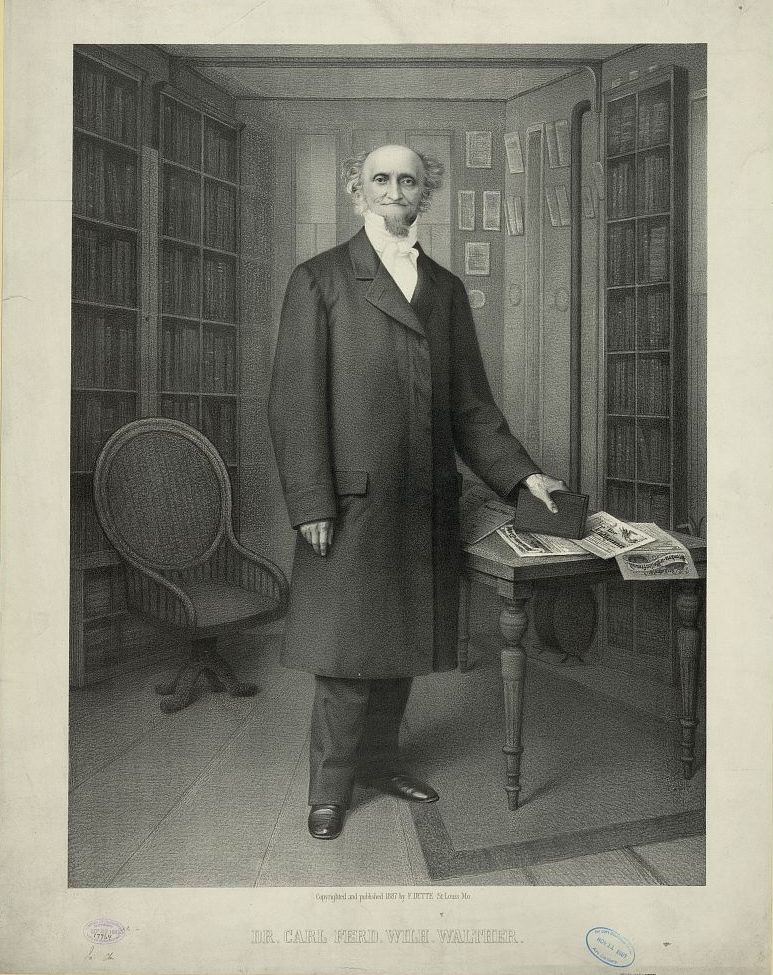
Of the matters submitted to the Hon. Synod for discussion, those drafted by Herr Professor Walther,
Theses
on Communion-Fellowship with Those of Other Faiths,
were, by resolution, taken up, initially at the first session and then at three subsequent ones. These theses, which had been distributed in printed copies among the synod members present, were first read out one after the other in context and then individually explained, discussed, and proven from the attached scriptural passages. In addition, the author also demonstrated from various passages from our symbols and the writings of orthodox fathers the complete agreement of the above theses with the doctrine and practice of the Evangelical-Lutheran Church.
Thesis 1.
The true visible church in an unrestricted sense, or a part of it, is that in which God’s Word is preached purely and the holy Sacraments are administered according to Christ’s institution.
It is important to hear why the doctrine of the true visible church is taken as a basis here. A burning question of this time, and at the same time the bitter accusation of many who have fallen out of the bonds of a crude, unveiled union into a modern, new-faith Lutheranism against us and other faithful Lutherans, is this: Why do we not accept people of other faiths to Holy Communion? — They want nothing to do with the unholy theory according to which, falsely invoking the word of Christ: “Come unto me, all ye that labour and are heavy laden, and I will give you rest” (Matt. 11:28), everyone should be admitted to the Lord’s Supper as well as to the sermon; rather, they call this theory a downright sin and distortion of the Word of God and exclaim indignantly: One should not throw pearls before swine and the sanctuary before dogs. Nevertheless, they want to admit to Holy Communion all those who are not openly unchristian, regardless of their special confession. This unionist error is also held by the leaders of the so-called Church-Council, among others, who erroneously refer to a passage in our symbols.2 We must therefore, they say, admit to Holy Communion all those who prove themselves to be dear Christians. — But this almost unionistic principle is rooted in their erroneous doctrine of the Church. Our opponents do not wholeheartedly believe that there is a true visible church on earth in an unrestricted sense. — It is therefore all the more necessary that we bring this doctrine to our clear awareness in order to justify our doctrine and practice of the Lord’s Supper. If the opinion of the leaders of the “Church-Council” and their spiritual comrades were divine truth, we Lutherans would be committing a grave sin with our ecclesiastical separation from all other Christian fellowships. For if people of other faiths also belong to our Lord’s Supper, they actually also belong to our church, whose bond of unity and sign of confession is precisely the sacrament; we must therefore necessarily unite with them ecclesiastically in all other things as well. But our thesis gives us correct information about the true visible church. It speaks of such a church in an unrestricted sense. One can also speak of a true visible church in a non-unrestricted sense, just as one can speak of a cripple as a true, real human being. However, just as a person who is healthy in all his parts is called a normal person, a person as he should be, so here a true visible church is understood in an unrestricted sense to be such a church as it should actually be according to God’s will and foundation, a normal one. However, it should be noted that we are not talking here about the church in general, but about a visible church. A true visible church in an unrestricted sense is a group of Christians who are always mixed with evil and hypocrites, but with whom the pure, unadulterated Word of God and Sacrament can be found. A true visible church in a restricted sense, on the other hand, is what we call a similarly mixed group in which God’s Word and Sacrament are only essential. Such a church, for example, is the Reformed Church. It is a community that has come together with the intention of practicing God’s Word and Sacrament among themselves. But because it does not have these means of grace pure and unadulterated, one cannot speak of it as a true visible church in the unrestricted sense. However, praise be to God, there is such a church, and that is the Evangelical Lutheran Church. We happily confess this and hold with a firm conscience of faith that our dear church is the church planted by the Lord Christ and his apostles 1800 years ago, because our faith, doctrine, and confession agree in all things in the most exact way with the Scriptures, the words of Christ and the apostles. The Lutheran church is therefore not only a real church, but the true visible church of God on earth, insofar as true means nothing other than: as it should be according to God’s Word. The less we can or want to boast of our pious walk before other churches, the more we can and must boast before others of the pure doctrine which, thanks to God’s undeserved grace, shines on us poor sinners like the clear, bright sunlight. — But the leaders of the “Church-Council” deny this. To them, our church is only the best among many good ones, not the orthodox one next to the false believers, not the true visible church in an unrestricted sense. For these theologians, the difference between our church and other churches is therefore only a gradual one, not a specific one. That is why they only ever speak of “denominations” and thus prove themselves to be a sect whose claim to be the best must appear quite ridiculous. This term denomination or “evangelical denominations” for all Protestant parties, except Unitarians, serves our opponents in the “Church-Council” as a substitute for the expression of vulgar Unionists, that all Christians who are not papists or gross rationalists are to be regarded as orthodox, and that all these orthodox must also maintain ecclesiastical fellowship among themselves. — But this designation is as wrong as this form of expression. For example, one cannot call the Reformed Church an evangelical-reformed church, since it is not reformed by the pure Gospel. The predicate evangelical belongs to our church alone. We appropriately put the word evangelical in front of the name Lutheran because we do not believe in Luther, but in the pure Gospel taught by Luther. We are not Lutherists [Lutheristen]. Our adversaries know this very well and yet our doctrine of the orthodox Lutheran church is basically an abomination to them. They reject it as arrogant, intolerable presumption when we say that we Lutherans alone are in possession of the full truth. One can see that their unionist practice of the Lord’s Supper is also rooted in the miserable theory of open questions. If there are doctrines in the Lutheran Church itself that can be answered with Yes and No by Lutherans, why would one not also want to hold Communion with non-Lutherans who hold this or that special doctrine! — Our theologians of doubt only ever want to seek the truth, but have never found it, and in doing so place themselves alongside those pagan sages who always sought the truth but never found it and therefore called themselves philosophers, i.e., lovers of the truth. — But since Christ and his Gospel appeared on earth, the eternal, complete, saving truth has also been on earth, and for everyone. Anyone who denies this and does not yet have the truth is truly a miserable, pitiful creature and certainly not a Christian. — How clearly, distinctly, and comprehensibly, even for a child, are contained in God’s Word, for example, the doctrines of Baptism, of the Lord’s Supper, of the eternal, universal will of God! — Anyone who only holds his reason captive under the obedience of faith and does not willfully resist can and must be made divinely certain of the truth here and convinced that the counter-doctrine is of the devil. — Would our adversaries dare to accuse those apostolic congregations [Gemeinden] of arrogant self-conceit if they had refused the hand of brotherhood and communion in the sacrament to insidious false spirits, against whose poison of the soul the holy apostles had warned them verbally or by letter, and had declared to them: “We have the truth and you do not, but a doctrine of devils”? — They would not. But they do not want to grant us precisely what they must grant to those apostolic congregations. Why not? Because, as they say, we do not have the apostles as teachers, but only Luther. But O foolish objection, which reveals to us their unbelief in the Word of God! For do we Lutherans not still today have this holy Word of God “pure, well and right by his power, described in Holy Scripture”? Does not St. Paul still speak to us in the Bible in exactly the same way as he preached and wrote to his congregations at that time? Do we not therefore still have the eternal, full, infallible truth today? And would it not be a very false, wretched feeling of shame, stirred up by the devil, to think that it would be arrogant and self-conceited to say: I have the truth, because I stand on the rock of the Word of God, and I reject the contrary doctrine as a lie of Satan! — May God in his grace preserve us from such a sense of shame and all admiration for the spirit of unionism.
Incidentally, the reason why so many shy away from faithful adherence to the Word of God and pure doctrine is that they can easily and rightly conclude from this that faithful adherence to a life that is exactly in accordance with the Scriptures is just as detestable to them as pure doctrine. On the other hand, an orthodox Christian who has correctly recognized the doctrine of original sin has respect for God’s Word in general, as well as only for that piety which agrees with the Word.
We see that the great seductive powers within the Church today are, on the one hand, the Pope, who alone considers himself infallible, and, on the other, the [Prussian] Union, which finds infallible truth nowhere. Against both, we Lutherans hold that there is indeed an infallible truth, but only in the Word of God, and that we certainly possess it as long as we stand on the Word. Or should this be too much of an assertion, and not place us alongside the Roman Antichrist, who claims infallibility in matters of faith, morals and discipline for himself alone? No, never. For there, in Rome, they claim infallibility apart from, without, and even contrary to God’s Word by the devil’s instigation, but here we profess to be infallible, despite all our own personal capacity for error, because and as long as we speak as God speaks in His infallible Word. That is the enormous difference. Our spirit is, praise God, different from that of the Pope, but also from that of the Methodists. For while the latter blaspheme and condemn us because of our doctrine of the only orthodox Lutheran Church, they now claim to be the only true Church of God because they alone live piously. — Therefore, they are affected by what St. Paul writes 2 Tim. 3:1–9 about the glorious, arrogant, pompous, and hypocritical people of the last abominable times, while we are told what is written in the 14th verse: “But continue thou in the things which thou hast learned and hast been assured of, knowing of whom thou hast learned them.”
Listen to what Luther says about the form of the true visible church and the infallible truth of its doctrine: “The Catechism [Kinderglaube] says that there is a holy Christian church, and St. Paul says (1 Cor. 3:17): ‘The temple of God is holy, which temple ye are; but if any man defile the temple of God, him shall God destroy’[3]; therefore the holy church cannot suffer lies or false doctrines, but must teach only that which is holy and true, and that means God’s Word; and if it teaches only one lie, then it is already idolatrous. . . . But here someone who is good-natured (as people say) may reply: What harm would it do if we would adhere to God’s Word but would retain all these things (papistic abuses and errors) or also some others that are tolerable? I reply: Such persons may be called good-natured, but they are wrong-hearted and susceptible to seducement; for, as you hear, the church must not teach anything else than God’s Word, serve anyone else than God, place another light beside the [true] Light (placed by God in the darkness). It is indeed a will-o’-the-wisp and error even though it were only a single untruth, for the church should not and cannot teach any lies or error, not even a single one. If it teaches a single lie, it is already altogether wrong, as Christ declares in Luke 11:35: ‘Take heed therefore that the light which is in thee be not darkness. If thy whole body therefore be full of light,’ having no part dark, ‘the whole shall be full of light.’ That means the whole must be light and no part must be dark. The church must teach only God’s Word and truth, and neither error nor lies. And how could it be otherwise since God’s mouth is that of the church? Again, God cannot lie and therefore neither can the church. . . . The church must teach only God’s Word and must be sure of it, for on this account it is called the pillar and ground of the truth, built upon a rock, holy and without blemish. That means, as it has been rightly and well said: The church cannot err, for God’s Word, which it teaches, cannot err. But what is taught otherwise or in doubt whether it is God’s Word dare not be a doctrine of the church. . . . Duke George, of unblessed memory, once said that he knew well that many abuses have crept into the church, but that it could not be condoned that a single monk of a diminutive burg should venture to reform it. Very well, he admitted (and not only he) that your church is full of abuses; and that means it is not a pure, true church, for that should be holy and pure and without any additions, not to say, without any abuses.” (Wider Hans Wurst. 1541. Walch XVII, pp. 1682 ff. Walther: Die evang.-luth. Kirche etc., pp. 43–45. [The True Visible Church etc., pp. 36–37.])
Of course, these words of Luther are not meant to imply that there are not often poor, weak, erring Christians in the orthodox church as well; but as soon as they are convicted of their error by God’s Word, they abandon it, fall in line with God’s Word and confess the truth. But those in the Lutheran Church who stubbornly cling to their error must eventually be expelled. It is different in the Reformed Church. For this church, in its distinctiveness, stands precisely on error and, for example, in the doctrine of Holy Communion, does not listen to the clear Word of God, but to its foolish rational thoughts. One is therefore infallible and free from error wherever one holds fast to the Word of God. For as certain as the Bible is the Word of God and inspired by the Holy Spirit, as certain as Christ is the Son of God and the mouth of eternal truth, it is also certain that we cannot err if we hold to the letter of Holy Scripture. He who does not believe this has neither strength and victory in the temptations of the devil, nor comfort in the terrors of death, and must miserably perish. His faith is nothing but a ghost. For true faith, as Luther says, dies a thousand times over because it has the truth. It makes us infallible. We do not say that a Lutheran Christian cannot err even in one thing contained in Holy Scripture, but only this we assert, that he has the full truth in all articles of faith, which are so clearly and distinctly revealed to everyone in Scripture, so that he can live and die happily on them. It is also a great deception of the false spirits when they claim that only this or that doctrine of faith, such as that of the deity of Christ, is clearly and distinctly revealed in Holy Scripture, while others, such as certain doctrines of distinction, are not, and that therefore one cannot attain the infallible truth in the latter. To this we say: No. All the doctrines of faith are clearly and unmistakably revealed in Holy Scripture, and in confessing these doctrines our Church is the infallible mouth of God, an assertion which, as we have said, is an annoyance to our adversaries, but a very great comfort to us. — But what we confess in the thesis we prove from the Scriptural passages appended to it. John 8:31, 32: “Then said Jesus to those Jews which believed on him, If ye continue in my speech [Rede], then are ye my true disciples [meine rechten Jünger]; and ye shall know the truth, and the truth shall make you free.” According to the basic text, the first part of this passage actually reads: “If ye continue in my word [Worte] (λόγῳ), then are ye indeed my disciples [in Wahrheit meine Jünger],” and from this we can clearly see that the Lord Christ declares those to be his true disciples, that is, the true church, who hold fast to his word, namely to the simple understanding of it. This is what the Lutheran Church does. Indeed, this also applies to the children of God living in false churches, for although they err here and there, they do so unwittingly. But as soon as they realize their error, they abandon it and remain with the speech or words of Christ. Nor do they cling with their hearts to the error, but only to Christ their Lord. But now the same Lord says of all those who abide in his word: “And ye shall know the truth, and the truth shall make you free.” Whoever therefore does not want to make Christ Himself a liar must confess hereafter that the true visible church of God on earth, that is, the Evangelical-Lutheran Church, and every Christian who abides in the Word, has found and really attained the infallible truth. The following passage
John 10:4, 5 reads: “The sheep follow him: for they know his voice. And a stranger will they not follow, but will flee from him: for they know not the voice of strangers.” — So, what is the Church? The totality of the sheep or disciples of Christ. What is true of these is also true of the Church. A sheep hears its shepherd’s voice and follows him. So does a Lutheran Christian follow his shepherd Christ. He believes His Word, however incredible it may seem to his reason. Furthermore, a sheep does not recognize the voice of a stranger, but rather flees it. This is how a Lutheran Christian condemns false spirits and their heresies, no matter how sweet and acceptable they may sound to his reason.
The passage Rev. 3:7–11 forms part of the epistle to the bishop of the church in Philadelphia. Christ does not say to him through the mouth of John: “Because thou livest so piously,” but rather: “Because thou hast kept the word of my patience, I also will keep thee from the hour of temptation, which shall come upon all the world.” This adherence to pure doctrine was therefore his crown, which he was not to allow to be taken from him. Although it says earlier: “I know thy works,” these works here mean nothing other than faithful adherence to the word of truth, just as the bishop of Laodicea they mean nothing other than his lukewarmness and his apostasy from the good confession. And how the promise given to the church in Philadelphia has been fulfilled to this day is evidenced by the multitude of Christians still living in this city, while the Laodicean church has disappeared and its place has become a heap of ruins. If the above promise is also to be fulfilled for us and our children after us, then it is truly necessary that we also faithfully keep the word in these last times of temptation. Note also that in this epistle Christ does not call those who have fallen away “dear brothers,” who take a different and justified standpoint, but rather those who “lie.”
1 Cor. 1:10 reads: “Now I beseech you, brethren, by the name of our Lord Jesus Christ, that ye all speak the same thing, and that there be no divisions among you; but that ye be perfectly joined together in the same mind and in the same judgment.” Here the divine judgment on the spirit of this time is pronounced and the Holy Spirit breaks the rod over the Union. The Lord says to it, as it were: “You are not my church.” For the unchurched, as is well known, one speech, mind, and opinion is an abomination, which in their opinion brings about the division and fragmentation of the church and which they want to leave to us “Old Lutherans.” But do they not thereby bear witness to themselves that their much-vaunted unity in the Union is nothing but a whitewashed grave and a hypocritical comedy? For how can there in truth be any talk of the unity of the church, where its members are only glued together outwardly (as in the papacy) and where many different beliefs and doctrines are held within it? It is not we, but they, the unchurched, who are accused of splitting up the church, and one might well say that they have as many divisions as there are people. However, the Holy Spirit of God also condemns the leaders of the “Church Council” with the words “the same mind and judgment.” Although they want to have the same speech in the church, demand the acceptance of all confessional writings of the Evangelical Lutheran Church, demand the signatures to them, they do not want to argue and argue about the “same mind” and “same judgment” for long. And yet, in the eyes of the Holy Spirit, this is no less a hypocritical and despicable union maneuver. For how can the speech of the mouth or the writing of the hands bring unity where hearts are torn and divided by various minds and judgments? — The passage
Eph. 4:3–6 defeats the man-made work of union. For here it says: “. . . endeavouring to keep the unity” (not of the body, but) “of the Spirit in the bond of peace.” And what does this consist of? In one body and one Spirit (namely, in one spiritual body implanted in Christ), so that Christians have one Lord, one faith, one baptism, one God and Father. This is the true inner unity that should exist among Christians in the church. And where it exists in this way, diligence should be exercised to maintain it through love, and care should be taken that envy and pride among Christians do not destroy them. Thus we see how this passage, which the unionists so often and gladly cite as their motto and favorite saying, contains precisely their destructive judgment.
Thesis 2.
A fellowship in which God’s Word is fundamentally falsified or at least allowed to be fundamentally falsified is not a true, orthodox church, but a false, heterodox church or sect.
This is very clear from the passage:
John 10:26, 27: “But ye believe not, because ye are not of my sheep, as I said unto you. My sheep hear my voice, and I know them, and they follow me.” Just as therefore according to this (cf. also the passage chap. 10:4, 5 above) only those are Christ’s sheep or true church who hear His voice, i.e., His Word, and follow Him, so also those who do not hear His voice, i.e., do not believe the Word, are not His sheep, but a false church. Furthermore it says:
Chap. 14:23, 24: “If a man love me, he will keep my words: and my Father will love him, and we will come unto him, and make our abode with him. He that loveth me not keepeth not my sayings.” In these words, too, the Lord Christ clearly indicates the characteristics of the true and false church. Those who keep Christ’s word are the true church, in which God Himself makes His home. It is God’s house and true temple. The Lord of heaven and earth dwells in it, not only according to His nature, but also according to His presence of grace. This is the hallmark of the true church. The false church, on the other hand, can be recognized by the fact that it basically does not keep God’s Word, but falsifies it. That is why God cannot dwell in it. It is a sect with which we do not want to have fellowship. — It is true that even within the Evangelical-Lutheran Church this or that person strays from the Word of God, but because this happens out of weakness and ignorance, it does not make our church a sect. But whoever fundamentally and persistently departs from the Word of God belongs to the false church.
But it is also very important that the thesis states that even where God’s Word is allowed to be fundamentally falsified, there is a false church. This is the case, for example, in the [Prussian] Union. For we do not deny that there may still be some in it who generally teach God’s Word purely. This fact alone does not make it, the United Church, either pure or a true visible church of God. On the contrary, we must confess that it is worse off than any other Protestant sect. For in these churches the situation is such that the true Christians therein, in their ignorance, think and are convinced in their hearts that their error is truth. One can therefore fight with them honestly and sincerely, just as we Lutherans do with honest Reformed Christians, on the doctrine of the Lord’s Supper, baptism, the Person of Christ, and so on. But in the United Church one may falsify the Word of God with impunity. Here the lie is as justified as the truth, and error is permitted in an ungodly way. Pure doctrine is declared to be a matter of indifference and a life characterized by works is considered the main thing. Truly, this wretched principle of union must be condemned even by the pagan Cicero. For when he mentioned in a speech the various doctrines of some philosophers, he added: “Which of these opinions is the right one, I do not know; but one thing I do know, namely, that only one of them can be the right one.” But the Union is also struck by Christ’s terrible judgment of the bishop of Laodicea: “Oh, that thou wert cold or hot! So then because thou art lukewarm, and neither cold nor hot, I will spue thee out of my mouth.” (Rev. 3:15, 16.) Just as a man who is eager for a refreshing drink of water is so disgusted when lukewarm water enters his mouth, that he immediately spits it out, so the holy God is so disgusted by those who regard His revealed Word as an indifferent thing and equate error with truth, that He rejects them from His presence. — The theory of different directions leading to one goal, invented and held by unbelievers and unionistic, false Lutherans, is also nonsensical. For just as it is not possible for a number of travelers to all reach the same city if they take paths in different directions, so also is it impossible to reach one and the same destination in the spiritual realm by following different directions. Where there are different directions, a very different goal is always reached. — The orthodox Lutheran church certainly knows how to carry those in its midst who have gone astray out of weakness in order to bring them to repentance through punishment and instruction from God’s Word. However, if this does not succeed and those who are stubbornly in error reveal themselves, our church no longer recognizes them as brothers, but separates itself from them. The orthodox church can therefore never tolerate or justify error or false doctrine; it can never enter into union with falsehood. If, for example, a pastor wanted to present false doctrine and his listeners tolerated it, did not protest or punish him, or did not renounce him, we would have to consider them erroneous and possibly even heretical. For one rightly judges a parishioner by his preacher, just as one judges a church by its confession. Therefore, even if we readily admit that there are some honest souls in, for example, the Reformed Church whom we must consider to be dear Christians and brothers if we know them well, we can never unite with them in church. The United Church, on the other hand, is the church in which false doctrines, or at least false teachers, are tolerated and regarded as brethren. It is true that the United churches object, that they also follow God’s Word, that they accept the confessions of both churches, Lutheran and Reformed, where they agree, and where this is not the case, they decide according to the principle of evangelical doctrinal freedom from God’s Word. But even this is nothing but a hypocritical evasion and deliberate godlessness, since the Unionists do not confess a third correct doctrine above the divergent doctrines in question, but rather those among them who are Lutheran hold and declare the Lutheran doctrine to be the correct one, and those who are Reformed hold and declare the Reformed doctrine to be the correct one. Let us also listen to the fathers. First
Luther. He writes: “The holy church fails and stumbles and even errs, as this is taught by the Lord’s Prayer; but it neither defends nor justifies its error, but humbly begs for pardon and corrects its lapse. Therefore it is forgiven so that its failing is no longer accounted as a sin. If I am not to recognize by its obedience or its hardened disobedience, nor distinguish the true church from the false, I can no longer speak of any church. Then we may honor and regard as the holy church all heretics as also all factions and sects, for they are no worse than is the church of the pope, if indeed malicious disobedience toward God is not deleterious. But the papistic church is no better, because it maliciously disobeys God in the same way and perverts His Word; in addition, it justifies itself as being right as no other sects and heretics.” (Brief wegen seines Buchs von der Winkelmesse [Letter concerning My Book on the Private Mass]. 1534. Walch XIX, p. 1579. Walther: Die evang.-luth. Kirche etc., pp. 27 and 28 [The True Visible Church etc., pp. 22–23].)
Furthermore W. Baier: “The unity of the church is opposed also by syncretism or the fusion into brotherly and ecclesiastical concord of parties disagreeing in religion, despite the disagreement, so that there are tolerated either the doctrinal errors in the dissenting part or at least the erring persons themselves within the ecclesiastical communion as brethren in Christ or coheirs of eternal life, which toleration is wrong, even if the latter are regarded as weak and erring, but nevertheless as brethren who participate in the same divine service. Here indeed it is certain that the unlearned who through invincible ignorance are so given to certain errors that nevertheless by God’s grace they retain the saving faith, might be suffered as weak brethren were they known to us. But in this connection we speak of the dissenting part in view of the public ministry and the doctrine of faith and life, as it is publicly preached, as also in view of the sacraments as they are administered, namely, corruptly, so that therefore the members of such a visible communion are regarded per se, inasmuch as they are members of it, and not in view of that which belongs to them per accidens [accidentally]. — Such toleration of errors, first, is in opposition to the Scripture passages which command us to preserve the whole Christian doctrine free from error (2 Thess. 2:15), to keep the good thing committed unto us (2 Tim. 1:14), that is, to keep it intact, uncurtailed and unadulterated, and to continue in the things which we have learned (2 Tim. 3:14). But the doctrine will not be kept pure if opposing errors are tolerated at the same time and in an equal manner or are permitted to become mingled with it. Secondly, such toleration is in opposition to the duty of reproving imposed upon faithful teachers by God, through which [errors] are rebuked and condemned (cf. Titus 1:9, 13; 2 Tim. 4:2; 3:16), to which correspond the examples of Christ (Matt. 5:12 ff.; 16:6) and of Paul (Gal. 1:6). Thirdly, such toleration is very dangerous, for those errors and corruptions, unless they are restrained, assailed, and condemned, will spread ever more widely; the truth of the doctrine is rendered doubtful and suspicious, or at least it is regarded as a matter of indifference; and finally those that err are confirmed, and the deceivers are given a chance to infect ever more [people]. But the toleration of erring persons, since it pertains not merely to the unlearned, but to the entire communion, and therefore at the same time to the very public ministry and the heretical teachers, is in opposition to the commands to convince, rebuke, and avoid false teachers and propagators of errors (Rom. 16:17; 2 Cor. 6:14, 17; Gal. 1:8; 5:12; 2 Thess. 3:6; 1 Tim. 6:3; Titus 3:10).” (Comp. theol. posit. [part] III, [chap.] 13, 37 [pp. 665, 671]. Walther: Die evang.-luth. Kirche etc., pp. 34–35 [The True Visible Church etc., pp. 28–29].)
Thesis 3.
Every person is obligated to confess the true visible church and, if he has the opportunity, to adhere to it.
This thesis is therefore also important for our purpose. Whoever is convinced that there can, should, and does exist a true visible church, as stated above, must also admit that every person has the duty to join it. But the opinion that one has the freedom to join this or that church flows from unbelief that there really can be such a true visible church of God. But what does David say in
Ps. 26:6–8: “I will wash mine hands in innocency: so will I compass thine altar, O Lord: that I may publish with the voice of thanksgiving, and tell of all thy wondrous works. Lord, I have loved the habitation of thy house, and the place where thine honour dwelleth.” So the prophet is referring here to the true Church. In this alone dwells the glory of God, because 1. here only is His Word valid and because 2. here only is it taught that we are justified by grace alone through faith in the Gospel, which is heard here in preaching, absolution, baptism, and the Lord’s Supper. In the false church of the works-righteous, on the other hand, God is deprived of his glory. It would be just as absurd as godless to say: I have contributed something to my physical life, to my creation, through my own works or merits. But it is even more frightening and ungodly to say: I have contributed something, even if only the slightest, to the attainment of spiritual and eternal life. Anyone who thinks this way is a robber of God’s honor and is cursed. And yet this happens in the false church. Here people do not thank and praise God, but themselves. But the true Church is the church of thanksgiving, and in it all the miracles of the Lord are preached. That is why David loves this church so much and sticks to it. The passage
Matt. 10:32–33: “Whosoever therefore shall confess me before men, him will I confess also before my Father which is in heaven. But whosoever shall deny me before men, him will I also deny before my Father which is in heaven” — is likewise a main passage to prove that one should adhere to the right, i.e., the true visible church; not because, as the papists erroneously claim, it is only through this that one is in the Church at all, a Christian and saved, but because it is a duty to confess. And this is necessary, not for the sake of God, but for the sake of ourselves and our fellow redeemed. For it is God’s will that all men should be saved through the Gospel. Christians, however, are to preach it to and confess it before the world, not as though they all had a duty or a necessity to be public servants of the Church, but in such a way that they adhere to the true visible church, hear the pure Gospel in it, with it confess and defend the same against opposition. In this way the Church is a wholesome leaven in the world.
In Luke 9:26 the Lord Christ says: “For whosoever shall be ashamed of me and of my words, of him shall the Son of man be ashamed, when he shall come in his own glory, and in his Father’s, and of the holy angels.” All those who do not profess the church of the pure Word, or who adhere to a false doctrine, such as the Reformed, are ashamed of the words of Christ. An excellent example of faithful confession and adherence to the true visible church, on the other hand, is given to us by the first Christians in Jerusalem, of whom
Acts 2:41 and 42 testifies that they continued steadfastly not only in the apostles’ doctrine, but also in the fellowship, i.e., they professed the orthodox church, even though doing so was associated with great danger to life and limb. They realized that it was not enough to believe the pure truth for themselves, but that they were also obligated to confess this truth publicly. — Therefore, if Nicodemus had remained as he once was when he came to Jesus by night, in woeful shyness of confession, he would not have been a Christian and would not have been saved — which is why, precisely with this visit in mind, the Lord Christ said to him: “Verily, verily, I say unto thee, Except a man be born again, he cannot see the kingdom of God.” (John 3:3.) The passage
Heb. 10:24, 25 reads: “And let us consider one another to provoke unto love and to good works: not forsaking the assembling of ourselves together, as the manner of some is; but exhorting one another: and so much the more, as ye see the day approaching.” The “forsaking” here does not refer to staying away from a church meeting or a public worship service, but rather to keeping away from the fellowship of the orthodox church in general, although it is certain that anyone who misses the worship service and the church meeting is also already leaving the Church.
In Matt. 18:17 the Lord says: “And if he shall neglect to hear them [the witnesses], tell it unto the church: but if he neglect to hear the church, let him be unto thee as an heathen man and a publican.” Note this word against the enthusiasts who pretend that Christ has thrown the truth into the world, as it were, and that anyone who wants to accept it can do so. But that is wrong. Christ has established a kingdom through which to save the world, and, according to His word and will, there really should be a visible church whose voice one is to hear and to which one should profess allegiance.
1 John 2:19 says: “They went out from us, but they were not of us; for if they had been of us, they would no doubt have continued with us: but they went out, that they might be made manifest that they were not all of us.” This passage should be held up to those of other faiths who come to us and speak commendably of us and our confession, but who wish to remain quietly with their faith and in their church, because, as they think, they could also be saved without joining us. Tell such people: If you really held with us, you would also come to us. Either your praise is just hypocrisy or you are acting against your conscience. In the place
2 Tim. 1:8 the apostle writes to Timothy: “Be not thou therefore ashamed of the testimony of our Lord, nor of me his prisoner.” This passage provides the proof that and reason why we should also call ourselves “Lutheran.” Paul calls on Timothy to confess not only the word of Jesus, but also him, Paul. Whoever confesses Jesus should also confess those who preach Jesus correctly. Some who consider our Lutheran confession to be right deny it before our enemies by denying the Lutheran name. Even if we can take comfort in such denials, these people are hypocrites to whom Christ will one day say: You have betrayed Me! for you have betrayed my faithful witnesses. Or have you never read: “Inasmuch as ye have done it unto one of my brethren and servants, ye have done it unto me”? Of course, we are only talking here about those who consciously deny the true church. For it may well be possible for someone to leave the evangelical-Lutheran church outwardly and yet still remain a true Christian. For example, an awakened Christian lacking in knowledge may come here from Germany to a Lutheran congregation, but, enchanted by the sham spirituality of the Methodists, he may think that true, living Christianity can only be found in that community, and may then join them without having lost his Christianity. — But we see from all this that it is not enough to believe the pure doctrine, but that one must also publicly confess one’s allegiance to the orthodox believers. Also writing about this very well is
Luther: “I see that it is very necessary to admonish those whom Satan is now beginning to persecute. Among them there are some who think that they, when attacked, might escape danger by if they say: ‘I do not adhere to Luther nor to anyone else but cleave to the holy Gospel and the holy or Roman church; for then we shall remain unmolested.’ And yet they retain my doctrine in their heart as evangelical and hold to it. Truly, such a subterfuge will not help them, and it means as much as denying Christ. Therefore, I beseech them earnestly to beware. It is true that you by no means should say: ‘I am a Lutheran or a papist,’ for none died for you nor is your Master than Christ alone, and you should regard yourself as a Christian. But if you believe that Luther’s doctrine is evangelical and the pope’s unevangelical, you must not cast Luther aside; otherwise you will cast aside his doctrine, which you regard as that of Christ. So you must say: ‘Luther may be a scoundrel or a saint, for that I do not care; yet the doctrine is not his but that of Christ Himself.’ For you see that the tyrants have in mind not [merely] to kill Luther but to destroy his doctrine. It is on account of his doctrine that they attack you and ask you whether you are a Lutheran. Here surely you must not reply evasively, but you must frankly confess Christ, whether He be preached by Luther, Claus, or George. The person you may ignore, but the doctrine you must confess. For thus St. Paul writes to Timothy 2 Tim. 1:8: “Be not thou ashamed of the testimony of our Lord, nor of me, who am bound for his sake.[4]” If it would have sufficed for Timothy [merely] to confess the Gospel, Paul would not have commanded him not to be ashamed of himself, yet not of the person of Paul, but of Paul as a prisoner on account of the Gospel. If then Timothy would have said: ‘I hold neither to Paul nor to Peter but to Christ,’ though he knew that Peter and Paul taught Christ, he thereby would have denied Christ Himself. For Christ says Matt. 10 of those who preach Him: ‘He that receiveth you receiveth me; he that despiseth you despiseth me.’[5] Why is that? Because in thus treating His messengers (who bring His Word), it is as if they treated Christ Himself and His Word in the same way.” (Meinung von beider Gestalt des Sacraments zu nehmen [Opinion on Receiving the Sacrament in Both Kinds]. 1522. Walch XX, 136. 137. Walther. Kirche und Amt. 1852. Pp. 164–65. [Church and Ministry, pp. 139–40.])
Thesis 4.
Every man is obligated to avoid heterodox churches and, if he belongs to one, to renounce it and leave it.
We learn this from:
Ps. 26:4, 5: “I have not sat with vain persons, neither will I go in with dissemblers. I have hated the congregation of evil doers; and will not sit with the wicked.” — The vain persons from whom David keeps his distance are precisely the false spirits who stand on their own vain wisdom and righteousness and not on the Word of God. Further it is said:
Psalm 94:20: “Thou wilt never be one with the throne of iniquity, which frameth mischief by a law.” — Throne [Stuhl] here means “teaching-chair” [Lehrstuhl] or “pulpit.” With those who misinterpret, i.e., falsify the law, i.e., God’s word in general, God will never agree, but is their Enemy. But if He is their Enemy, how could we maintain friendship and unity with them? Therefore, not only with those who, as unbelievers, do not want to know anything at all about God’s Word, but also with those who misinterpret this Word or turn it into false teaching, we should and must disagree. We are commanded the very same also in
Jer. 15:19: “If thou holdest to me, then will I hold to thee, and thou shalt remain my preacher: and if thou teachest the righteous to separate themselves from the wicked, thou shalt be my teacher: and before thou shouldest hold to them, they must first return unto thee.” Here, in fact, we are also commanded to separate from the ungodly. People object: Are all members of a false church ungodly? But to this we reply: Certainly not all; there are also Christians among them, but the ungodly — namely the false teachers and stiff-necked defenders of error — are precisely to blame for the fact that such a heterodox fellowship exists and remains, and that is why we must renounce it and keep away from it. From the passage
Rom. 16:17: “Now I beseech you, brethren, mark them which cause divisions and offences contrary to the doctrine which ye have learned; and avoid them” — we see, however, that it is not we who, when we separate ourselves and keep away false believers, disrupt the unity of the Church and cause it to splinter, as we are falsely accused of doing, but rather them which cause divisions and offenses contrary to the pure, wholesome doctrine of the Word of God.
In 1 Cor. 11:19 St. Paul says: “For there must be also heresies [Rotten] among you, that they which are approved may be made manifest among you.” — Heresy, according to the original text (αἵρεσις), means a fellowship of people who hold an erroneous doctrine against one or more articles of faith, that is, a sect. But the one who separates himself from such sects is revealed to be an orthodox Christian. Christians who unknowingly remain among them may well remain Christians through God’s wonderfully gracious preservation, but they are not revealed to us as such.
1 Cor. 10:18 says, among other things: “Are not they which eat of the sacrifices partakers of the altar?” From this we learn what is necessary for our separation from the false church: namely, that we abstain from all worship fellowship with it.[6] For just as those Corinthians who ate of the pagan sacrifice to idols entered into fellowship with the pagans, so even now a Christian enters into fellowship with the false church through participation in false worship.
Matt. 7:15 is the well-known but unfortunately little-heeded warning of Christ: “Beware of false prophets, which come to you in sheep’s clothing, but inwardly they are ravening wolves.” Some who listen to false teachers say: “We pick out the best of what they preach,” but we ask: “Is that what it means to beware of them, or is that running right into the gaping maw of the wolf?” Christ says: Do not listen to them! And truly, if they were not heard, they would have to stop preaching. After all, most of them are also belly-servers who preach only for the sake of good money. Luther could say that all he needed to overthrow the papacy was a great sack of money. — The chief proof texts for our thesis are also:
1 Tim. 6:3–5: “If any man teach otherwise, and consent not to wholesome words, even the words of our Lord Jesus Christ, and to the doctrine which is according to godliness; he is proud [verdüstert], knowing nothing, but doting about questions and strifes of words, whereof cometh envy, strife, railings, evil surmisings, perverse disputings of men of corrupt minds, and destitute of the truth, supposing that gain is godliness: from such withdraw thyself.”
Titus 3:10: “A man that is an heretick after the first and second admonition reject.” — A heretical person is precisely such a one who stubbornly errs in an article of faith.
Acts 20:30 and 31: “Also of your own selves shall men arise, speaking perverse things, to draw away disciples after them. Therefore watch, and remember, that by the space of three years I ceased not to warn every one night and day with tears.” — The Unionists also want to reject manifest unbelievers, but not the heterodox. This idea, however, is contradicted by this passage, in which we are warned against fellowship with those who hold perverse or false teachings.
2 John 10, 11: “If there come any unto you, and bring not this doctrine, receive him not into your house, neither bid him God speed: for he that biddeth him God speed is partaker of his evil deeds.” This is a chief proof text. People like to call John the disciple of love, but if he were to preach this passage to the world today, they would stone him to death. But he speaks divine truth. He also says beforehand: “Whosoever transgresseth, and abideth not in the doctrine of Christ, hath not God.” That is why one also should not bid such people God speed, i.e., not as though he should avoid civil courtesy towards them and the most necessary interaction with them, but rather that he should avoid all such contact with false believers from which they could infer our sympathy with them, for that would mean denying Christ. Marriages with those of other faiths are therefore dangerous, especially if the man is the heterodox party. What a heavy cross the orthodox party then has to bear, and how many thereby often succumb and lose their faith and good conscience completely! Even overly close business connections with false believers are not advisable. The apostle even says of such a person: “Receive him not into your house,” i.e., such people, except in the case of their being in dire need, should not be entertained in a friendly manner, nor given any support whatsoever for their ecclesiastical purposes.
Finally, 2 Cor. 6:14 reads: “Be ye not unequally yoked together with unbelievers: for what fellowship hath righteousness with unrighteousness? and what communion hath light with darkness?” Many people think that this passage does not apply to the heterodox, since it is talking only about unbelievers. But they are mistaken. The Union is based on nothing but unbelief, in that it accepts, authorizes, or even tolerates the heterodox and those who publicly teach against God’s Word. It is therefore actually the unbelievers who build the Union temple. Whoever joins the Union also joins the wicked and unbelievers who are in it as a matter of principle. An orthodox Christian should and must therefore seriously flee such communities and prefer never to receive communion or rather die than enjoy a Zwinglian communion. We are well aware that the false believers accuse us of taking great pleasure in disputes and quarrels over pure doctrine and in disunity in the Church. Oh, they do not suspect that it is a heavy cross for us. Yet God’s Word binds us. The Savior says: “He that loveth father or mother more than me is not worthy of me: and he that loveth son or daughter more than me is not worthy of me” (Matt. 10:37); yes, He says: “If any man come to me, and hate not his father, and mother, and wife, and children, and brethren, and sisters, yea, and his own life also, he cannot be my disciple.” (Luke 14:26.) In these latter words the Lord means to say: Whoever is not resolved to do, does not actually do, something out of love for Me which might perhaps be regarded by his own parents or other relatives as an act of hatred, cannot be a true Christian. Thus a faithful Lutheran may have a father who is tender, but blinded by heterodoxy, and who approaches him with many moving words and pleas, yes, with tears and entreaties, that his son might not belong to the Lutherans, that (in his father’s eyes) stiff-necked, harmful sect, that he might not, by accepting or defending the Lutheran name and confession, cover his father’s gray head with shame and bring him down with sorrow to the grave. And yet, in this case, such a Lutheran Christian must not yield or give way; he must not look to his father’s sorrow and sighing, but only to the Word of his God. But how will the blind world judge this obedience to Scripture? It will condemn his act as the most shameful hatred and malice against his physical father. — To endure this is no small thing, but it is necessary.
The Smalcald Articles in the Appendix [Of the Power and Primacy of the Pope] say: “This being the case, all Christians should beware most diligently that they do not make themselves partakers of such godless doctrine, blasphemy, and unjust tyranny, but they should flee from and curse the pope and all his members or adherents as the kingdom of Antichrist, as Christ has commanded: ‘Beware of false prophets.’ And Paul commands that we should avoid false teachers and execrate them as an abomination. And 2 Cor. 6 he says: ‘Be ye not unequally yoked together with unbelievers: for what communion hath light with darkness?’ etc. It is indeed difficult for us to separate ourselves from so many lands and people and teach a different doctrine. But here is God’s command that everyone should take care and not consent to those who teach false doctrine or intend to uphold it by tyranny.” (Müller S[ymbolischen] B[ücher] 336–37. [Par. 41, 42; Church and Ministry, p. 116.]) and
Luther: “Because so many and great warnings and admonitions of God have been addressed to them (the sacramentarians), . . . I must let them go and avoid them as the αὐτοκατακρίτος [autokatakritos] Titus 3:11, who knowingly and maliciously want to be condemned. Nor will I have fellowship with any of them, nether by letters, writings, words, nor deeds, as the Lord commands Matt. 18:17, whether he be Stenkefeld [Schwenkfeld], Zwingli, or whoever he may be. I regard them all as one ilk [Kuchen], for they refuse to believe that the Lord’s bread in the Holy Supper is His true or real body, which the wicked and Judas receive orally as well as St. Peter and all [other] saints. Whoever refuses to believe this (I declare), let him not molest me with letters, writings, or words. Let him not expect me to have fellowship with him, since that will never happen.” (Kurzes Bekenntniß vom heil. Sacrament wider die Schwärmer [“Brief Confession of the Holy Sacrament against the Enthusiasts”]. 1544. Walch XX, 2211. 12. [Church and Ministry, p. 126.])
- [Fünfzehnter Synodal-Bericht des Westlichen Districts der deutschen evang.-luth. Synode von Missouri, Ohio u. a. Staaten. Anno Domini 1870 (Fifteenth Synodical Report of the Western District of the German Ev.-Luth. Synod etc.) (St. Louis, Mo.: Druckerei der Synode von Missouri etc., 1870), 21–73.] ↩︎
- For it says in the Preface to the Book of Concord: “For we have no doubt whatever that even in those churches which have hitherto not agreed with us in all things many godly and by no means wicked men are found who follow their own simplicity, and do not understand aright the matter itself, but in no way approve the blasphemies which are cast forth against the Holy Supper as it is administered in our churches, according to Christ’s institution, and, with the unanimous approval of all good men, is taught in accordance with the words of the testament itself.” [Par. 20; Triglot, p. 19.] ↩︎
- [Luther’s rendering] ↩︎
- [Luther’s rendering] ↩︎
- [Luther combines Matt. 10 and Luke 10.] ↩︎
- [Note that Walther does not limit this discussion to communion-fellowship: “aller gottesdienstlichen Gemeinschaft.”] ↩︎

