
This was, more or less, the question put to me by a new Lutheran brother I had the pleasure of speaking with over the phone yesterday.
He wanted to say, by way of qualification, that while he is basically convinced of Lutheran doctrine, and while it has solved a few acute theological questions that have gnawed at him for years . . . well, he hasn’t read absolutely all of the Book of Concord.
“I’ve read the Small Catechism and the [Augsburg] Confession” he said, and mentioned that he had read around in some other places.
What I said to him, I say to you:
If you haven’t read all of the Book of Concord, that’s fine. If you’ve read and understood the Small Catechism and the Augsburg Confession, there aren’t going to be any surprises in the rest of the book. There’s not going to be anything new. Yes, there will be a further unfolding of the articles of doctrine — a fuller exposition of them in light of different controversies — but nothing materially different from the Small Catechism and the Augsburg Confession. Chip away at the rest slowly.
“Is there anything else I should be reading?” he asked.
Maybe you have the same question. If so, here is what I told him:
Pick up a Lutheran dogmatics text.
Lutheran standard theological texts are called “Dogmatics.” In the Reformed world it is perhaps more customary, at least in recent years, to speak of “Systematics.” There are differences between these approaches to theology, and there are reasons why it is accurate to say that “Lutheran theology is properly dogmatic,” but today I’m just going to say it without giving the reasons.
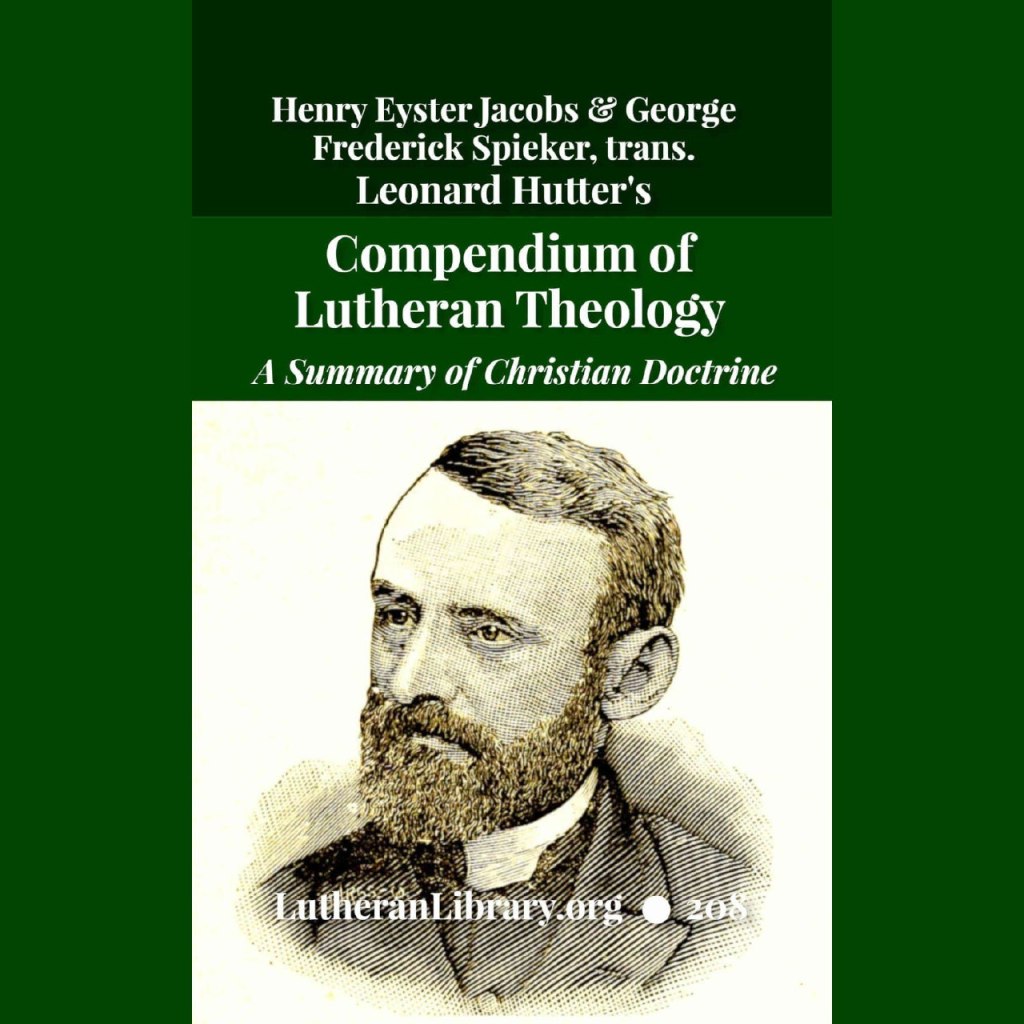
The oldest and most venerable Lutheran dogmatics text is The Compendium of Lutheran Theology by Leonard Hutter. For short it is known as “Hutter’s Compend.” Buy it here or access a pdf for free.
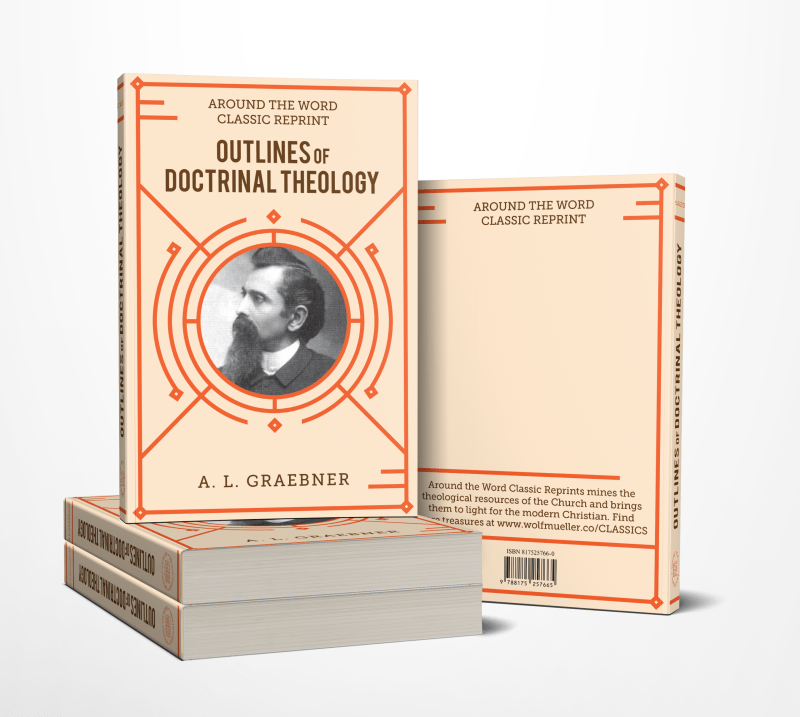
Not the oldest, because only one can be the oldest, and I just told you what it is, but arguably the best starter dogmatics in terms of compactness and masterful simplicity is Augustus Graebner’s Outlines of Doctrinal Theology. Buy it here or access a pdf for free. If you have Amazon Prime, this might be the cheapest option.
Standard Disclaimer
I have no affiliation with Lutheran Librarian or Brian Wolfmueller.
Lutheran Librarian, whoever he is, reprints all sorts of old Lutheran theological books fairly indiscriminately. That is not a criticism; it’s just a fact. Some of the books are great; others, not so much. The only print edition I have from him is Bente’s Historical Introductions to the Book of Concord, which, incidentally, is another book you should read, so here’s a featured tweet about it:
And then there’s Brian Wolfmueller. Wolfmueller sees no problem with communing a self-identified Marxist at his church, and his views on race are a pig’s breakfast. In this he is hardly unique — quite the opposite: he typifies Current Year conservative Lutheranism. I’m only directing you to his site because, as far as I know, no one else has put Graebner’s Outlines back into print. Gather your rosebuds as ye may.
There is such a thing as being overly scrupulous when it comes to sourcing books. I’ll just say right now . . . sometimes you need to hold your nose and just buy what’s available and cheap. You guys want every single one of your books to be some artisanal codex printed via steam-powered linotype on ethically-sourced papyri and hand-stitched with small-batch catgut by a tradwife by the light of a spermaceti lamp. And then you don’t even read them.

With that said, Concordia Publishing House’s prices are obscene, and I fully support avoiding doing business with them. The obscene prices make this an easier prospect. The “Not Quite Perfect” sale and the fall and spring warehouse sales can be great times to buy, but otherwise it’s highway robbery.
Look at this paperback of Valerius Herberger’s Genesis volume, mentioned in the recent podcast relaunch. $50 for a 420-page paperback?
And CPH couldn’t be bothered to continue with the project. Do they have better things to do?

Really, though this was also a blessing, as a smaller independent publisher, Emmanuel Press, was able to take up the mantle and has now published Exodus (594 pages, $39.00) and Leviticus (220 pages, $28.00), with Numbers (352 pages, $35.00) available for pre-order.
. . . those are still kind of expensive. But Emmanuel Press is small, and they don’t have as much of a margin.
This was supposed to be a shorter post.
Pick up Hutter or Graebner. You won’t regret it.
PS. The eReader hack
Just going to copypasta the note I wrote to our church men’s group on this topic:
Brothers:
I’d like to make a recommendation: obtain some kind of device for reading PDFs. As I was discussing with [NAME] on Sunday, I use a Kindle Scribe for this purpose. The reMarkable e-Reader is another device that guys recommend.
The key desired features of such a device are (1) a screen approaching the size of standard paper; (2) easy on the eyes, i.e., not a computer/phone screen — the devices mentioned above use display tech that makes the screen very paperlike; (3) dedicated to reading, i.e., you can’t really do anything else with it.
Having physical copies of all of the best books is optimal, without a doubt. Nothing can replace that. Someday, we’re going to have a legitimate church library. You all have home libraries. That said, it is not feasible for us to obtain absolutely everything that we’d like to read in book form. Sometimes it’s theoretically feasible, but it isn’t practical.
The newer Kindle Scribe models are pretty slick, as the tech has improved even in just a few years (as it always does). That said, the 1st generation refurbs are just fine (example). The two that I have are both 1st gen: one I bought during a Prime Day sale, and the other I bought refurbished on eBay.
Looking ahead, the ability for me to just send a PDF to everyone ahead of a Sunday doctrine class would be very helpful.
And it’s already happened with some of you that you ask for a book recommendation. I have an absolutely fire recommendation, but I either don’t have it or I’ve lost or can’t find my copy. You look it up on BookFinder, and . . . there’s one copy on ThriftBooks UK for £461.67.
But, hey, I have the book in PDF.
But who wants to read a PDF on the computer?
If you have strong objections to this pitch, no worries. Not trying to turn anyone in here into a cyborg. I myself am a Luddite at heart, but this is one of the hacks I have used in recent years that has actually had great utility and ROI. I find that reading PDFs — not so much eBooks, but actual facsimile pages — is a pretty close approximation to the information transfer that a book provides. Something about the framing of text within the fixed fields of discrete pages helps my brain retain things. Obviously it doesn’t have the tactile and aesthetic advantages of a book — you can’t physically leaf through a PDF, and there’s no “old book smell” — but, again, it’s a hack and a tool, not a replacement.
TL;DR – You can’t optimize in every category. Buy once/cry once on a refurbished Kindle Scribe. It’s useful.
“What about audiobooks?”
We’re working on it, anon. We’re working on it.
+SDG+
Thank you for reading. The Boniface Group is the mission society of Holy Trinity Ev.-Lutheran Church of Gem County. If you would like to support our work, you may do so here. (Crypto options coming soon.) To learn more, visit our homepage and start reading from the top. Thank you, and God bless you.
✠
 The Boniface Group