
On Monday, March 23, we made the following announcement over on X:
Today I’m going to describe what these resources will be and tell you where you can find them every week. Before I do all that, I’m going to set the frame a bit with some comments on the general situation faced by right-wing Christian men.
This is a somewhat lengthy post. You’ll need about fifteen minutes.
God bless.

There has been a significant uptick in interest in churchgoing among right-wing men in recent years.
Correlated with this, and over the same rough span of years, my circle of friends and acquaintances has become a de facto “church finder” network. It is rare for a week to pass in which I do not receive direct or indirect requests for assistance in this regard. Conversation with mutuals confirms that my experience is not unique — far from it.
This is a wonderful thing. God be praised for it.
I’m not going to waste my time and yours by giving a definition of the term “right-wing” or a history of politics since the war or a history of Christianity in America since the same war. I’m simply going to build a basic profile of the sort of man who asks someone like me to find him a church.
Such a man . . .
- generally speaking, is White.
- understands that liberalism is not merely a set of viewpoints roughly corresponding to a preference for the Democratic Party in electoral politics, but is much more like adherence to a New Global Religion.
- is fed up with the creeping liberalism of his local congregation, which matches the creeping (or lurching) liberalism of the “church body” that his congregation is part of/associated with
– or – - hasn’t been to church in a long time; has recently become convicted about this; wants to start going again, but a cursory search and a few reluctant visits have revealed that the liberalism described in (2) is deeply embedded pretty much everywhere
– or – - has never been to church (but, being an American male in the Current Year, knows what church tradition his family hails from) but wants to start going, but . . . a cursory search and a few reluctant visits have revealed that the liberalism described in (2) is deeply embedded pretty much everywhere.
- has done enough research (maybe listened to some podcasts, maybe read some things) to know that he is at least somewhat interested in Lutheranism.
Last but not least:
- thinks cracking a few beers with John Chrysostom, Vlad Țepeș, and Martin Luther sounds like a great time.
But we have a problem:
The Problem
Any organization not explicitly right-wing sooner or later becomes left-wing.1 Most congregations and church bodies are not explicitly right-wing. They have not been for a great while. Ergo, they have become left-wing.
The grim reality is that they are almost universally controlled by cabals of men whose contempt for the beliefs of their nominal fathers in the faith (except within the very narrow bounds of confessional theology) is quite open.
These men are in fact explicitly not right-wing, and they want to make sure everyone knows this. “We need to admit that Luther said a lot of awful things.” “Dabney was a product of his time.” “Their theology was gold, but the rest of their beliefs were terrible.”
By and large, the men in the pews are familiar with this state of affairs. It is the one they know best; more likely it is the only one they know.
The number of men alive today who remember anything substantially different is small and rapidly dwindling: they are senior citizens. Of these, the majority greatly prefer how things are to how things were. Indeed, many of them helped destroy the old ways — and they are quite proud of it.
For example: most men in the Lutheran Church – Missouri Synod (LCMS) over the age of 60 approve of female suffrage in congregational assemblies (“She’s a pistol, ain’t she?”), and of this number, many recall with pride how they were part of the (all-male) vote to enfranchise the women sometime in the 80s.2 If you doubt this, go and ask one of them — they are quite thick on the ground in your average LCMS church, so it shouldn’t be difficult to find one (or twenty).
But I digress. Because the men in the pews are familiar with this state of affairs, they tend to want to conserve it, even if unconsciously. They are, at the end of the day, conservative about what they know best, i.e., the moral norms of the post-WW2 consensus. Which is why they are called “conservatives” . . .

. . . and why they are worse than useless in the general effort to rebuild, reinstitute, and reenshrine the basic civilizational goods that have been destroyed, deconstructed, and desecrated — and that is the case even if they recognize that their churches (and their families, and their country) are on a bad path.
All of this is a problem because it means that nine times out of ten, when anon gives me his ZIP code, I cannot in good conscience send him to the nearest Lutheran church, because it is a den of liberalism.
Even if the church “does the liturgy.”
Even if it explicitly identifies as “confessional.”
I grew up in the LCMS, so the LCMS church locator is where I look first. When my results are grim — again: about nine times out of ten, they are — I query my (W)ELS friends. Sad to say, but this doesn’t usually improve the score.3
What about the one time out of ten that I tell anon “yeah, go visit St. Paul’s”?
In that case I know that the pastor would not persecute him for being right-wing.
That’s it. That’s the low bar. And most Lutheran congregations cannot clear it with a running start.
“Then why are you Lutheran?”
Because Lutheranism is true, and I have super low time preference.
The real question is, how are you, someone who maybe also believes that Lutheranism is true, going to go to church if the only option within two hours is pastored by a nerdy hireling who fantasizes about putting men like you under discipline for recommending the Stone Choir podcast to your friends?
For the sake of brevity, I will not deal with the “uh, that’s Donatism” flag that sometimes gets thrown at this point. I will simply note that it is bogus. It proceeds from ignorance or stupidity or both, and you should ignore it.
Thou shalt sanctify the holy day.
Are you alone, with no family or friends? Plan and build for the time when you are not. Begin setting aside time on Sunday, as the Lord’s Day and chief Christian holy day, to pray, read Scripture aloud, and sing (or read) some hymns.
To help you do this, I’ll be posting a modified version of our Sunday bulletin on the Holy Trinity Gem County Telegram channel and in this Google Drive folder every Friday night.
I would highly recommend printing it out. It’s going to run between two or three sheets double-sided, sequenced so that you can fold the stack and have a neat little 5.5″ x 8.5″ booklet that’s 8-12 pages long.
If at all possible, print it out. If you can’t, you can’t. But the more offline and offscreen you can be during this time, the better. My personal recommendation is that you do not try to “gather” with others via webcam, voice call, etc. That isn’t gathering. If you can’t gather yet, because it’s just you, then embrace the time of exile that you find yourself in as a blessing from the Lord. Hug the cactus.
The basic inkjet printer I picked up at a garage sale for $10 — a Canon TR4720, looks like it retails for $100 — prints double-sided. I don’t know very much about printers, but from this I infer that double-sided printing, even with basic inkjets, is a common feature.
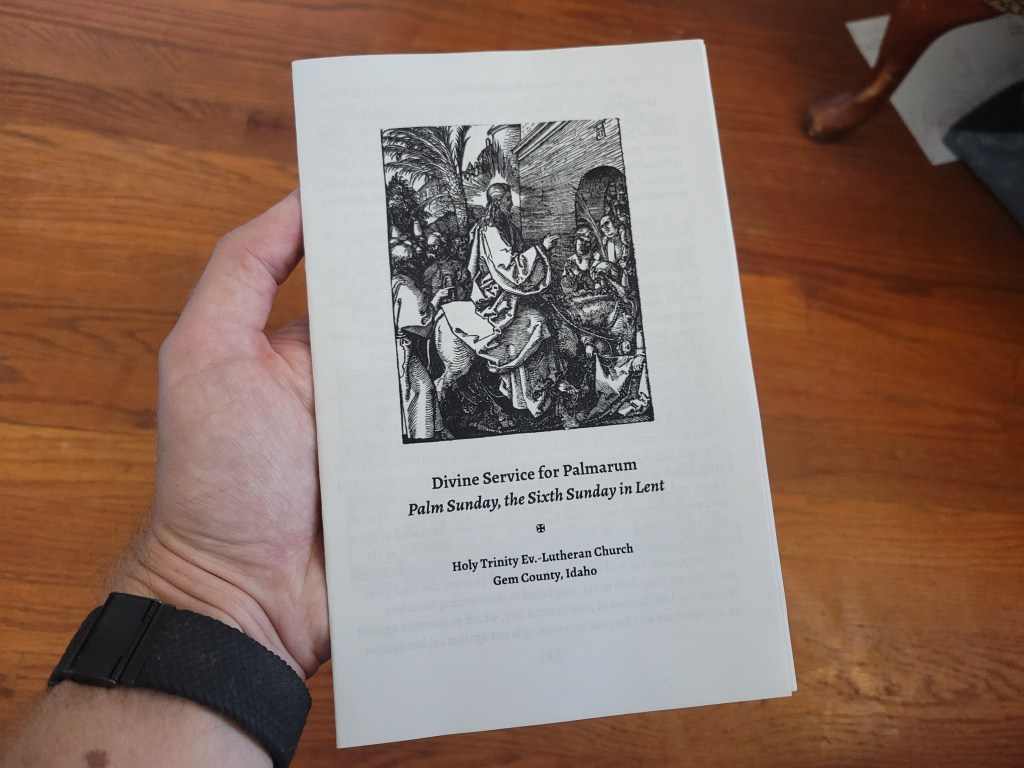
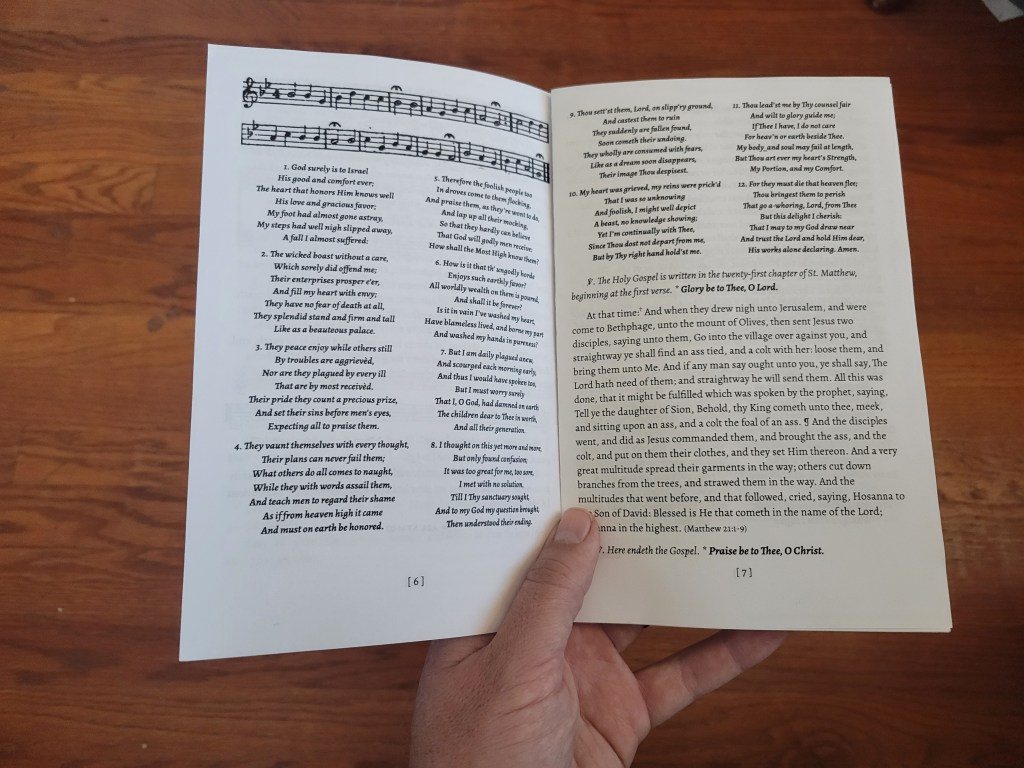
That said, if you have to read things from your phone, then do so with a good conscience. It’s tough out there.
Maybe you’re not alone. Maybe you have a family or some local friends or roommates. If so, do all of the above with them: set aside time for prayer, hymns, and the recitation and reading of the psalms and other passages of Scripture.
What about a sermon? Much could be said here. For now, I will suggest that you read something. There are several resources that I would recommend. As before, I would advise against piping something in digitally on Sunday morning. As edifying as that may be, save it for another time.
Instead, read aloud . . .
- One (or both) of the devotions of N. J. Laache (these are shorter) (serial Tele channel)
- One of Martin Luther’s postils (sermons) (Church Postil pdf and epub) | (House Postil pdf and epub)
- The catechetical expositions of Johann Spangenberg (hard copy)
- One of C. F. W. Walther’s sermons (Year of Grace, Part 1) | (Year of Grace, Part 2)
All of these are going to be expositions of the lessons appointed for the day.
Appointed for the day by whom? By your Christian ancestors, anon — by way of custom, not of law.
At Holy Trinity we use a lectionary, or system of weekly appointed readings, corresponding to what is called the Church Calendar. To be very brief: this lectionary is largely the same one that prevailed throughout northern Europe since the time of Charlemagne’s reforms in AD 800. Virtually all lectionary-using Christians in the West used the same one until the 1960s, when some homosexual Jesuit higher critics persuaded the followers of the papacy to start using a different one. For reasons which we won’t get into today, most of the other calendar- and lectionary-respecting Christians in the West followed suit, post haste.
That said, the revised version of the new lectionary, called the Revised Common Lectionary or Three-Year Lectionary, is not evil (but it has certain problems). The Word of God is still the Word of God. If you prefer this new lectionary, that is fine. That said, we do not use it. We use the old one, so if you’re going to start using our weekly bulletins to help you get things up and running where you are, you’re going to use it, too, or you’re going to spend an awful lot of time retrofitting things, at which point it might not be worthwhile.
“I think using a lectionary and church calendar are strange fire and the sin of Jeroboam, and I think the same thing about hymns that aren’t from the psalter. Your bulletin violates the Second Commandment.”
Well, you’re wrong, but don’t go against your conscience. There’s probably not a whole lot for you here, to be honest. God bless you as you go about worshiping Him according to the dictates of your conscience.
The Lord’s Supper
You should hold off on celebrating the Lord’s Supper until a congregation is formally established, which act should entail the calling of regular ministers. This gets into other topics which we will address here eventually, but not today.
Lord willing, you will get there. But a journey of a thousand miles begins with a single step. For the moment, we are just focusing on squaring up the compass and taking those initial steps.
Miscellaneous Notes
- Everything is meant to be done out loud. Yes, even if you’re all by yourself.
- In the bulletin, italics are ordinarily sung. Plain italic is the part of the minister or leader. Bold italic is everyone together.
- We will eventually provide guidance on chanting and singing. For now, if you don’t know how to sing what’s in front of you, just read it.
- The various parts of the rite are not labeled in our bulletin. Upon seeing our bulletin, a friend of mine described it as very “Spartan.” He’s not wrong. But it works for us. (It also helps us save on ink.) For you who may be coming from the outside, it might be confusing at first. But I would submit that taking an inductive, gradual approach to learning what each of these different parts is called will pay dividends in the long run. At some point I will publish an outline and explanation. For now, just take it as presented, as an organic whole.
- Some churches include an Old Testament lesson during the Sunday service. We do not, because we read and study the Old Testament congregationally at a different time on Sunday. If you want to include an Old Testament lesson, use the suggested lessons here. In fact that page should be a very useful resource just in general.
- We use the Authorized (King James) Version for the New Testament — not because we think other versions aren’t the Bible, but because it comes from the most stable NT textual tradition (the Textus Receptus, 98-99% overlap with the Majority Text), and because we find it to be beautiful and reverent. We like it. You might not. That is fine. If you don’t, use a version of your choosing instead.
- Yes, anon, we use the Septuagint for the Old Testament— Lancelot Brenton is preferred. That said, for the various psalm verses interspersed throughout the rite, if there is no material difference, we generally stick with the AV.
- We review the Small Catechism every Sunday before the sermon, two questions at a time. Each question gets repeated two weeks in a row. (Old Missouri inside baseball: we use the text of the old 1912 catechism from Concordia Publishing House because it is in the public domain, and there are things about it that we prefer to the 1943.)
- Third sex Dunning-Kruger Lutheran liturgy spergs keep walking. Every modification I made was conscientious and deliberate. Does it make you mad? No one cares.
Lighting the Beacon

As the OP states, meeting regularly for prayer, Scripture-reading, etc., on the Lord’s Day is the first step in the process of discerning the possibility of establishing a congregation.
If you do this with a core group consistently for the better part of a year, you are ready to start that conversation.
But how do you assemble that group? How do you find your fellows? How do you establish concord?
That will be the topic of the next installment, which, since it will require less in the way of introduction and ramp-up, should be forthcoming much sooner.
+SDG+
Thank you for reading. The Boniface Group is the mission society of Holy Trinity Ev.-Lutheran Church of Gem County. If you would like to support our work, you may do so here. (Crypto options coming soon.) To learn more, visit our homepage and start reading from the top. Thank you, and God bless you.
✠
Footnotes
- “Robert Conquest’s Three Laws of Politics,” Isegoria; July 11, 2008. ↩︎
- The Missouri Synod in convention voted to allow female suffrage in 1969, but adoption by congregations rolled out gradually over the course of succeeding decades. ↩︎
- “Wisconsin Evangelical Lutheran Synod” and “Evangelical Lutheran Synod,” two small Lutheran synods that are in communion with each other but not with the Missouri Synod. (W)ELS congregations are a lot fewer and further between than LCMS ones, and although they do not formally allow women’s suffrage . . . well, they wish they did. So the women just rule them through the usual means: by dominating their whipped husbands. Ultimately liberalism dominates in (W)ELS congregations just as much as in LCMS congregations. Exceptions are exceptional, just like they are in the LCMS.
To round things out: I don’t bother checking AALC congregations, and there is a snowball’s chance in hell that anon is near a micro-synod church or an independent one that’s any good — most of these are just LCMS or (W)ELS in miniature with no realistic plan for perpetuating themselves. But there are a few that are very good, with more shrewd and sanguine leadership, and I have sent men to them. ↩︎


The sanctus.org link in the fifth miscellaneous note is dead, but I think it might be here?
June 2026 · Lutheran Lectionary
LikeLike