
An Wolfgang Brauer, Pfarrherrn zu Jessen,
von der Hauscommunion, am St. Davidstage, 1536.1 2 3
To Wolfgang Brauer, Pastor of Jessen,4
on Family Communion, on St. David’s Day, 1536.
Grace and peace in Christ!
Esteemed, dear Mr. Parson! In response to the question that your good friend in Linz, Sigmund Hangreuter, posed to you by letter and desired that you would pass along to me, this is my answer: You should inform the good gentleman and friend that he is under no obligation to adopt such a practice — of communing himself and his household — and that it’s also pointless to do so, since he is neither called nor commanded to do so. Besides, if the tyrannical church ministers, who actually do have an obligation to do it, won’t administer it to him or his family, he can still be saved in his faith through the Word. It would also cause a lot of sinful confusion if the Sacrament were administered like that in this home here and that home there. For sure in the long term there would be no good outcome and it would cause nothing but division and sects — seeing as people are just strange right now and the devil is a madman.
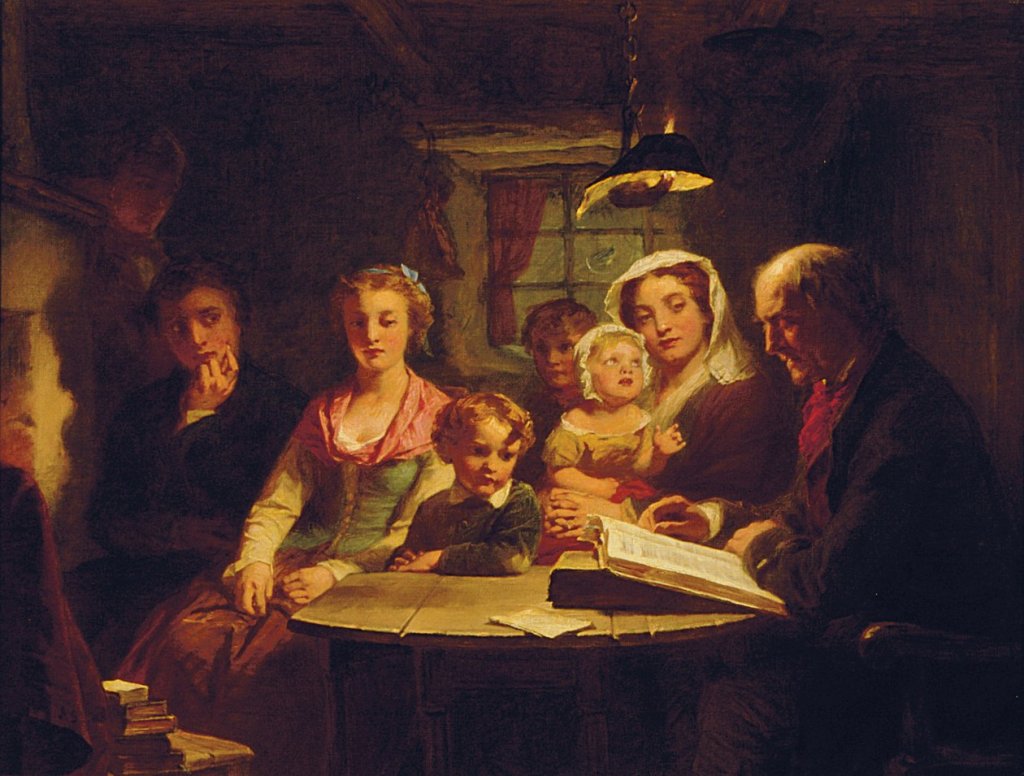
The early Christians in Acts did not separately use the Sacrament like that in homes; they gathered together for it. And even if they had done so, that example would still not be tolerable any longer now, just as it is not tolerable now for us to let all our possessions be communal property, as they did back then. For now the gospel has spread publicly, along with the sacraments. But a head of household teaching his family the Word of God is right and should take place, since God has commanded us to teach and train our children and household, and the Word is entrusted to each father. But the Sacrament is a public confession and should have public, called ministers, since what Christ says applies there — that it should be done in remembrance of him, that is, as St. Paul says, it should proclaim or preach the Lord’s death until he comes. And he also says there that people should come together, and he harshly rebukes those who wanted to use the Lord’s Supper specially, each one for himself. So too, though each separate head of household is not forbidden but commanded to teach his household with God’s Word, and that includes himself too, yet no one can baptize himself, etc. For a public office in the church and a head of household with his family members are two very different things, so that they should not be confused with each other, nor divorced from each other. Now since no necessity or proper call is involved here, nothing should be undertaken on one’s own initiative, without God’s specific command, for nothing good will come of it.
You may give this, my dear Mr. Parson, as an answer on my behalf. With that, I entrust you to God. Amen.
St. David’s Day, 1536
Mart. Luther
- D. Martin Luthers Sämtliche Schriften, ed. Johann Georg Walch, vol. 10, Die Catechetischen Schriften (Halle im Magdeburgischen: Johann Justinus Gebauer, 1744), [Walch 10:]2736–39. ↩︎
- Dr. Martin Luther’s Sämmtliche Schriften, ed. Joh. Georg Walch, vol. 10, Catechetische Schriften und Predigten, neue revidirte Stereotypausgabe (St. Louis, Mo.: Concordia Publishing House, 1892), [St. L. 10:]2224–27. ↩︎
- No. 2281, in D. Martin Luthers Werke. Kritische Gesammtausgabe. Briefwechsel, vol. 7 (Weimar: Hermann Böhlaus Nachfolger, 1937), [WA BR 7:]338–39. ↩︎
- Trans. Nathaniel J. Biebert, Red Brick Parsonage (blog), April 6, 2020, https://redbrickparsonage.wordpress.com/2020/04/06/luther-on-family-communion/. ↩︎

