“Archangel Raphael and Tobias,” oil on canvas; Titian, 1540-1545
It was the Feast of St. Michael and All Angels, several years ago. At the time my family and I were blessed to be members of a Lutheran congregation that still observed this holiday— historically dear and precious to Lutheran Christians— with an evening communion service.
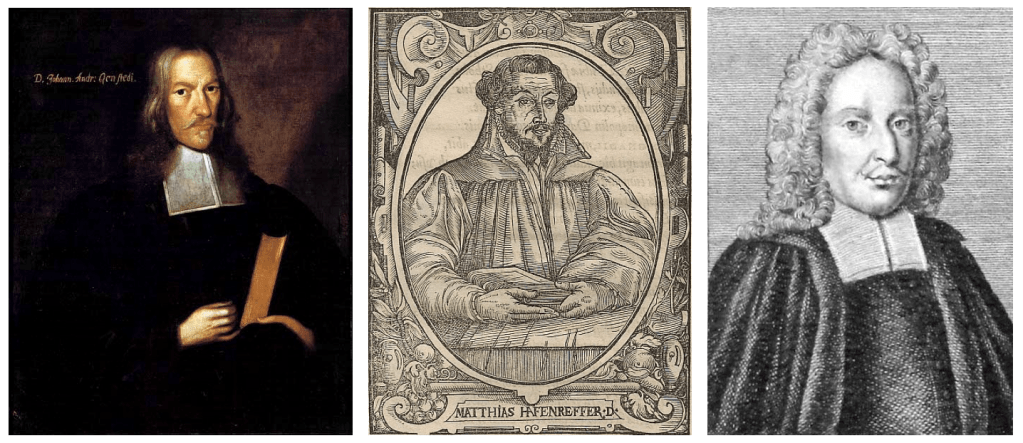
Johannes Andreas Quenstedt, Matthias Hafenreffer, Johann Wilhelm Baier.
Is there a difference between Holy Baptism as received by infants vs. adults?
As the title avers — in accordance with the Nicene Creed — there is but “one Baptism for the remission of sins” (TLH, p. 22). Yet it is undeniable that adult converts to Christianity who have not been baptized come to faith first and are baptized second.
Does this overthrow the contention that Baptism regenerates? Does it mean that Baptism should not be administered to infants or young children?
By no means. And yet there is a difference between the one Baptism for the remission of sins as it is received by adults vs. infants. The explication of this difference is wonderfully clarifying and furnishes true Christian comfort to every believer, whether he entered the Lord’s vineyard at the dawn of his life or only recently — or at some point in between.
From Heinrich Schmid’s Doctrinal Theology of the Evangelical Lutheran Church1:
In opposition to the assertion of the Papal Church, that “sin is destroyed by Baptism, so that it no longer exists,” the doctrine of the forgiveness of sins by Baptism is thus more particularly defined: “The guilt and dominion of sin is taken away by Baptism, but not the root or incentive (fomes) of sin.” (Holl. [David Hollaz], 1096)
Ap. Conf. [Apology of the Augsburg Confession] (II, 35): “(Luther) always thus wrote, that Baptism removes the guilt of original sin, although the material of sin, as they call it, remains, i.e., concupiscence. He also affirmed of this material, that the Holy Spirit, given by Baptism, begins to mortify concupiscence and creates new emotions in man. Augustine speaks to the same effect when he says: ‘Sin is forgiven in Baptism, not that it does not exist, but that it is not imputed.’”
Grh. [Johann Gerhard] (IX, 236): “There is no other ordinary means of regeneration than the Word and the Sacrament of Baptism. By the Word infants cannot be influenced, but only adults, who have come to years of discretion. It remains, therefore, that they are regenerated, cleansed from the contagion of original sin, and made partakers of eternal life, through Baptism.”
Br. [Johann Wilhelm Baier] (690): “But here, as regards the immediate design [of Baptism] a diversity exists in respect to the different subjects. For faith is at first conferred upon and sealed to all infants alike by Baptism, and by this faith the merit of Christ is applied to them. But adults, who receive faith from hearing the Word before their Baptism, are only sealed and confirmed in their faith by it. (Examples, Acts 2:41; 8:12, 36–38; 16:14, 15, 31, 33; 18:8.) And not only now, when Baptism is received, but afterwards, and throughout their whole life, it efficaciously contributes to the confirmation of their faith and further renewal.”
Grh. (IX, 169): “To infants Baptism is, primarily, the ordinary means of regeneration and purification from sin; … secondarily, it is the seal of righteousness and the confirmation of faith; to adult believers it serves principally as a seal and testimony of the grace of God, sonship and eternal life, but in a less principal sense it increases renovation and the gifts of the Holy Spirit. Infants by Baptism receive the first fruits of the Spirit and of faith; adults, who through the Word have received the first fruits of faith and of the Holy Spirit, procure an increase of these gifts by Baptism.”
Hfrffr. [Matthias Hafenreffer](500): “But what? Suppose one is regenerated by the Word. Has he need of Baptism also? And can Baptism be said to be to him the laver of regeneration? Answer: Both. For believers, too, ought to be baptized, unless they be excluded by a case of necessity. And when they are baptized, Baptism is truly to them the laver of regeneration, because it augments regeneration, wrought by the Word, by a wonderful addition; because, also, the sacramental act seals the regeneration of faith to absolute certainty.”
Although Baptism, where it is rightly performed, is a Sacrament and offers saving grace, without any respect to the faith of the recipient, yet it is also true that, in the case of adults, a beneficial result follows only where Baptism is received by faith.
The question: Is a hypocrite, therefore, also regenerated, if he receive Baptism? is thus answered by Hfrffr. (499): “In such a case we must distinguish between the substance of Baptism and its fruits. For a hypocrite, if he be baptized, receives indeed true Baptism, as to its substance, which consists in the legitimate administration of the Sacrament according to the words of the institution and in the promise of divine grace. But as long as he perseveres in his hypocrisy and infidelity, he is destitute of its salutary fruits and effects, which only believers experience. There fore, God really offers his grace and the forgiveness of sins to him who is baptized, and desires on his part to preserve that covenant perpetually firm and entire without any change, so that the grace promised in the covenant may always be accessible to him who is baptized, and that he may enjoy it as soon as he repents; but, as long as he remain a hypocrite and impenitent, he is destitute of it.”
Quen. [Johannes Andreas Quenstedt] (IV, 117): “Even to all hypocrites Baptism offers spiritual gifts, as regeneration and whatever is comprehended under it, the gift of faith, remission of sins, etc., … but some adults, by actual impenitence, hypocrisy, and obstinacy, defraud themselves of the saving efficacy of Baptism; and hence, although these gifts be offered to them, they are not actually conferred; yet, in the meantime, it is and remains in itself a salutary organ and means of regeneration, since the deprival of the first act does not follow from the deprival of the second act through some fault of the subject.”
Cat. Maj. [Large Catechism] (IV, 33): “Faith alone makes the person worthy to receive profitably this salutary and divine water. For, as this is offered and promised to us in the words together with the water, it cannot be received otherwise than by cordially believing it. Without faith, Baptism profits nothing; although it cannot be denied that in itself it is a heavenly and inestimable treasure.”
For all who have received the Lord’s Baptism at any point in their lives, it was — and it is, and it will remain your whole life long — “a gracious water of life and a washing of regeneration in the Holy Ghost,” in the words of the Catechism, as St. Paul teaches in Titus 3: “He saved us by the washing of regeneration and renewing of the Holy Ghost, which He shed on us abundantly through Jesus Christ, our Savior, that, being justified by His grace, we should be made heirs according to the hope of eternal life. This is a faithful saying” (vv. 5-8).
As certainly as Christ gave His body and shed His blood in death for the forgiveness of sins and brought life and immortality to light by His rising again, just as surely were you “buried with Him in baptism, wherein also ye are risen with Him through the faith of the operation of God, who hath raised Him from the dead” (Colossians 2:10).
Thank you for reading. The Boniface Group is the mission society of Holy Trinity Ev.-Lutheran Church of Gem County. If you would like to support our work, you may do so here. (Crypto options coming soon.) To learn more, visit our homepage and start reading from the top. Thank you, and God bless you.
✠
Heinrich Schmid, The Doctrinal Theology of the Evangelical Lutheran Church, Verified from the Original Sources. C. A. Hay & H. E. Jacobs, Trans. Second English Edition, Revised according to the Sixth German Edition, Philadelphia, PA: Lutheran Publication Society, 1889; pp. 549–551. Nota Bene: additional line breaks have been added for clarity. —ed.↩︎
In the apostolic and primitive church there were two kinds of presbyters who in Latin were called seniores, as we conclude from 1 Tim. 5:17. Some administered the office of teaching, or as the apostle there says, they labored in the Word and doctrine; these were called bishops, pastors, etc. Others, however, were appointed to be censors of morals and guardians of church discipline, since the pagan government did not support the teachers of the church in this manner; these were called governors and leaders (as we conclude from 1 Cor 12:28 and Rom. 12:8). Ambrose comments on 1 Tim. 5 at the beginning: “Also the synagogue and the church had seniors without whose advice nothing was undertaken. I do not know by what kind of carelessness this fell into disuse — perhaps by indolence or rather by the pride of the teachers who alone wanted to be esteemed as being something.”
Both kinds were commonly called elders (Acts 15:22; 1 Tim. 5:17) and rulers (Heb 13:7, 17, 24). Both formed the sacred college that Paul calls the presbytery, saying: “Do not neglect the gift that is in you, which was given to you by prophecy with the laying on of the hands of the presbytery” (1 Tim 4:14). From this passage we conclude that at the ordination of ministers, not only the pastors but also the elders chosen from the people laid their hands on the ordained person in the name of the entire congregation, just as not only Aaron but also the elders of Israel laid their hands on the Levites who were ordained (Num 8:10). Some, however, think that here the term presbytery signifies in a special sense those elders who were pastors and bishops. Today the consistory or the church council [senatus ecclesiasticus], over which ecclesiastical and political officials preside and that concerns itself especially with church discipline, corresponds to the presbytery.
— Johann Gerhard, Loci theologici, “De minist. eccl.,” par. 232; qtd. in C. F. W. Walther, Church & Ministry, tr. J. T. Mueller, Concordia Publishing House, St. Louis, 1875/1987, pp. 264-265
A special episode of The Axehead Circular featuring a reading of “Matins and Vespers in the Life of the Church,” by the Rev. Charles L. McClean, pastor of Our Saviour Lutheran Church in Baltimore. A link to a PDF of this article can be found in the show notes.
Some wag put my name down as a signer of the Antioch Declaration. For the record, I did not sign it, and furthermore I never would. I also do not reside in “Emmet” (the town’s name is spelled “Emmett”).
I would appreciate you sharing this post. Thank you!
It has come to our attention that someone has put the name of one of our directors on the list of signatories to the "Antioch Declaration."
Trent Demarest did not, and does not, subscribe to the Antioch Declaration, nor does St. Boniface Lutheran School of Western Idaho.
“Let all the faithful, whether men or women, when early in the morning they rise from their sleep and before they undertake any tasks, wash their hands and pray to God; and so they may go to their duties. But if any instruction in God’s word is held that day, everyone ought to attend it willingly, recollecting that he will hear God speaking through the instructor and that prayer in the church enables him to avoid the day’s evil; any godly man ought to count it a great loss if he does not attend the place of instruction, especially if he can read. . . . But if on any day there is no instruction, let everyone at home take the Bible and read sufficiently in passages that he finds profitable.” (Hippolytus of Rome, The Apostolic Tradition, Part IV.35)
Today we learn what happens when the opening monologue doesn’t end, Trent doesn’t really have a topic, and the entire episode is a tangent. Not entirely, but close enough. Today we’re talking about the village again, but in a roundabout way. It’s called “the conversation and consolation of brethren,” and boy do we all need it. No, it isn’t a conference. It’s not not a conference. But if it’s only happening at conferences, something is very, very wrong. We discuss sharks in your living room, der ewige Porch, weaving, hymn-singing, and why you don’t need call documents to be a Christian, a friend, or a Christian friend.
In this episode Trent introduces William Holmes McGuffey and his famous readers. He talks about why the idea of the tabula rasa is false and pernicious, the biological reality of the American people, and some lessons about national identity from Ancient Israel. The discussion moves to the topic of the great shift in language instruction in the mid-twentieth century, why you might want to think twice about Dr. Seuss, and why Calvinism is a whipping boy for historians of American education. Toward the end of the episode, Trent points out several instances of how the virtues of McGuffey’s readers are often made evident in the mirror of his enemies’ critiques.
In this episode Trent begins a survey of the weekly schedule used by St. Boniface. He discusses the significance of the week as a divine period of time, makes a digression on the worthlessness of modern American conservatism, and thinks out loud regarding the benefits of differentiated attendance and the variable shortening of the school day as a means of accommodating diverse academic abilities. As the episode wraps up, Trent makes the case for dialing down the academic rigor when teaching Literature and History during the elementary school years, not because these subjects are unimportant, but because the opposite is the case, and the readiness is all.
In this episode Trent does a survey of the academic calendar used by St. Boniface Lutheran School and the St. Sarah Cottage School. He discusses the convention followed by the school for naming its academic terms, makes a digression on the propriety and rectitude of Thanksgiving as a civil Christian holiday, and gives the rationale for the liberal distribution of breaks throughout the school year. The episode wraps up with a discussion of the two testing weeks on the calendar, the reason for the variable lengths of the terms of the school year, why you should eat steak, and the rationale for tying “Spring Break” to Holy Week and Easter Week every year.
In this episode we answer the question “Are you a classical school?” In the show opener Trent maintains that it does, in fact, take a village to raise a child. The episode moves from there to a description of what the term “classical education” meant prior to the turn of the century and a discussion of how the recent attempt at redefinition by the New Classical Schooling movement is fraught with problems. In the final segment Trent describes nineteenth-century German Lutheran parochial schooling in America, suggests that this historical model provides a better pattern for Christian schooling than the New Classical Schooling model, and hints that another episode on the topic might be warranted.
In this episode we consider the idea of architectonics, specifically how theology, not politics, is the true architectonic science. Trent discusses the meaning of “Evangelical Christianity” and comments on how Lutheranism is situated within this stream, and how a basic Evangelical confession is essential to the institutional character of St. Boniface. The show ends with a discussion of the school’s “Six Points,” the hoped-for relationship between the St. Boniface School and partner families, and the importance of being equally yoked.
In this episode Trent Demarest introduces himself, The Boniface Group, St. Boniface Lutheran School of Western Idaho, and the St. Sarah Cottage School. He also gives a brief summary of the rationale behind the names for these organizations, discussing St. Boniface of Mainz, the so-called “Apostle to the Germans,” as well as St. Sarah, the wife of the patriarch Abraham.








 The Boniface Group