
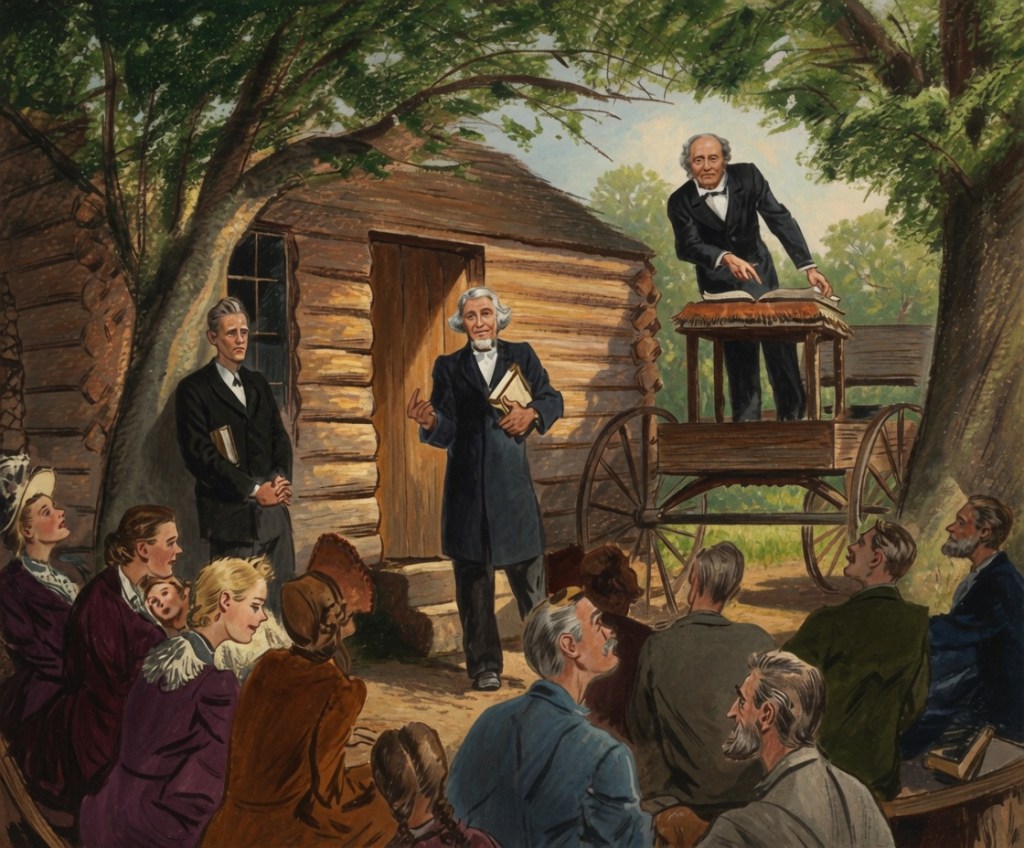
It is impossible to listen to a recorded sermon. It is impossible to watch a recorded sermon. You cannot read a sermon on the internet or even in a book. You cannot share one with a friend — not one that’s already been preached, at any rate. For a sermon, as a species of Christian conversation, just is a thing articulated, heard, and engaged in in real time and space. A sermon is not the sound of words. A sermon is not a field of text.
When we hear the term “sermon”, we naturally think of the public preaching of the Word on a Sunday or other holy day, to and in the midst of the congregation, and it is well that we should. Nevertheless, it is also good to remember that the term “sermon” in its original derivation means something like discussion.
This is no assertion on the mere basis of etymology: 1 Corinthians 14 is essentially St. Paul giving commands regarding the proper conduct of a doctrinal discourse and discussion — in other words, it is St. Paul saying how the sermon should be regulated in a godly way.
The great early twentieth-century Lutheran theologian Georg Stoeckhardt (1842-1913) makes incidental, yet fairly extensive, reference to this topic here in this writing. “Frequently a discussion connected to the instructional discourses,” he comments, “a sort of conversation on the teaching. Whoever had not understood something asked the teacher, and this point was discussed.”
Nowadays it is more customary for the instructional discourse to take place in the midst of the service (the “sermon” as we know it) and for the discussion to take place afterwards (the commonplace of “Bible Class”), although if I had to guess the split on how many after-church Bible classes are devoted to the preacher fielding questions about his sermon versus him boring his fellow saints to distraction with a one-man hobbyhorse rodeo . . . well, I’m not sure I could do it.
There’s nothing wrong per se with the separation between the two halves of the ancient sermon. That said, it wouldn’t be wrong per se to keep them together, although given that the separation is now a longstanding custom in a matter of adiaphora — since well before the Reformation, in fact —, we Lutherans, at least, would seem to be admonished by our Confessions to retain it.
While we’re on the subject, though . . . when was the last time you witnessed or participated in the other half? But actually — not just as a perfunctory five minutes before you proceeded to spend an hour and half on three verses of Habakkuk (interspersed with anecdotes about a discussion on Facebook from the previous week), as though you were graciously indulging a whim from the proles and more or less doing them a favor.
No, but when was the last time you took as long as was needed to give an account of your doctrine that day and answer your fellow Christian men’s questions about it?
No, not because you are magnanimous, but because you owe it to them, and you owe it to your Lord. You are not infallible, and being apt to teach is part of what is required of you. It is conceivable that you might even receive correction from them. What? came the word of God out from you? or came it unto you only?
And would you not be glad to receive it? Or does that only happen at Winkels and conferences, when you’re among fellow professional Christians?
We do not put sermons on our website at Holy Trinity. We can’t. It would be impossible. To be a bit insufferable: sermons are events. They cannot be put anywhere.
We do record the sermons and make the recordings available to . . .
- members who were absent
- catechumens who might wish to re-listen and discuss them with absent family members, and
- on occasion, local inquirers here in the Treasure Valley.
Yes, preaching is public, but let’s be clear about what is meant by this. In his annotations on the 1943 Synodical Catechism of the old LCMS, Edward Koehler points us in the right direction:
Question 275: How does the local congregation publicly administer the Office of the Keys? * Answer: According to God’s will the Christian congregation chooses and calls men as ministers, who in the name of Christ and in the name of the congregation publicly perform the functions of the Office of the Keys. (The pastoral office a divine institution, Acts 20:28; Eph. 4:10-12.)
Koehler: The word ‘publicly’ here does not mean openly, before the eyes of the public, but it means in the name of the public, which, in this case, is the local congregation. While each true believer in Christ is a royal priest in his own right, and should, therefore, by word and deed ‘show forth the praises’ of God (650), he will not remain aloof from other believers, but rather seek the fellowship of those that hold the same faith as he (690), and join a Christian congregation in order that together with others he may do what the Lord commanded all of them to do. — Since all members of a congregation have the same right and duty, no one may take it upon himself to act in the name of all others, but he must by them be called or commissioned to preach, etc., (Rom. 10:15).
Read the rest here. (Here is an unroll for those not on X.)
The propagation of sermon recordings to the general public fundamentally alters the nature of preaching. It causes the preacher to preach with potential abstract anybody anywhere in mind, rather than the actual saints who are congregated around the Word and sacraments in that particular place and time.
“Not true, I can do both!”
Even if we were to grant for the sake of argument that you could (you actually can’t), that would still be a problem, because you are only supposed to be doing one of those things at that time. For once in your life, stop trying to multitask.
“Oh yeah, what about WAM? He preached on the radio!”
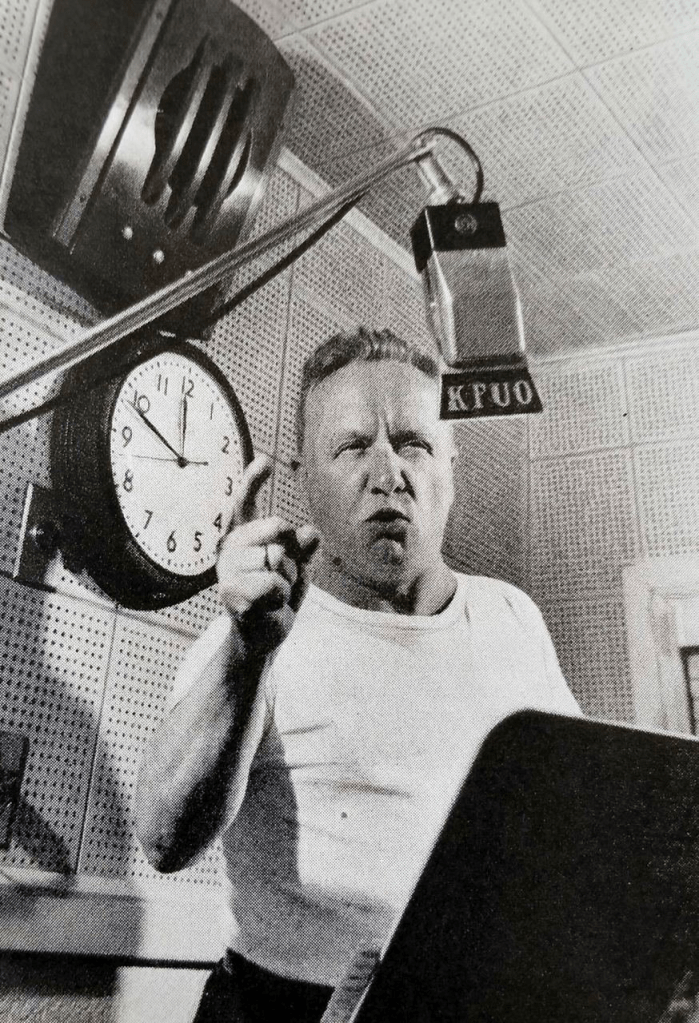
Do you think that’s the interior of a church? Is there a congregation sitting just outside the frame?
Walter A. Maier did not record the sermons he preached to his congregation and then broadcast the recordings on the radio. He gave his radio addresses on the air, yes. In a certain sense these were indeed sermons. They were great. We are big WAM fans here. There is a place for dedicated public addresses outside the four walls of the church. Podcasts are a species of that. I’m not sure why a video of your talking face and twitching waxed mustache needs to be involved, or how you justify this use of your time to your congregation, but I digress — clerical looksmaxxing, theobro/theonerd narcissism, and related topics will have to be taken up some other day.
Yes, there is a place for the public address in evangelism, other things being equal.
But do not pretend that you, immediately scurrying into the vestry with your iPhone after the service to upload your sermon recording onto Spotify and shop the link around to your fanbase, real or imaginary, are doing the same thing that WAM and others did.
(Old guys who started doing this before the rise of social media get a pass in my book, unless their sermons are trash. Hello, Clint.)
A sermon outline or partial transcript, created before or after the factum of a sermon itself, is not a sermon. It is a theological essay, a meditation, a devotional writing. Being a different thing, it serves a different function — perhaps a salutary one, but in any case never the same one.
Our congregation will very occasionally publish outlines, i.e, partial transcripts, of past sermons preached by our pastors. If and when this is done, it is done by the common consent and agreement of the men of the church and in their name. We pray that these outlines would be edifying and profitable to any who read them.
It seemed good to us, in view of the recent controversy over the propriety of denigrating the Athanasian Creed, to publish an outline of the sermon preached at Holy Trinity Ev.-Lutheran Church of Gem County on the Feast of the Holy Trinity, 2026. You may read it here.
Thank you for reading. The Boniface Group is the mission society of Holy Trinity Ev.-Lutheran Church of Gem County. If you would like to support our work, you may do so here. (Crypto options coming soon.) To learn more, visit our homepage and start reading from the top. Thank you, and God bless you.
✠


2 thoughts on “On the Sacredness of Sermons”