
Is there a difference between Holy Baptism as received by infants vs. adults?
As the title avers — in accordance with the Nicene Creed — there is but “one Baptism for the remission of sins” (TLH, p. 22). Yet it is undeniable that adult converts to Christianity who have not been baptized come to faith first and are baptized second.
Does this overthrow the contention that Baptism regenerates? Does it mean that Baptism should not be administered to infants or young children?
By no means. And yet there is a difference between the one Baptism for the remission of sins as it is received by adults vs. infants. The explication of this difference is wonderfully clarifying and furnishes true Christian comfort to every believer, whether he entered the Lord’s vineyard at the dawn of his life or only recently — or at some point in between.
From Heinrich Schmid’s Doctrinal Theology of the Evangelical Lutheran Church1:
In opposition to the assertion of the Papal Church, that “sin is destroyed by Baptism, so that it no longer exists,” the doctrine of the forgiveness of sins by Baptism is thus more particularly defined: “The guilt and dominion of sin is taken away by Baptism, but not the root or incentive (fomes) of sin.” (Holl. [David Hollaz], 1096)
Ap. Conf. [Apology of the Augsburg Confession] (II, 35): “(Luther) always thus wrote, that Baptism removes the guilt of original sin, although the material of sin, as they call it, remains, i.e., concupiscence. He also affirmed of this material, that the Holy Spirit, given by Baptism, begins to mortify concupiscence and creates new emotions in man. Augustine speaks to the same effect when he says: ‘Sin is forgiven in Baptism, not that it does not exist, but that it is not imputed.’”
Grh. [Johann Gerhard] (IX, 236): “There is no other ordinary means of regeneration than the Word and the Sacrament of Baptism. By the Word infants cannot be influenced, but only adults, who have come to years of discretion. It remains, therefore, that they are regenerated, cleansed from the contagion of original sin, and made partakers of eternal life, through Baptism.”
Br. [Johann Wilhelm Baier] (690): “But here, as regards the immediate design [of Baptism] a diversity exists in respect to the different subjects. For faith is at first conferred upon and sealed to all infants alike by Baptism, and by this faith the merit of Christ is applied to them. But adults, who receive faith from hearing the Word before their Baptism, are only sealed and confirmed in their faith by it. (Examples, Acts 2:41; 8:12, 36–38; 16:14, 15, 31, 33; 18:8.) And not only now, when Baptism is received, but afterwards, and throughout their whole life, it efficaciously contributes to the confirmation of their faith and further renewal.”
Grh. (IX, 169): “To infants Baptism is, primarily, the ordinary means of regeneration and purification from sin; … secondarily, it is the seal of righteousness and the confirmation of faith; to adult believers it serves principally as a seal and testimony of the grace of God, sonship and eternal life, but in a less principal sense it increases renovation and the gifts of the Holy Spirit. Infants by Baptism receive the first fruits of the Spirit and of faith; adults, who through the Word have received the first fruits of faith and of the Holy Spirit, procure an increase of these gifts by Baptism.”
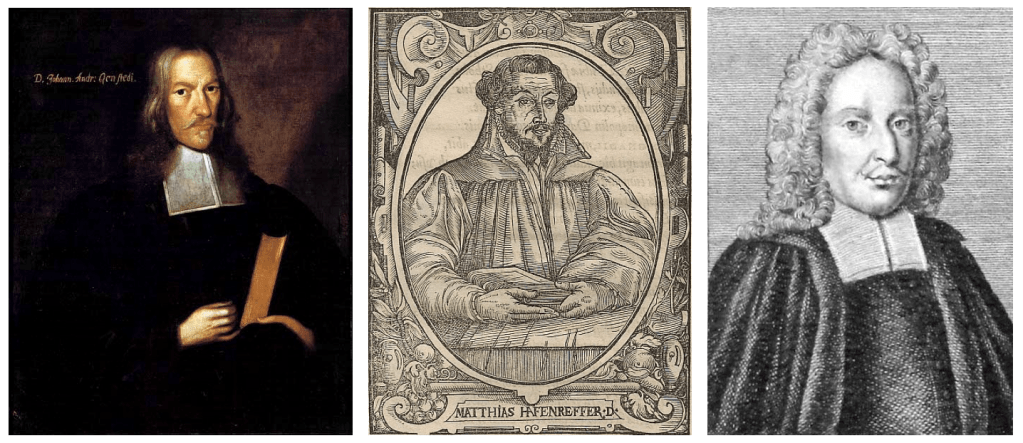
Hfrffr. [Matthias Hafenreffer] (500): “But what? Suppose one is regenerated by the Word. Has he need of Baptism also? And can Baptism be said to be to him the laver of regeneration? Answer: Both. For believers, too, ought to be baptized, unless they be excluded by a case of necessity. And when they are baptized, Baptism is truly to them the laver of regeneration, because it augments regeneration, wrought by the Word, by a wonderful addition; because, also, the sacramental act seals the regeneration of faith to absolute certainty.”
Although Baptism, where it is rightly performed, is a Sacrament and offers saving grace, without any respect to the faith of the recipient, yet it is also true that, in the case of adults, a beneficial result follows only where Baptism is received by faith.
The question: Is a hypocrite, therefore, also regenerated, if he receive Baptism? is thus answered by Hfrffr. (499): “In such a case we must distinguish between the substance of Baptism and its fruits. For a hypocrite, if he be baptized, receives indeed true Baptism, as to its substance, which consists in the legitimate administration of the Sacrament according to the words of the institution and in the promise of divine grace. But as long as he perseveres in his hypocrisy and infidelity, he is destitute of its salutary fruits and effects, which only believers experience. There fore, God really offers his grace and the forgiveness of sins to him who is baptized, and desires on his part to preserve that covenant perpetually firm and entire without any change, so that the grace promised in the covenant may always be accessible to him who is baptized, and that he may enjoy it as soon as he repents; but, as long as he remain a hypocrite and impenitent, he is destitute of it.”
Quen. [Johannes Andreas Quenstedt] (IV, 117): “Even to all hypocrites Baptism offers spiritual gifts, as regeneration and whatever is comprehended under it, the gift of faith, remission of sins, etc., … but some adults, by actual impenitence, hypocrisy, and obstinacy, defraud themselves of the saving efficacy of Baptism; and hence, although these gifts be offered to them, they are not actually conferred; yet, in the meantime, it is and remains in itself a salutary organ and means of regeneration, since the deprival of the first act does not follow from the deprival of the second act through some fault of the subject.”
Cat. Maj. [Large Catechism] (IV, 33): “Faith alone makes the person worthy to receive profitably this salutary and divine water. For, as this is offered and promised to us in the words together with the water, it cannot be received otherwise than by cordially believing it. Without faith, Baptism profits nothing; although it cannot be denied that in itself it is a heavenly and inestimable treasure.”
For all who have received the Lord’s Baptism at any point in their lives, it was — and it is, and it will remain your whole life long — “a gracious water of life and a washing of regeneration in the Holy Ghost,” in the words of the Catechism, as St. Paul teaches in Titus 3: “He saved us by the washing of regeneration and renewing of the Holy Ghost, which He shed on us abundantly through Jesus Christ, our Savior, that, being justified by His grace, we should be made heirs according to the hope of eternal life. This is a faithful saying” (vv. 5-8).
As certainly as Christ gave His body and shed His blood in death for the forgiveness of sins and brought life and immortality to light by His rising again, just as surely were you “buried with Him in baptism, wherein also ye are risen with Him through the faith of the operation of God, who hath raised Him from the dead” (Colossians 2:10).
Thank you for reading. The Boniface Group is the mission society of Holy Trinity Ev.-Lutheran Church of Gem County. If you would like to support our work, you may do so here. (Crypto options coming soon.) To learn more, visit our homepage and start reading from the top. Thank you, and God bless you.
✠
- Heinrich Schmid, The Doctrinal Theology of the Evangelical Lutheran Church, Verified from the Original Sources. C. A. Hay & H. E. Jacobs, Trans. Second English Edition, Revised according to the Sixth German Edition, Philadelphia, PA: Lutheran Publication Society, 1889; pp. 549–551. Nota Bene: additional line breaks have been added for clarity. —ed. ↩︎
 The Boniface Group