
It was the Feast of St. Michael and All Angels, several years ago. At the time my family and I were blessed to be members of a Lutheran congregation that still observed this holiday— historically dear and precious to Lutheran Christians— with an evening communion service.
We arrived ten minutes early. After settling my children in the pew, I took up the bulletin and looked over the appointed hymns for the day. Ah! There it was. Philipp Melanchthon’s majestic “Lord God, We All to Thee Give Praise,” composed for the occasion in 1543. In terms of intellectual acumen Melanchthon was a true Wunderkind, but (as all gnesio-Lutherans are wont to point out) he was not the boldest, most unwavering man, and after the death of Martin Luther he went a bit wobbly. Even so, it cannot be denied that Melanchthon’s Michaelmas hymn is an absolute belter (or, if you prefer, a banger— de gustibus). No observance of St. Michael’s is complete without it. I was glad to see it on the docket.
I was glad, but I was also curious to see what changes, if any, the editors of the Lutheran Service Book (2006) had made to the received text from The Lutheran Hymnal (1941). The transposed syntax of the opening line (thus also the title) didn’t really bother me— “Lord God, We All to Thee Give Praise” to “Lord God, to Thee We Give All Praise”— although I wasn’t wild about the altered second line— “Thanksgivings meet to Thee we raise” (elegant) had become “With grateful hearts our voices raise” (clunky and overly direct). At first glance, however, not much else seemed amiss.
The hymn goes as follows. It’s “Long-Meter,” so either Erhalt uns, Herr (familiar to Lutherans as the tune for “Lord, Keep Us [in Thy Word and Work]/[Steadfast in Thy Word]”) or Old Hundredth (familiar to everyone as the tune for the Common Doxology) will work nicely should you wish to sing it. Otherwise you can just enjoy it as poetry. The Lutheran Hymnal #254 is on the left; Lutheran Service Book #522 is on the right.
1. Lord God, we all to Thee give praise,
Thanksgivings meet to Thee we raise,
That angel hosts Thou didst create
Around Thy glorious throne to wait.
2. They shine with light and heav’nly grace
And constantly behold Thy face;
They heed Thy voice, they know it well,
In godly wisdom they excel.
3. They never rest nor sleep as we;
Their whole delight is but to be
With Thee, Lord Jesus, and to keep
Thy little flock, Thy lambs and sheep.
4. The ancient Dragon is their foe;
His envy and his wrath they know.
It always is his aim and pride
Thy Christian people to divide.
1. Lord God, to Thee we give all praise,
With grateful hearts our voices raise,
That angel hosts Thou didst create
Around Thy glorious throne to wait.
2. They shine with light and heav’nly grace
And constantly behold Thy face;
They heed Thy voice, they know it well,
In godly wisdom they excel.
3. They never rest nor sleep as we;
Their whole delight is but to be
With Thee, Lord Jesus, and to keep
Thy little flock, Thy lambs and sheep.
4. The ancient dragon is their foe;
His envy and his wrath they know.
It always is his aim and pride
Thy Christian people to divide.
So far so good. Thank you, Lord, for the holy angels (v. 1). Let’s remind ourselves of who they are and what they do (vv. 1-3). Let’s consider who it is that they protect us from (v. 4). The plot is thickening in this wonderfully catechetical hymn. It continues:
5. As he of old deceived the world
And into sin and death was hurled,
So now he subtly lies in wait
To ruin school and Church and State.
5. As he of old deceived the world
And into sin and death has hurled,
So now he subtly lies in wait
To undermine both Church and state.
Here is where my brow furrowed a bit.
As a lifelong Lutheran, and as a one-time theology graduate student (i.e., I am a seminary wash-out), I can imagine the obsessive academic min-maxing that went into the first edit, the change of “was” to “has”: “No, no, ‘was hurled’ makes it sound like God caused Satan to sin! We need to emphasize that Satan sinned of his own free will!” This is absurd. It is perfectly correct to say that Satan was hurled, perfect passive, from heaven into sin and death. He was in fact hurled by God (through the proximate ministry of the archangel Michael, perhaps). No correction was needed.
More troubling, however, and what really stood out to me that Michaelmas evening— and what has stuck with me ever since, such that years later I am writing a blog post about it— was the LSB editors’ deliberate deletion of the reference to the school.
Why would you do that?
Did Satan stop lying in wait to ruin our Lutheran schools at some point between 1941 and 2006?
Was Satan so thoroughly victorious in his ruination of our schools by 2006 that we decided to cut our losses and pivot to the fronts where the beautiful losing was not yet complete?
Before I continue, let me concede a couple points. First, it is not unheard of for hymns that are in the public domain (by law or de facto) to be altered. This is especially true for hymns in translation. Things are certainly lost in translation. But sometimes things are gained. Sometimes a hymn is altered in a way which ultimately enriches it, even if the alteration takes a degree of liberty with the original text.
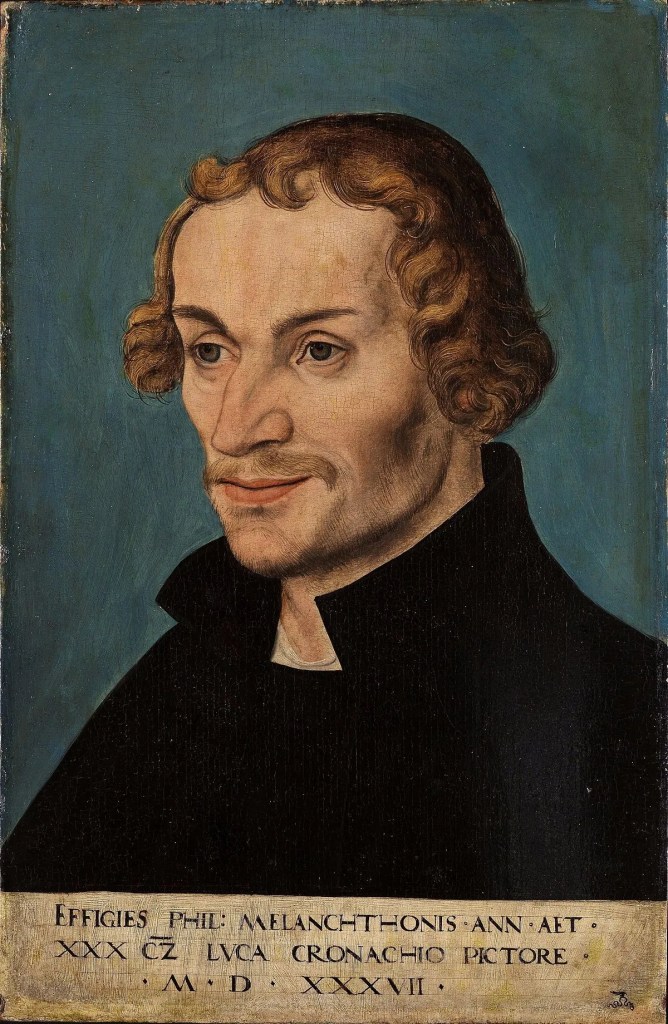
As mentioned above, this hymn was composed by Philipp Melanchthon in 1543. The original was not in German, however, but Latin. You can peruse the full Latin text of Dicimus grates tibi here, reproduced in the 1848 Evangelisch-Lutherisches Gesang-Buch, the hymnal of the Buffalo Synod. (Point of clarification: the Buffalo Synod, which no longer exists, has no connection to the centrist gatekeeper Lutherans on Twitter who use a unicode bison as their group-identifier; the “Buffalo” in reference is the city in western New York.) The original Latin of the stanza in question runs as follows, with a prose translation in parallel:
Hinc domos, urbes, tua templa,
gentes, et tuae legis monumenta tota,
et bonos mores abolere
tentat funditus omnes.
Hence homes, cities, your temples,
nations,— both whole memorials of your rule
and good customs to abolish,
—all from the foundation he [Satan] vexes
Needless to say, neither TLH nor LSB contain translations of Melanchthon’s original; rather, they both contain adaptations of a translation of a German paraphrase of the original Latin. This German paraphrase was done by the great hymnographer and churchman Paul Eber in 1554, appearing as #235 in the aforementioned Buffalo Synod hymnal under the title Herr Gott, Dich loben alle wir. Here is Eber’s paraphrase of the verse in question, with a prose translation in parallel:
Und wie er vor hat bracht in Noth
die Welt, führt er sie noch in Tod;
Kirch, Wort, Gesetz, all’ Ehrbarkeit
zu tilgen ist er stets bereit.
And as he [Satan] before brought the world into trouble,
he still leads it to death;
Church, word, law, all virtue
he is always ready to destroy.
The first known English translation of this hymn was done by American Lutheran pastor Emanuel Cronenwett and was first published in the 1880 Evangelical Lutheran Hymnal of the Ohio Synod. Cronenwett’s translation of the verse in question reads as follows on the left; TLH’s adaptation is in parallel on the right.
He blighted earth with lying breath
And holds his grip e’en now till death;
Chafes madly to annihilate
All virtue, honor, Church, and State.
As he of old deceived the world
And into sin and death was hurled,
So now he subtly lies in wait
To ruin school and Church and State.
Plenty could be said about the adaptation which appears in TLH. To be sure, there are reasons why one might prefer Cronenwett’s original (or perhaps something in between, such as #286 in the 1918 Evangelical Lutheran Hymn-Book of the Missouri Synod, the predecessor to TLH, which has all twelve verses of the German cento). All that aside, for now I will simply note that “school” is clearly used in TLH #254 as a term which summarizes “virtue and honor,” and that this makes a great deal of sense if one keeps in mind the Old Lutheran conception of a school. (More on this below.)
Second concession: In this particular instance as in many others, The Lutheran Hymnal is not the paragon of Lutheran hymnodic excellence. I want to make this very clear, lest I be misunderstood. Still, TLH looms ponderously large in post-war American Lutheran history. It saw almost universal usage among the Lutherans of the Old Synodical Conference for over forty years. It is part of the living memory of Lutherans today, and not merely as an artifact of nostalgia. CPH (Concordia Publishing House) still prints TLH (although it never seems to go on sale anymore). Many of us know it, see it at church, and use it at home, despite its significant displacement by LSB. I know of congregations which still use TLH, some partially, some exclusively. In fact I know of some which have switched back to TLH from LSB, employing the latter only as a hymn-supplement.
All of this is to say, while older English-language Lutheran hymnals (such as the 1918 ELHB mentioned above) are undeniably better than TLH, at least as far as their hymnody is concerned, as a matter of simple historical fact virtually none of the foregoing predicates applies to them. Few people, if any, remember seeing ELHB in the pews. There are still physical copies floating around out there (I myself have a very nice one), but most people who peruse its pages are looking at a PDF. No one is switching back to ELHB wholesale. CPH does not even offer it on a print-on-demand basis.
In fine, by the time the LSB was published in 2006, TLH had had sixty-five years of formative influence on the liturgical, devotional, and theological consciousness of American Lutherans in ways both good and bad— but, I would submit, mostly good.
And to return at long last to the particular case in reference: by the time LSB was published, American Lutherans had been confessing in song the dread truth that Satan “subtly lies in wait / To ruin school and Church and State” on Michaelmas for over half a century. Ignoring for the time being the insignificant impact of Lutheran Worship (1982), and assuming that no one in American Lutheran history has ever actually sung LW #189 for any reason other than to roast it, we can say that TLH #254 was the canonical version of Melanchthon’s Michaelmas hymn for over sixty years.
Then at some point in the 2004-2005 run-up to the publication of LSB in 2006, some (no doubt well-meaning) committeeman took a cursory glance at the sturdy Three Estates tripod of “school and Church and State,” didn’t fully recognize what he was looking at, and decided that the future faithful would be better served by an awkward pair of Two Kingdoms stilts: “Church and State.” And in whatever peer review that followed, no one pointed this out.
Whatever the reason for this omission may have been, its result is undeniable: a truncated confession. Mind you, this is not simply a matter of what is not confessed; it is a matter of what was once confessed but is no longer, at least not here.
And if I had a dollar for every time the Missouri Synod has carelessly gotten rid of some supposedly unimportant doctrinal detail in precisely this manner, just in my lifetime, I would have some folding money.
Sic transit gloria Missouri.
This post is not really about one line in a Lutheran Michaelmas hymn. It is about a sea-change that took place within Lutheranism and within American Christianity more generally in the latter half of the twentieth century and which has continued unabated into the first quarter of the twenty-first. In view of this sea-change, the edit in question is quite unremarkable, as are hundreds if not thousands of others.
Is the bowdlerization of Christian hymns a leading or lagging indicator of a Great Forgetting, a portent or a postscript? The answer is “both.” But that it is indeed the former— a leading indicator, a portent of imminent continued degeneration— is the far more underestimated truth. I hate to be the one to break it to you, and I hope that I am not, but the Missouri Synod, as an institution, is not done getting worse.
Politics may be downstream from culture in some sense, but culture is downstream from power, and power rightly understood is not merely a function of civil government. There is hard power, and there is soft power. Corporations exercise power. Industries exercise power. Publishing houses exercise power. The academy (to include universities and seminaries) exercises power. Church denominations and synods exercise power. How many boxes in the foregoing list are checked by a modern incorporated church-body? I can’t answer that question for all of them, but I can tell you that “LCMS, Inc.” checks them all.
Consider the application to the example raised above: if actors within the power centers of a church denomination (let’s use the best, most accurate term: elites) collectively decide— not so much through formal resolution as through emergent behavior— that the hymnal which most churches are going to end up using is simply not going to mention that the Old Evil Foe is constantly trying to ruin our schools (perhaps they also “decide” to omit language about resisting temptation, fighting against sin, enduring divine chastisement, etc.), then most people are just not going to sing about or contemplate that dread truth— or any of the others in the parenthetical list.
Another brick in the wall. And then another. Pretty soon you forget what’s on the other side of the wall. Later generations grow up with no knowledge of the other side, not so much skeptical as blissfully ignorant.
That’s how it works, isn’t it? At first the Great Forgetting produces known unknowns; its last, most bitter fruit, however, is the unknown unknown.
But the bliss doesn’t last, and neither does the ignorance. By way of example, many who are now entering adulthood— so-called Generation Z, the “zoomers”— know that they’ve been had, that they’ve been deprived of the articles of a rich Christian heritage (by people who say things like “adulting is hard”). They don’t want corporate-approved bowdlerizations of the great hymnals, prayerbooks, and catechisms of Christendom. They want the nutritious farm-to-table spiritual food that previous generations tossed out in favor of fruit snacks. Their growing realization of the fact of their casual disinheritance has fostered widespread indignation, distrust, sometimes outrage.
What exactly has been forgotten? What has been the main casualty in this Great Forgetting?
The answer, I would submit, is the Home.
If this seems less obvious, perhaps even dubious, hear me out.
Satan subtly lies in wait to ruin School and Church and State, and not just Church and State, because the School represents the Home. A school just is the extension of the natural parental prerogative. “For all authority flows and is propagated from the authority of parents,” Martin Luther writes in his Large Catechism. He continues:
For where a father is unable alone to educate his child, he employs a schoolmaster to instruct him; if he be too weak, he enlists the aid of his friends and neighbors; if he departs this life, he delegates and confers his authority and government upon others who are appointed for the purpose.
Thus a school just is a cooperative endeavor by parents, either directly or through their selected proxies, for the purpose of raising up their children in the fear and admonition of some lord, some master.
This is true of a public school. It is true of a private school. It is true of a parochial school. It is true of a home school. While some of these genera obscure or deny the essential nature of the School more than others— as do any number of particular specimens—, it is nonetheless a truth that cannot be effaced. Attempts to obscure it or deny it only draw attention to it. Once seen, it cannot be unseen. As surely as every soul that has ever lived was begotten by a father, every school rears a father’s child. And as surely as God is the Father, from whom all fatherhood receives its name, the Home is archetypal for both the Church and the State. That is why Satan attacks it most relentlessly.
Time was when Lutherans were apt to speak of the “Three Estates,” the three realms through which God governs creation and within which mankind lives and flourishes. These estates are the Home, the Church, and the State. The terms used vary. I’ve seen “Household” and “Family” as synonyms for “Home,” and I’ve seen “Society” and “Commonwealth” as synonyms for “State”— a term which admittedly is more equivocal than it needs to be, especially in America. Granting that it is possible to make nuanced distinctions among these alternative terms, the gist is the same: God instituted the Home, the Church, and the State. And he did so before the Fall into sin.
Adam the Man of Earth was the first father, the first bishop, and the first king. But this arch-Man wasn’t any of these things until God created Woman on the sixth day. When Eve was brought to Adam, the three estates came fully into being. Eve was Adam’s wife, and in a unique way she was also his child. Eve was the first to attend to Adam’s preaching of God’s Word. Eve was the first subject in Adam’s kingdom.
You get the point. To digress further would take us too far afield, at least for now.
Suffice it to say, this doctrine of the Three Estates seems to have fallen into disuse among Lutherans over the course of the last seventy-five years, gradually giving way to a theological paradigm known as “Two Kingdoms Theology” or just the “Two Kingdoms” for short. The problem is not that the doctrine of the Two Kingdoms is incorrect per se. It is a biblical doctrine. The problem is that the “Two Kingdoms” are “Heaven and Earth,” but most Lutherans seem to think that they are “Church and State.”
“Heaven and Earth” is a true dichotomy. It accounts for everything. We pray that God’s will would be done “on earth as it is in heaven.” We long to see the rift between heaven and earth fully and completely healed, to see the promised new heavens and new earth, fully in communion with each other. We have a foretaste of that glorious reality in the Lord’s Supper, but the fullness is not yet.
“Church and State,” on the other hand, is a false dichotomy. It does not account for everything. The debate about the question(s) of “separation of Church and State” is important, but many of the ostensible defenders of the Church and its prerogatives fail to recognize the real gravamen of the issue, which is that the Church and the State cannot properly relate to one another without the Home.
I wrote above that the Home is archetypal for both the Church and the State. That is true, but the whole truth is more profound. In a primordial sense, the Home— as an entity subsisting in and perpetuated from the conjugal union of man and wife— begets, births, and sustains both the Church and the State. This is an incontestable theological and biological reality. Where else are you going to get people? Test tubes?

My friends and I started The Boniface Group and its affiliate organizations, the St. Boniface Lutheran School of Western Idaho and the St. Sarah Cottage School, because we believe that the Christian School has been effectively lost among Lutherans. We believe that this loss signals an even deeper privation, namely the loss of an orthodox confession regarding the estate of the Home. We believe that contemporary conservative Lutheran attempts to restore the School are by and large doomed— either to failure or, far worse, worldly success (cf. James 4:4), because they are demonstrably not rooted in, and are in fact opposed to, the biblical doctrine of the Three Estates, and all that it entails.
So we are doing something else. And you are welcome to join us— in Idaho, or wherever you are. If you want to start a Christian school— a homeschool, a co-op, a traditional brick-and-mortar school, or some kind of hybrid— we are here to help. If you simply want to listen in on or participate in the conversation we’re having here, you’re welcome to do that, too.
Over the next several months, we’re going to be talking in greater detail about the topics alluded to in this post. Architectonics. Pedagogics. Catechesis. Hymnody. Curricula. Calendars. Schedules. Policies. The whole nine yards.
If you’re a Christian father and you’re in the vicinity of Caldwell and Emmett, Idaho— or if you’re bound to be, or if you might want to be— and what I have said thus far resonates with you, these conversations might hold special relevance for you. Our schools will open their doors in the summer of 2025. Ahead of that, our 2024-2025 Homeschool Trial is currently ongoing (see the links in the main menu of this site). Keep track of this site for updates. Subscribe to our podcast if you haven’t already. Get in touch with us via email if you have specific questions.
On earth we have no continuing city. This is most certainly true. But the Home is nonetheless instituted by God. And as surely as it is part of God’s very good original creation, it will be part of His new creation, the glorified new heavens and new earth. The Home is ours to maintain and to steward for the sake of God’s glory and the good of our children, until Our Lord comes again in glory, and then forever after.
Yes, “Satan subtly lies in wait / To ruin school and Church and State,” and we underestimate his wiles at our eternal peril. But that isn’t how that hymn ends. It would be a terrible last word, kind of like how singing just the first stanza of “A Mighty Fortress Is Our God” (an unintentionally hilarious Lutheran custom) leave things looking pretty bleak. No; we are not left without heavenly aid in our contentions:
But watchful is the angel band
That follows Christ on every hand
To guard His people where they go
And break the counsel of the Foe.
For this, now and in days to be,
Our praise shall rise, O Lord, to Thee,
Whom all the angel hosts adore
With grateful songs forevermore.
Amen. God grant it.
 The Boniface Group
One thought on “How It Started”